

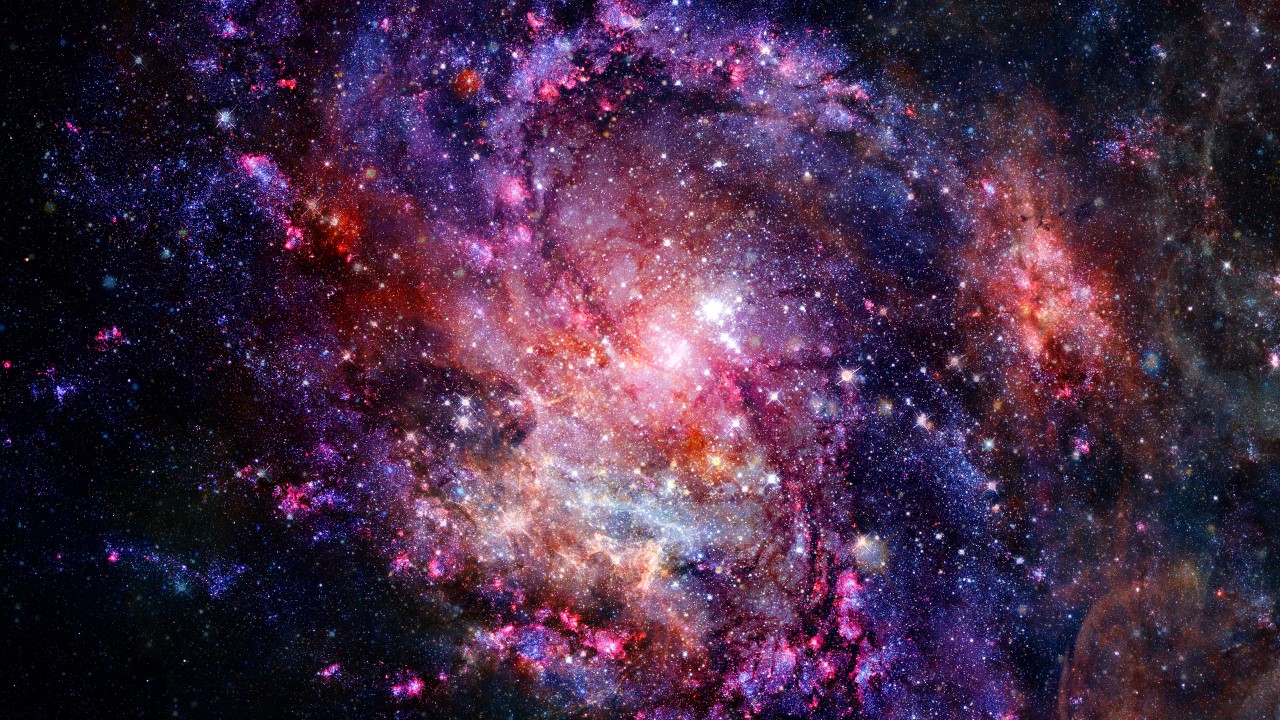
A spectacular image captured by the European Southern Observatory (ESO) with the 1.54 m Danish Telescope, located at the La Silla Observatory in Chile, reveals the chaotic beauty of the star-forming region NGC 6559. Located approximately 5,000 light-years from Earth, in the direction of the constellation Sagittarius, this nebula offers a crucial glimpse into the processes that give rise to new stars.
Despite being a relatively compact celestial object, just a few light years in diameter, NGC 6559 is a natural laboratory where gas and dust interact in a complex way. Unlike giants such as the famous Lagoon Nebula (M8), which extends for more than 100 light-years in cosmic proximity, this smaller region is an intense focus of star-forming activity, showing that the scale does not diminish the importance of celestial phenomena.
The Intricate Dance of Matter in Sagittarius’ Stellar Nursery
The formation of new stars is a fundamental process in the universe, and NGC 6559 vividly illustrates each step. It all starts inside vast molecular clouds, where the concentration of gas and dust reaches critical densities. In these specific areas, gravity itself begins to act, pulling the material towards the center and triggering a contraction process.
As more and more material accumulates and pressure increases, the cloud core becomes sufficiently hot and dense. At a tipping point, hydrogen nuclear fusion reactions are initiated, releasing an immense amount of energy. It is at this moment that a newborn star begins to emit its own light, marking the beginning of its long and luminous existence.
The cosmic chemistry behind reflection and emission nebulae
The vibrant colors that adorn NGC 6559 are the direct result of the complex interactions between the nebula’s material and the light from the young stars being born within it. Each tone tells a different story about the composition and energetic phenomena present there, making the region a true “cosmic tapestry”.
Detailed observation reveals different types of nebulae:
- HII regions (reddish):Also known as regions of ionized hydrogen, they are emission nebulae. The hydrogen present in them is ionized by the intense ultraviolet radiation emitted by massive and newly formed stars. When recombining, this hydrogen gas emits a characteristic red light, mainly in the Hα line.
- Reflection nebulae (bluish):These nebulae do not emit their own light, but reflect and scatter light from nearby stars. NGC 6559 contains dust particles rich in elements such as carbon, iron and silicon. Blue light, having shorter wavelengths, is dispersed more efficiently by these particles, which gives the entire area a bluish hue.
- Dark nebulae (black bands):Seen as silhouettes in the corners of the image, these are areas where cosmic dust is extremely dense. The concentration of material is such that the light from the stars and nebulae located behind is completely blocked, causing these regions to appear as dark voids in the sky.
The Fate of Stars: How Formation Regions Evolve Over Time
Star-forming regions, like NGC 6559, are dynamic, transitional environments. The massive stars that emerge from these cosmic nurseries exert a colossal influence on their surroundings. Their powerful stellar winds, added to the intense radiation they emit, act as erosive forces.
Over time, these winds and radiation sweep up and disperse the gas and dust that originally formed the nebula. This gradual “cleansing” process leads to the evolution of the region, which will eventually transform into an open star cluster. In these clusters, only the stars that were generated remain, now free of their native material. The intricate and multifaceted appearance of NGC 6559 is therefore a portrait of a fleeting moment in this cycle of continuous transformation of the cosmos.
A natural laboratory to unravel galactic evolution
Observing nebulae like NGC 6559 offers astronomers a unique opportunity to study in detail the mechanisms of star formation, which are universal in our galaxy and beyond. Understanding the interplay between gas, dust and the light from young stars in these cosmic “nurseries” is critical to deciphering the evolution of entire stellar systems and, by extension, the development of galaxies.
Studying NGC 6559 allows researchers to trace the life cycle of matter in the universe, from the coalescence of interstellar clouds to the shining of new stars and the subsequent scattering of remnant material. This data is essential for refining our models about how the Sun and our own planetary system may have formed billions of years ago, and how the future of the stellar universe may unfold. The complexity of this nebula, with its distinct zones of ionized gas, reflective dust, and dark silhouettes, serves as a living manual for contemporary astrophysics.