

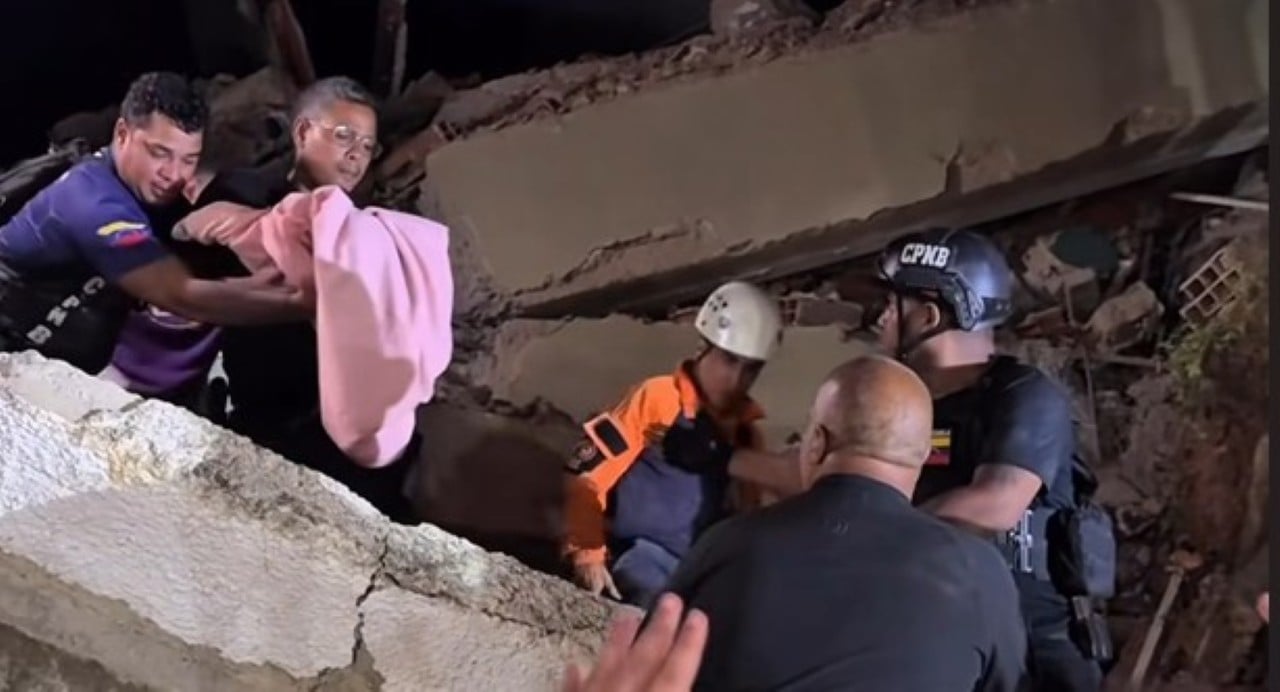
A newborn baby, just 18 days old, was safely pulled from the rubble of a collapsed building in La Guaira, Venezuela, after an impressive 32 hours trapped beneath the structure. The rescue of the baby and his mother, who was also found and rescued, brought a rare moment of joy amid the devastation caused by a series of earthquakes that hit the region.
The delicate rescue operation in the coastal city
The dramatic rescue took place on Friday night, in La Guaira, a coastal town located north of the capital Caracas, which was severely affected by the earthquakes. Search and rescue teams worked tirelessly among the wreckage, illuminated by spotlights, in a race against time. A video captured the emotion of the moment the little one was carefully passed from arm to arm.
The scene of the baby being delivered, protected by a blanket and later cleaned with wipes, moved those present. Applause broke out among rescuers and the population, celebrating the life that emerged from the chaos. The newborn’s mother was located and saved about an hour after the child, consolidating the teams’ victory.
The unique challenges of surviving a newborn under the wreckage
The survival of a baby so young, just 18 days old, for a period of 32 hours in such adverse conditions, is considered a rare and remarkable event. Newborns are extremely vulnerable, requiring constant care and a safe environment for development. Lack of access to food and hydration is a critical threat.
Rapid loss of body heat (hypothermia) is another very serious risk for newborns, whose thermoregulation systems are not yet fully developed. Additionally, inhaling dust and debris in the rubble can cause severe respiratory problems, while the fragility of their bones and organs makes them extremely susceptible to internal injuries and crushing. A baby’s ability to make itself noticed or signal its presence is also limited, which makes the work of rescue teams difficult. This specific case highlights the tenacity of life and the effectiveness of relief operations in extreme conditions.
The impact of earthquakes and the search for the missing in Venezuela
The tremors that shook Venezuela on Wednesday consisted of two successive earthquakes, with recorded magnitudes of 7.2 and 7.5. The resulting scenario is one of great devastation, with a growing number of victims. To date, the earthquakes have caused the deaths of at least 920 people.
Additionally, thousands of individuals were injured in several locations and a significant number are still missing, increasing the anguish of families and the urgency of the search for survivors under the rubble. The scale of the tragedy mobilizes national and international efforts to assist the affected regions.
Venezuelan resilience in the face of seismic activity
Venezuela is located in a region of considerable seismic activity, on the border between the Caribbean and South American tectonic plates. This geographic position makes it susceptible to earthquakes, which are recurring natural events in the country. Throughout its history, Venezuelan territory has faced several earthquakes, some with devastating impacts.
The constant threat of earthquakes requires the country to maintain safety protocols and rescue teams prepared to respond to emergencies. The quick and coordinated response after these recent earthquakes demonstrates the resilience of the communities and the dedication of the professionals involved, who work in highly complex and risky scenarios.
Key points about the tragedy and rescue
- Baby age:18 days of life.
- Time under rubble:32 hours.
- Rescue location:La Guaira, Venezuela.
- Earthquake magnitudes:7.2 and 7.5.
- Confirmed victims:At least 920 deaths.
- Additional impact:Thousands injured and missing.
- Rescued:The baby and his mother.
Search and rescue operations continue intensively in the affected areas, with the hope of finding more survivors. The story of La Guaira’s baby stands as a beacon of hope and resilience amid the pain and destruction that has ravaged the country.