The cost of fueling vehicles is expected to increase by up to 25% this year, compared to 2025, driving many drivers to look for alternatives to reduce expenses. Given this scenario, the temptation to adopt widely publicized fuel-saving “tricks” can be great. However, it is essential to discern which of these practices are effective and which represent a financial and safety risk for the driver.
Tire inflation: the dangers of incorrect or excessive pressure
Tires with inflation below the recommended level increase resistance when rolling, resulting in greater gasoline consumption. If just one tire has a pressure that is 8 psi below ideal, the cost at the station can increase by up to 4%. The popular belief that inflating tires above the indicated pressure optimizes efficiency is, in fact, a dangerous and baseless misconception.
According to tests by Popular Mechanics, over-inflating tires provides minimal fuel savings of less than 1%, even in the most favorable conditions. In addition to compromising driving comfort, overpressure can generate additional repair costs and the need for early tire replacement. Canada’s Ministry of Transport warns that “an over-inflated tire uses only the central part of the tread. The smaller contact area means less grip on the road, resulting in uncomfortable driving, handling problems (such as difficulty steering and braking) and increased wear on tires and suspension components.” Therefore, safety is compromised, with a greater risk of punctures at high speeds.
Maintaining tire pressure at ideal levels, as indicated on the driver’s door label, is the best measure to ensure safety and efficiency, avoiding unnecessary risks.
Adaptive Navigation: The Hidden Cost of Cruise Control
There is still no consensus on the benefits of adaptive cruise control (ACC) on fuel economy. A 2024 survey published in the journal Nature, with the title “Effect of adaptive cruise control on fuel consumption in real driving conditions”, points out that the use of ACC on highways can increase consumption by up to 0.14 liters per 100 km.
Study authors Ayman Moawad, Matthew Zebiak, Jihun Han, Dominik Karbowski, Yaozhong Zhang and Aymeric Rousseau explained that ACC systems control speed tightly without considering terrain or road conditions. Additionally, unlike human drivers who take advantage of inertia before braking, these systems do not seem to have the same braking efficiency, which may seem contradictory, since computers are expected to be better drivers.
The study highlighted that an ACC system that allowed speed variations of +/- 8 km/h, which resulted in a 3.5% improvement in efficiency for gasoline cars and 3.8% for electric vehicles. The reasons for this improvement include the reduced need for braking on descents, the reduction in downshifts on climbs and the reduction in power applied during the climb, as the speed could vary temporarily.
The researchers also note that as automated driving systems evolve from simple cruise control to Level 2/3 or higher autonomy, human occupants become more tolerant of changes in cruising speed made by the system without manual intervention.
The main conclusion is that, especially on uphill journeys, drivers who maintain constant acceleration, both on the rise and on the descent, end up saving fuel and reducing emissions. Thus, adaptive cruise control is practical, but for those looking to save money, the ideal is to drive more cautiously.

Air conditioning on the road: when the wind is open it can be worse
Turning on the vehicle’s air conditioning can increase fuel consumption by up to 20%. Deactivating it can save up to one liter of gasoline every 100 km, being even more significant on urban routes. Canada’s Ministry of Natural Resources estimates that these savings could reach $5,000 over a decade. Therefore, when traveling in urban areas, turning off the air conditioning, opening the windows and the sunroof allows natural ventilation, cooling the vehicle’s interior in a more economical way.
However, at highway speeds, opening the windows can create aerodynamic drag that harms fuel efficiency even more than using air conditioning. In these cases, activating the compressor is usually the best option. Vehicles with more square shapes, however, are an exception. The Oak Ridge National Laboratory in the United States revealed that for these models, keeping the windows open at high speeds can be more economical than using air conditioning, as aerodynamics are not as compromised.
In experiments carried out a decade ago, with vehicles with low aerodynamic efficiency, such as the Jeep Wrangler, Land Rover Defender or large pickup trucks, it was observed that air conditioning only became more advantageous at speeds above 130 km/h, well above legal traffic limits. Before reaching this “tipping point”, driving these rugged vehicles with the windows down and enjoying the fresh air is more fuel efficient than turning on the air conditioning.
Tips for efficient use of air conditioning
- Set the thermostat to a comfortable temperature, not excessively cold, as you would in your home.
- Check if the vehicle has an “eco” mode in the climate control system and use it to minimize the impact on consumption.
- Turn on the air conditioning intermittently, turning it off as soon as the desired temperature is reached.
- In cars without an automatic climate control system, activate the recirculation function to save energy by cooling the air already present in the vehicle, instead of capturing hotter outside air.
Safety and economy: the risks of going down hills in neutral
The idea of going down hills with your car in neutral to save gas is old and incorrect advice. Modern vehicles (and even those from the last two decades) are designed to cut off fuel supply when the driver decelerates with a gear in gear. This applies to both manual and automatic transmissions.
To confirm, check the onboard computer that displays instantaneous consumption: when you put the gearbox in neutral, you will notice a small waste of fuel, similar to what happens when the car is idling.
Additionally, highway safety experts strongly discourage driving in neutral for one critical reason. In an emergency situation, it may be impossible to re-engage the transmission quickly enough to avoid a collision, compromising control of the vehicle.
Empty tank: the dangers that go beyond dry breakdown
The Canadian Ministry of Natural Resources indicates that the fuel consumption of a medium-sized vehicle increases by approximately 1% for every 25 kilograms of additional weight. Considering that a liter of fuel weighs approximately 1 kg, a full tank adds around 60 kg to the total weight of the vehicle, which may lead some to think that driving with an almost empty tank is a good saving strategy.
However, the concern that this will stir up sediment at the bottom of the tank, driving it into the engine, is a myth. Sylvain Légaré, automotive research analyst at CAA-Quebec, explains that this idea, valid for older cars, does not apply to modern fuel tanks, made of composite plastics and equipped with efficient filters up to the injection system.
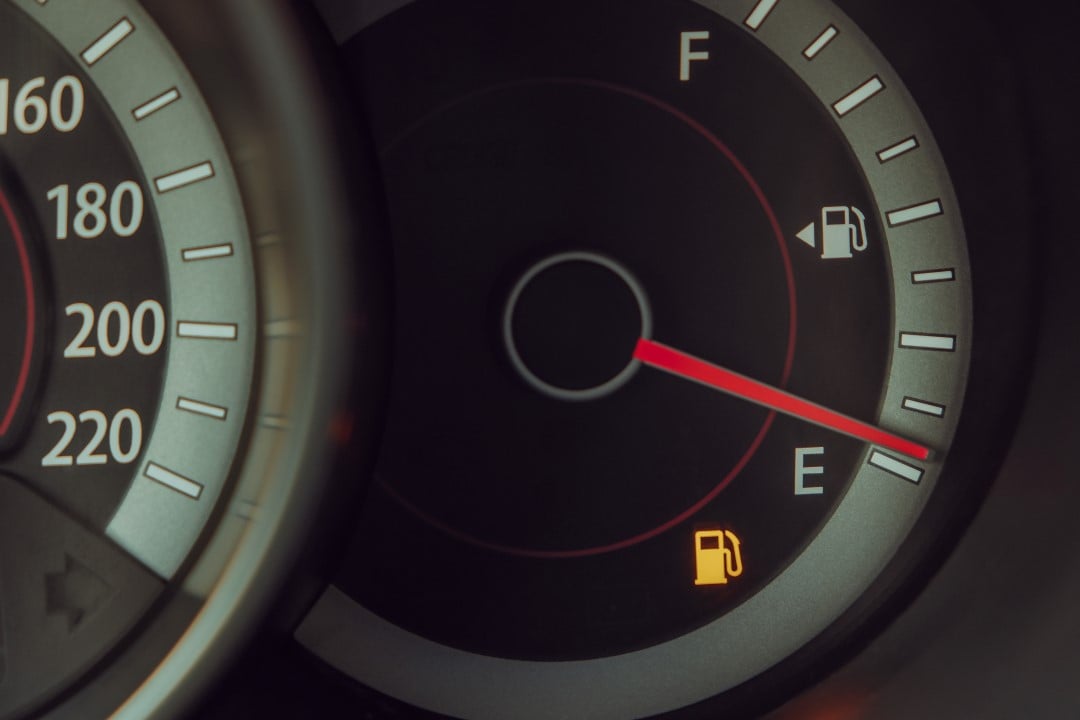
The central problem with running with a reserve tank is that the vehicle’s fuel pump is lubricated and cooled by gasoline. Letting the reserve light come on frequently can result in costly damage to the fuel pump. To maintain safety, it is advisable to keep at least a quarter of the tank full, and even more in winter to prevent condensation. In addition to the risk of collision and fines for avoidable breakdowns or reckless driving, which can arise if you cause a safety risk or block traffic, a lack of fuel on highways, such as those on the 400 series in Ontario, can lead to illegality when trying to walk to get fuel, requiring a tow truck that costs much more than filling the tank.
Effective strategies to reduce fuel consumption
There are many proven ways to save gas, such as driving at more moderate speeds, reducing overtaking and, if possible, opting for a smaller, more efficient vehicle. However, the most effective way to reduce consumption, in addition to considering an electric car, is to reduce time behind the wheel. Tools such as GPS, Google Maps and Waze offer several options for choosing shorter routes or avoiding traffic jams. In the long term, the safest way to get a lower fuel bill is to spend less time driving.