Webb Telescope discovers giant planet in famous star system
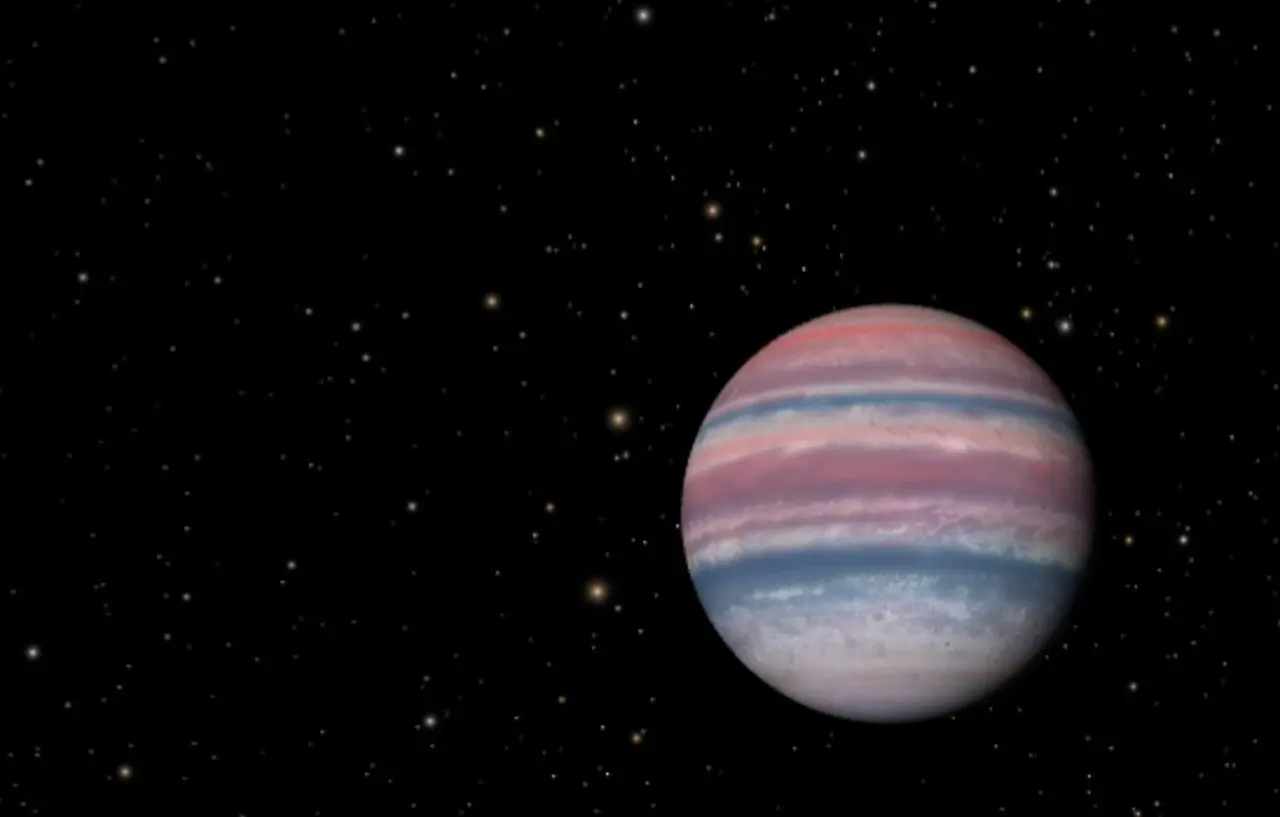
NASA announced the discovery of a previously hidden giant exoplanet in one of the most studied planetary systems in the Milky Way, thanks to the James Webb Space Telescope.
The relatively young and nearby Beta Pictoris star system was already recognized as home to two massive planets: Beta Pictoris b and Beta Pictoris c. Beta Pictoris b, in particular, was one of the first exoplanets to be directly imaged by astronomers. With the confirmation of Beta Pictoris d, the total number of known planets in the system rises to three, making Beta Pictoris only the second system to have at least three imaged planets.
Interestingly, astronomers did not detect Beta Pictoris d through traditional imaging as a bright point of light. Its identification occurred based on the unique chemical signature present in its atmosphere, an innovative technique that could revolutionize the search for exoplanets. This method, which allows you to find worlds amid cosmic dust and debris, promises to be crucial for discovering planets in environments where direct imaging is challenging, offering a valuable new tool for astronomy.
Aidan Gibbs, lead author of the new study published in Astrophysical Journal Letters and a postdoctoral researcher at the University of California, San Diego, commented on the importance of the discovery. He stated that “this discovery adds another piece to an already fascinating planetary system.” Gibbs went on to say that “Beta Pictoris has long served as a laboratory for understanding how planetary systems form and evolve, and now we have another planet helping us tell that story.”
How the young planetary system near Earth works
The Beta Pictoris system is located approximately 63 light-years from Earth and is estimated to be around 23 million years old. Its relative youth and proximity to our planet provide astronomers with a unique opportunity to observe the interaction of newly formed planets with the disk of dust and debris left over from the system’s creation.
Researchers’ estimates indicate that Beta Pictoris d is at least twice the mass of Jupiter. Even with this considerable proportion, it is the smallest among the three identified giant planets that orbit the star.
On the same topic: NASA’s Webb Telescope discovers new giant planet with innovative method
Computer modeling suggests that the planet orbits Beta Pictoris at a distance of approximately 30 astronomical units. This position places it in a region similar to Neptune’s orbit in our solar system. Among the three known planets in the system, Beta Pictoris d holds the widest orbit, although it remains within the inner boundary of the debris disk.
Unexpected discovery of a planet by chance
The research team did not have as its main objective the search for a new planet with Webb. Beta Pictoris d appeared unexpectedly while astronomers were investigating the atmosphere of Beta Pictoris b using the telescope’s NIRSpec (Near Infrared Spectrograph).
To do this, the scientists employed the NIRSpec Integral Field Unit, an instrument capable of recording both an image and a spectrum for each pixel. The spectrum, in turn, divides light into its constituent wavelengths, enabling astronomers to analyze the chemical composition and movement of distant objects.
Gibbs said: “We weren’t looking for a new planet. We were trying to understand one that we already knew existed. Then this telltale sign appeared in the data where we didn’t expect it.”
Instead of a smooth spectrum resulting from light reflected by dust, the researchers observed a distinct pattern of peaks and valleys. The signal included carbon monoxide absorption lines arranged in a sequence resembling a barcode, a feature expected in the atmospheres of giant planets.
Spectroscopy also allowed the team to measure the object’s radial velocity, which describes its movement toward or away from the observer. The object’s speed, location, and alignment with the debris disk matched exactly what scientists predict for a planet orbiting Beta Pictoris.
These measurements were crucial in ruling out other hypotheses, such as the presence of a distant background star or a brown dwarf, whose atmosphere could also contain carbon monoxide.
Chemical evidence confirms existence of a hidden world
“There was an unexpected bright light source in the Integral Field Unit image, but we have learned not to trust bright patches in images,” said Jean-Baptiste Ruffio, a research scientist at the University of California, San Diego, and principal investigator of the early Webb observations that led to the discovery. He added that “they could be instrumental artifacts or other structures in the debris disk. By obtaining a spectrum at the same time as the image, we were able to quickly confirm our suspicions.”
See Also

IBM and OpenAI combine expertise to advance secure AI in large company operations

Kioxia and Sandisk Power AI with New High-Performance 9th Gen QLC 3D Flash Memory

Hackers claim attack and Uber Freight investigates data breach
More on this story: Discovery of possible Jupiter-sized exomoon challenges satellite formation theories
Astronomers later performed additional observations with Webb’s Mid-Infrared Instrument (MIRI) through a Director’s Discretionary Time request. These observations detected water vapor and methane, providing further evidence that the object was a planet and revealing additional details about its atmosphere.
This method gave researchers a significant advantage compared to traditional imaging techniques. From the first observation, they were able to not only determine that the object was a planet, but also begin investigation of its atmospheric chemistry and physical properties.
Ruffio said, “A spectrum contains an incredible amount of information. You don’t just learn that something is a planet; you immediately begin to learn about its temperature, chemistry and motion.”
An independent imaging investigation also reinforced the finding. This work was led by Ben Sutlieff, from the University of Edinburgh, and Markus Bonse, from the European Southern Observatory. Using data from the European Southern Observatory’s Very Large Telescope and Webb’s NIRCam (Near Infrared Camera), the researchers autonomously confirmed the existence of Beta Pictoris d.
How to find a planet in the cosmic fog
Beta Pictoris d managed to remain undetected for years as it was immersed in one of the most luminous debris disks ever observed by astronomers.
The dust present in the disk scatters the light from the central star, generating an effect similar to that of a dense fog. This excessive brightness makes it difficult for conventional imaging methods to distinguish a planet from nearby dust structures and other light sources.
Webb’s spectroscopic method allowed researchers to overcome much of this visual confusion. Rather than relying solely on the planet’s visible brightness, scientists have isolated narrow molecular signals that are distinctive of a planetary atmosphere.
The presence of Beta Pictoris d may also help astronomers understand the unusual appearance of the system’s debris disk. The disk has a clearly defined internal boundary, in addition to several other structures that, until then, were difficult to explain.
Previously, astronomers suggested that an undiscovered planet, similar to Beta Pictoris d, could be shaping the disk and generating some of these features. Their discovery now offers researchers a plausible explanation for the disc’s peculiar architecture.
Learn more: NASA reveals pioneering robotic strategy to care for habitable exoplanet observatory
New method for discovering exoplanets shows promise
This discovery goes beyond adding another world to the Beta Pictoris system. It demonstrates an effective new strategy for detecting exoplanets in complex, dust-filled environments.
Beta Pictoris d is the first directly observed planet whose main discovery was made through moderate-resolution spectroscopy. The result indicates that astronomers can locate worlds by identifying the molecular “fingerprints” of their atmospheres, rather than relying exclusively on traditional coronagraphic imaging.
This ability could prove particularly valuable when planets are camouflaged by luminous debris disks or other structures that make them difficult to differentiate in ordinary telescopic images.
The researchers plan to continue analyzing Webb’s observations to improve their estimates of Beta Pictoris d’s temperature, atmospheric composition, and orbit. These studies could offer an even deeper look at one of the best-known planetary systems outside our own.
Webb Telescope’s Magnified View of Distant Worlds
The James Webb Space Telescope has established itself as the world’s premier space science observatory. Webb is currently unraveling mysteries in our solar system, investigating distant worlds around other stars, and exploring the enigmatic structures and origins of our universe, as well as our place in it. This project is an international program led by NASA, in collaboration with its partners, ESA (European Space Agency) and CSA (Canadian Space Agency).