Wirth’s Law suggests that the rate at which software slows down exceeds the rate at which hardware accelerates. This idea may explain why today’s games, which visually don’t differ much from those of a decade ago, require considerably more resources to run with adequate fluidity and performance.
This reality is clearly manifested in the most recent Steam Hardware Survey, carried out in July 2026. For the first time in the platform’s history, 8-core processors surpassed the popularity of 6-core models, and GPUs equipped with 16 GB of VRAM established themselves as the most common configuration among users.
Data from July 2026 reveals that GPUs with 16GB of VRAM are now used by 25.9% of all Steam players. This percentage exceeds, albeit by a small margin, 8 GB video cards, which registered an adoption rate of 25.32%.
Compared to June 2026, 16GB GPUs had a 24.50% share, showing an increase of 1.4 percentage points in just one month. In the same period, 8 GB GPUs registered a drop of 0.32 points, marking an important transition in the market.
July 2026 was the first month in which 8 GB of VRAM was no longer considered fully sufficient for gaming on the platform, thus ending a long debate about ideal graphics memory. It is important to note that these numbers encompass all Steam installations, including Windows, Linux and Mac systems.
The decline of 6-core processors
The transition from 6-core chips has not been an immediate concern for many users, as they still provide adequate performance for most games. Not long ago, Intel used to release quad-core processors (4 cores) with little change year after year, until renewed competition from AMD drove the industry’s evolution.
Even today, 4-core processors maintain a 13.12% market share. However, the latest Steam statistics indicate a change is underway: 27.84% of users use 8-core processors, surpassing the 27.52% who have 6-core models.
This is a notable change, with 8-core chips gaining 0.32% in popularity in one month, representing the largest growth among all configurations. In contrast, 6-core chips lost 0.12% in their adoption rate in the same period.
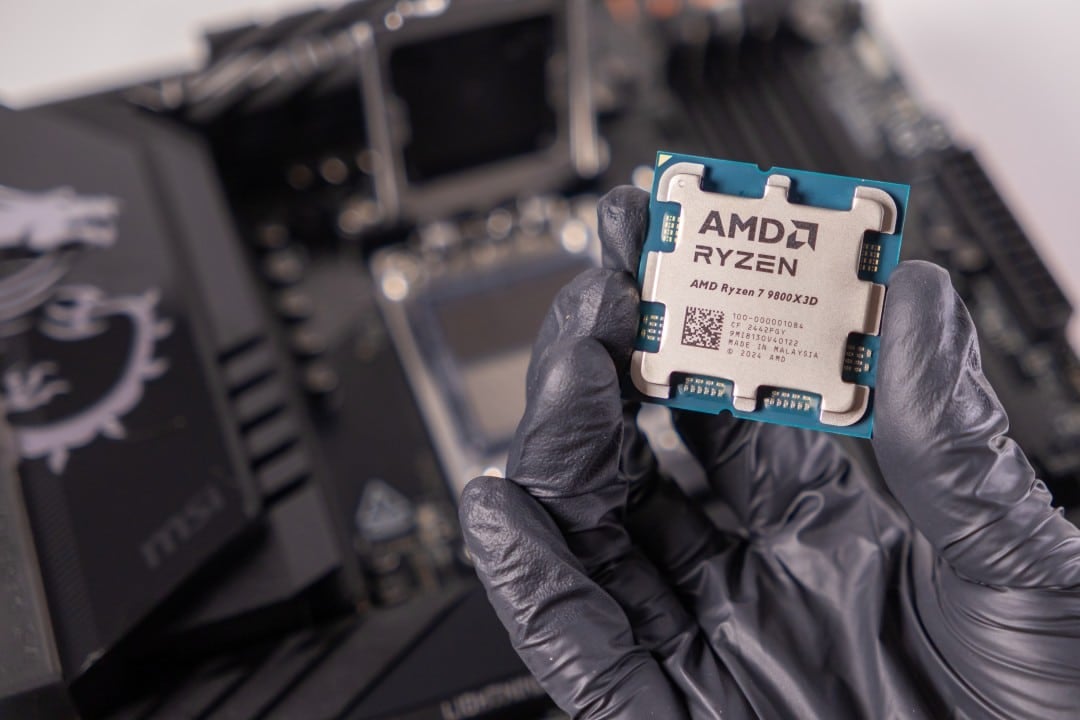
The wide acceptance of AMD’s X3D chips in the gaming segment has contributed to this trend, as models like the 5800X3D, 7800X3D and the latest 9800X3D are all equipped with 8 cores and 16 threads.
Furthermore, Intel’s hybrid architecture implies that few of its mid- or high-performance processors have exactly 8 cores. Although many include 8 performance cores, or P-cores, the overall structure differs.
Consolidation of new configurations
The obsolescence of 6-core processors and GPUs with 8 GB of VRAM did not occur abruptly. This process of decline has been gradual and visible since the previous year, when the presence of these components began to decline in the market.
Several global sales surveys consistently demonstrate consumer preference for 16GB versions of GPUs, even when 8GB models are available. The reduced amount of memory is simply not enough to run the latest titles, especially those that use technologies like ray tracing.
Historically, there is a saying in the technology world: “What Andy gives, Bill takes away.” It refers to the way Microsoft (Bill Gates) software used to eat up the hardware advancements provided by Intel (Andy Grove) in the 1990s, neutralizing the performance gains.
This idea remains relevant today, especially when combined with May’s Law. This law describes how an abundance of silicon can lead developers into complacency, resulting in code that is less optimized than it could be.
The situation takes on an ironic tone amid the current shortage of components, where rising memory and storage prices directly affect the same developers who, theoretically, would benefit from May’s Law.
It is essential to remember that the Steam Hardware Survey, although not completely representative of the global market, acts as an excellent barometer of prevailing trends. The data indicates that the NVIDIA RTX 3060 remains the most sought-after graphics card of the current generation, while the RTX 5070 records a rapid rise in the rankings.
In this scenario, manufacturers AMD and Intel appear on the list in a more discreet way, with their products being cited as honorable mentions, highlighting NVIDIA’s predominance in certain categories of gaming hardware.