There is a principle in computing known as Wirth’s Law, which points out how programs tend to become heavier at a faster rate than computer parts evolve. This concept helps to understand why recent releases require extremely powerful machines to deliver stable frame rates, even delivering graphics that are often reminiscent of titles released ten years ago.
The practical reflection of this growing demand was evident in the most recent Steam equipment report, released in July 2026. For the first time since the creation of the virtual store, eight-core processing units surpassed six-core versions in public preference, while graphics cards with 16 GB of video memory took the lead on users’ computers.
Statistics for July 2026 show that graphics accelerators equipped with 16 GB of VRAM are present on the machines of 25.9% of the platform’s customer base. This index managed to surpass, albeit by a narrow difference, the 8 GB components, which stood at a share of 25.32% of the total number of computers analyzed.
When the current picture is compared with the numbers from June 2026, 16 GB cards had only 24.50% presence, which represents a significant jump of 1.4 percentage points in the thirty-day interval. During this same time window, options limited to 8 GB suffered a decline of 0.32 points, showing a clear migration of consumers to more robust hardware.
The month of July 2026 will be marked as the moment when the 8 GB VRAM capacity lost its status as the ideal configuration to run the main titles on the market, putting an end to old discussions about the limit necessary for a good experience. The official document counts all machines connected to Valve’s service, including Windows operating systems, Linux distributions and Mac devices.
Reasons that led to the abandonment of six-core CPUs
The change to six-core chips did not happen out of desperation for players, as these parts are still able to deliver an acceptable level of fluidity in various interactive applications. In the recent past, Intel dominated the sector by delivering four-core components with timid updates each generation, a panorama that only changed when AMD returned to compete aggressively and forced the industry to increase the core count.
To this day, old quad-core processors endure bravely in a considerable portion of the computers evaluated in the research. However, updated Steam data confirms a significant turnaround at the top of the table, drawing the following market split:
- Eight-core CPUs: took the lead with 27.84% share, registering the biggest increase of the month with 0.32% growth.
- Six-core CPUs: fell to second place with 27.52%, experiencing a 0.12% drop in the installed base.
- Quad-core CPUs: maintain a 13.12% share of active machines on the gaming platform.
This movement in the ranking draws attention to the rapid pace at which consumers are updating their machines. The rapid migration to more robust systems shows that the community realized the need to abandon old architectures to avoid performance bottlenecks in future releases.
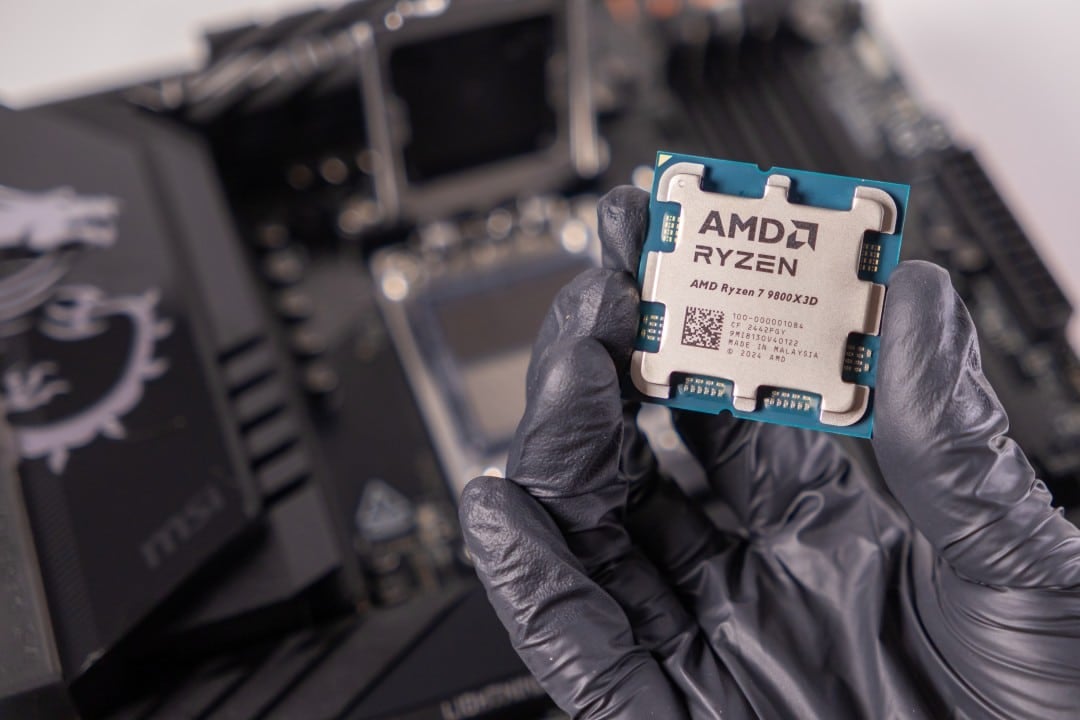
The resounding success of the X3D line manufactured by AMD explains a large part of this change in consumer behavior focused on digital entertainment. Products highly praised by technical critics, such as the 5800X3D, 7800X3D and the recently launched 9800X3D, share exactly the same base structure of eight physical cores and sixteen processing lines.
On Intel’s side, the adoption of a hybrid architecture means that its products aimed at gamers rarely have an exact count of eight total cores. Although the brand’s heaviest lines feature eight cores focused on maximum performance, known as P-cores, the final addition of efficiency cores completely changes the structural reading of the component.
Impact of lack of optimization on consumers’ pockets
The aging of the simplest CPUs and video cards with 8 GB of VRAM did not happen overnight, but rather as a predictable movement. This loss of relevance in statistics has been evident since last year, when the presence of these more modest hardware began to gradually shrink in monthly reports.
Reports from retailers around the world confirm that buyers are prioritizing the 16GB editions when purchasing a new GPU, ignoring the 8GB variants whenever possible. The lack of video memory makes it impossible to run recent works, mainly because the ports of games coming from the PlayStation 5 and Xbox Series X use unified memory, which overloads computers when processing heavy textures and advanced lighting effects via ray tracing.
There is a classic maxim in the halls of Silicon Valley that says: “What Andy delivers, Bill consumes.” The phrase makes a direct allusion to the dynamics of the 1990s, where operating systems created by Bill Gates’ Microsoft quickly swallowed up all the extra processing power that Andy Grove’s Intel was able to put on the market, nullifying the feeling of speed.
This historical concept remains perfectly applicable to the modern panorama, gaining even more strength when analyzed from the perspective of May’s Law. This theory argues that the ease of finding spare computing power makes development studios lazy, resulting in the delivery of heavy software without due technical polish.
The current context takes on an ironic tone when we observe the semiconductor supply crisis, which makes memory modules and storage disks absurdly expensive. This increase in production costs hits game creators hard, who, in theory, should take advantage of the abundance of resources predicted by May’s Law.
It is necessary to point out that Valve’s database does not reflect all the computers on the planet, but it works as the most accurate indicator of the direction of the entertainment industry. The numbers detail that the NVIDIA RTX 3060 continues to be the most popular graphics piece of the moment, while the newly arrived RTX 5070 is already climbing the rankings at an impressive speed.
Within this market picture, the giants AMD and Intel occupy secondary positions in the visual acceleration charts, appearing only as occasional mentions in the document. This reinforces NVIDIA’s absolute monopoly when it comes to providing the graphics hardware preferred by those who consume electronic games on their computers.