
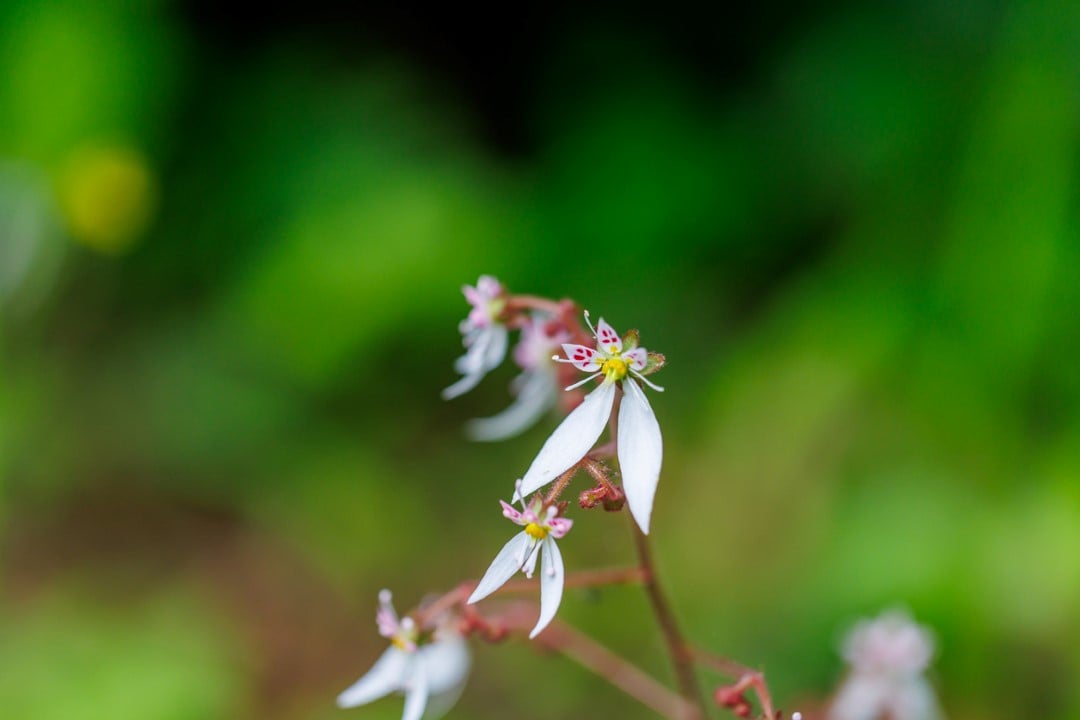
More than 150 years after British naturalist Charles Darwin raised the hypothesis, scientists confirmed that some species of the genus *Saxifraga* are in fact carnivorous. The doubt arose due to sticky “hairs” found on plants such as *Saxifraga rotundifolia* and *S. dark*.
In 1875, Darwin suggested that these hairy structures, known as glandular trichomes, secreted a sticky substance, similar to those seen in known carnivorous plants. However, to classify a plant as carnivorous, it is necessary to prove that it attracts, captures and digests insects, something that the methods of the time could not clearly confirm.
To test Darwin’s assumption, researchers focused on *Saxifraga candelabrum*, a flowering mountain plant that grows at high altitudes in the southern Qinghai-Tibet Plateau and Hengduan Mountains in China’s Yunnan and Sichuan provinces. The study was published on August 4, 2026, in the journal *Nature Communications*.
Chemical analyzes revealed that *S. candelabrum* attracts small mosquitoes with inviting odors and digests them using an enzyme called phosphatase. The isotope labeling technique confirmed the transfer of nitrogen-15 from captured insects to plants, demonstrating a complete process of nutrient capture and assimilation.
Then, genetic analysis established the connection of *S. candelabrum* with other sticky carnivorous plants, identifying common genes linked to prey attraction, digestion and nutrient absorption. Expanding the research to other types of traps, scientists found dozens of genes in different groups of plants associated with the digestion of insect remains. Professor Hang Sun, director of the Kunming Institute of Botany at the Chinese Academy of Sciences in Beijing and senior author of the study, said this data could help identify other plants with previously unrecognized carnivorous habits.
More on this story: Distance from the mainland protects plants on remote islands against pests and diseases, study finds
Sun reported in an email that “some plant species previously thought to have only sticky glandular hairs or to accidentally catch insects may actually possess as yet undiscovered digestive and nutrient absorption capabilities.” He added that “carnivorism is probably much more widespread among angiosperm flowering plants than previously believed, and new lineages of carnivorous plants may be discovered in the future.”
There are at least 350,000 species of flowering plants, and more than 750 of them are recognized as carnivorous. Botanist Susan Myers, director of horticulture and conservation at the Pittsburgh Botanic Garden, explained that different forms of carnivory have evolved independently in 14 plant families, in a phenomenon known as convergent evolution. She highlighted that this research offers important data about this fascinating lifestyle, although she did not directly participate in the study.
Myers described the study design as “brilliant”, including identifying the necessary morphology, digestive enzymes and, most importantly, tracking the labeled nitrogen. “What Darwin deduced by observation and inference, these researchers confirmed with modern technology,” she said in an email.

How plants attract and digest their prey
Study co-author Douglas Soltis, a professor at the Florida Museum of Natural History and the biology department at the University of Florida, has dedicated more than forty years to researching the Saxifragaceae family. He said, via email, that he was always curious if some of these plants could be carnivorous.
Full coverage: Latest News (EN)
Soltis explained that “many members of the family to which *Saxifraga* belongs have sticky glandular hairs, and insects are often seen trapped in them.” However, merely capturing insects does not mean that the plant is digesting them, as these hairs can also serve as a defense against herbivores.
The research began in a similar way to Darwin’s, with the observation of trapped plants and insects, both in their natural environment and in controlled conditions. Most of the mature plants analyzed captured dozens of insects, with up to 70 mosquitoes clinging to their sticky branches. Scientists discovered that the scent of the flowers, composed of substances already known to attract insects, was the main lure for prey. Larger flies, which acted as pollinators, were not captured, indicating that only less effective pollinators fell into the trap.
Insects are rich in nitrogen and, in several species of carnivorous plants, evolution is driven by the need to survive in soils naturally poor in nitrate, according to Soltis.
“These plants carry out photosynthesis and produce their own food, but they need nitrates,” he explained. “When the soil is deficient in nitrates, this is one of the adaptations that emerge.” This strategy is particularly useful for *S. candelabrum*, which lives at altitudes between 2,500 and 3,300 meters above sea level, in rocky, dry soils with few nutrients.
Learn more: Scientists point to octopuses as humanity’s successors in command of intelligent life on Earth
The alpine habitat of this plant represents a novelty for carnivorous species, said Soltis, who stated that most of them are found in swampy soils, such as pitcher plants and dionaeas. An advantage of this remote, high-altitude environment is that *S. candelabrum* is not threatened by climate change or human activity, according to Sun.
Sun said that “*Saxifraga candelabrum* is thriving in its current environmental conditions and is not a threatened species considering its population size and distribution area.”
New discoveries and Darwin’s legacy
The finding of carnivorism in *Saxifraga* is not Darwin’s first prediction to be confirmed. In 1862, after observing the orchid *Angraecum sesquipedale*, from Madagascar, with a 30-centimeter tube of nectar, he theorized that it could only be pollinated by an “enormous moth with a wonderfully long proboscis”, even though he had never seen such an insect. His intuition was validated in 1903 with the discovery of the moth *Xanthopan morganii praedicta*, from Madagascar, with a 30-centimeter tongue (the insect was reclassified in 2021 as *Xanthopan praedicta*).
Sun said that by picking up where Darwin left off, the new findings highlight that scientific research “is an ongoing journey that spans different eras.” He added that this allows us to “truly appreciate the unbroken academic heritage of fundamental research in the field of plant evolution, passed down from generation to generation.”
The identification of *S. candelabrum* as a carnivore also serves to remind us that plants are full of surprises and that there is still much to be discovered about them, Myers noted.