

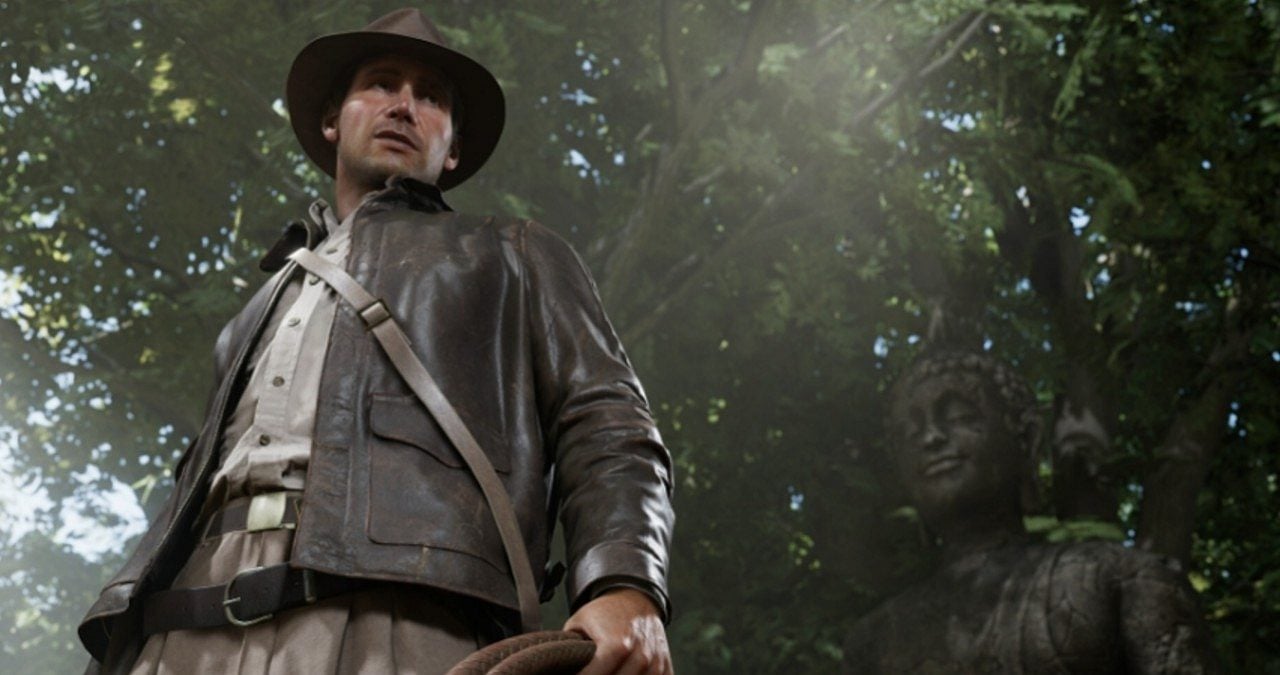
Recent technical scrutiny conducted by the Digital Foundry team has confirmed that the version of Indiana Jones and the Great Circle destined for the Nintendo Switch 2 presents a surprising level of quality. MachineGames engineers achieved a remarkable feat by preserving cutting-edge graphics technologies, including realistic light simulation and real-time mirroring, providing unprecedented visual richness for the portable console market.
In order to sustain such aesthetic fidelity, the adventure’s refresh rate was set at 30 frames per second, moving away from the 60 fps performance common in the most robust desktop devices. This design decision required aggressive optimization in audio compression, three-dimensional surfaces and save files, in addition to specific adjustments in central processing created specifically for the hardware recently launched by the Japanese giant.
Cutting-edge lighting technologies kept in the portable device
Throughout the development of this adaptation, the technical team refused to eliminate visual tools that are usually discarded in systems with less firepower. The work preserves the contact shading and reflections calculated on the screen itself, crucial elements for giving depth to the maps. The global lighting system via ray tracing was also successfully implemented, ensuring that the tombs and forests visited by the protagonist display the immersive atmosphere idealized by the art directors.
More on this story: Better than PS4: Devil May Cry 5 achieves superior performance on Nintendo Switch 2, according to experts
A clever tactic applied in the code was the use of variable rate shading, a technique that reduces the resolution of peripheral parts of the image to save machine resources in a way that is almost imperceptible to the player’s eyes. Due to these programming maneuvers, the mobile device’s light management can directly rival the visual delivery of the Xbox Series S, achieving results even superior to Microsoft’s video game in certain areas of the map.
The impact of Nvidia’s upscaling on the game’s final resolution
Image sharpness varies dynamically as the action unfolds. When docked in the dock for use on television, the title transitions between 540p and 1080p, driven by DLSS. The adoption of this artificial intelligence tool from Nvidia marks a historic revolution for the Mario maker, which for years depended on outdated hardware such as the Tegra X1 chip, now allowing gaming in the palm of your hand to oscillate between 360p and 720p with visual clarity that perfectly masks the low native pixel count.
In a direct comparison with the entry-level platform in the Xbox family, the hybrid console surprises by offering a higher average resolution throughout most of the campaign. However, the Japanese machine presents a greater level of aliasing in the contours of characters and objects. The quality of the projected shadows also suffers a noticeable drop, a defect that becomes more annoying when used outside the base, making it difficult to navigate in low-light corridors.
The level of geometric detail in the scenarios underwent a mandatory simplification when compared to releases for computers and desktop consoles. The engine responsible for rendering the surrounding world acts more aggressively, resulting in the sudden appearance of foliage and structures as the player progresses. When the screen is disconnected from the TV, this economy of polygons becomes even more prominent, conveying the feeling that the locations are slightly uninhabited.
Frame rate fluctuations during clashes and animations
Stress tests demonstrated that the target of 30 frames per second presents instabilities at critical moments. The animations that tell the narrative suffer from frequent bumps in fluidity. The real challenge for the hardware, however, arises in clashes against multiple simultaneous enemies, such as the fights that take place around the Vatican, where the overload of actions drops performance to the 20 frame range.
Learn more: Nintendo Switch 2 finds unusual performance gain with GameChat in Capcom games
Such performance issues occur due to the exhaustion of processing capacity, which needs to deal with the autonomous behavior of the villains and the generation of heavy visuals at the same time. The development team chose to tolerate these occasional drops in situations of absolute chaos, prioritizing maintaining a visually stunning and relatively seamless experience for the overwhelming majority of the journey.
Deep code optimizations to overcome memory limitations
Software engineers have gone beyond a simple texture downgrade, devising unique tools to harness every drop of power in the new system. The instructions sent to the processor were completely restructured to perfectly match the video game’s architecture, demonstrating the producer’s commitment to providing a highly refined version adapted to the reality of Nintendo’s platform.
In order to fit a production of gigantic proportions into the restricted space of the cartridge and internal memory, three data reduction strategies were applied:
- The visual coverings of the environments were compressed without sacrificing the artistic style, matching the standard quality seen on the Xbox Series S.
- The characters’ voices and action noises received special acoustic treatment, reducing the weight of the audio files without compromising the clarity of listening.
- The progress recording mechanism has been completely redesigned to consume a minimum fraction of storage and speed up transitions between maps.
The care applied to reducing textures means that the aesthetic presentation on the hybrid device is almost indistinguishable from that delivered by Microsoft’s entry-level console, as long as the latter is operating without graphical improvement packages. This approach raises the quality of the port to an outstanding level, reconciling a clean image with the urgency of saving precious gigabytes on the system.
Preservation of the original artistic vision on new hardware
The technological pillars of the graphics engine remain active throughout the game, ensuring that the backbone of the campaign does not undergo changes in relation to cutting-edge computers. The success in supporting ray tracing-based lighting shows that developers chose to adapt their tools to the device’s physical barriers, rejecting the easy way out of just deleting modern features from the programming.
On the same topic: Nintendo Switch 2 surpasses PlayStation 5 with four exclusive technological features on the market
This working philosophy ensures that the visual design imagined by the creators is delivered authentically to fans, regardless of reductions in pixel count. The practical result is an extremely competent platform transition, serving as definitive proof that the newcomer video game has the strength to execute big-budget titles with enormous competence.
The journey starring the iconic tomb explorer is now available for purchase by Nintendo Switch 2 owners globally. For enthusiasts looking to understand every detail about frame fluctuation and image reconstruction, the detailed dossier prepared by Digital Foundry remains accessible on its official channels.