

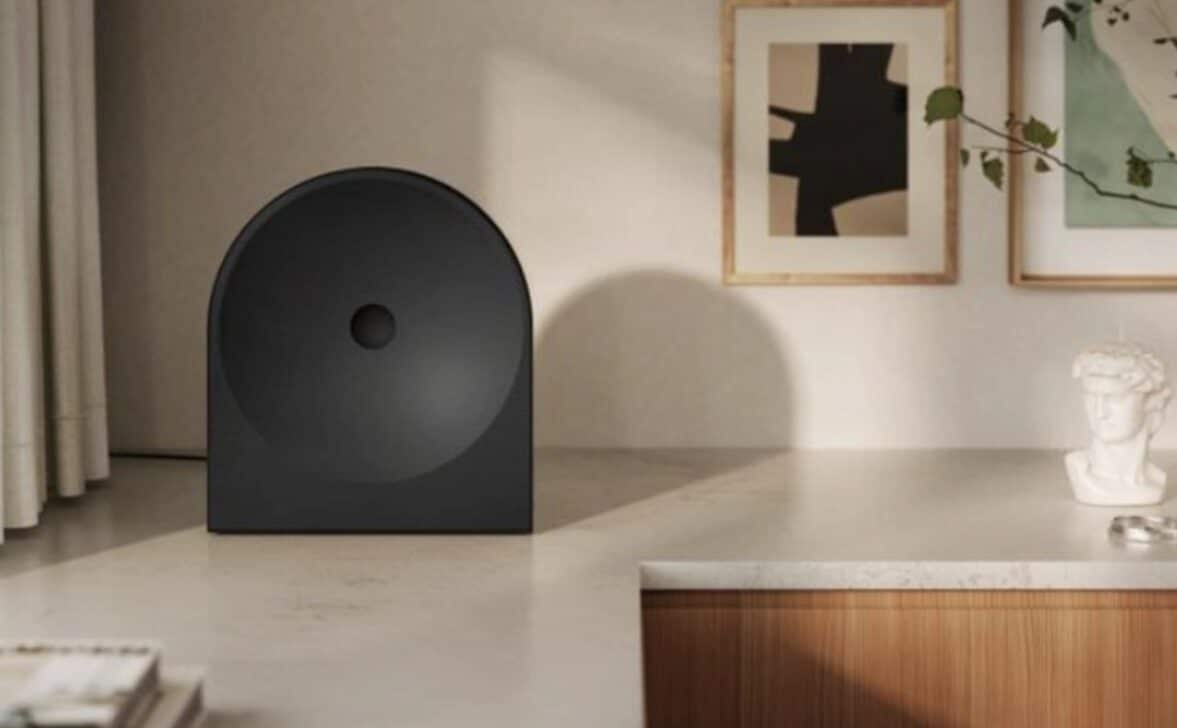
The South Korean giant Samsung has just revealed its latest bet for the residential sound market, called the Music Studio series. Developed in partnership with renowned industrial designer Erwan Bouroullec, the new family of speakers seeks to combine a minimalist aesthetic with cutting-edge features. The manufacturer’s main focus is to deliver tabletop devices that integrate perfectly into the decor of modern environments, without sacrificing sound power.
Unlike traditional Bluetooth devices, the new equipment uses Wi-Fi networks to transmit data, which guarantees much greater bandwidth and avoids losses in reproduction quality. This technical choice allows users to organize their spaces with complete freedom, eliminating the tangle of visible cables. The strategy highlights the brand’s effort to win over consumers who demand both high acoustic fidelity and a refined look in their homes.

Main specifications and differences of premium table models
The highlight of this generation is the Music Studio 7, which takes on the role of top-of-the-line model with a robust 3.1.1 channel system. Product engineering distributes sound emitters across the front, top and sides of the chassis. According to the company, this geometric arrangement was calculated to generate an authentic three-dimensional immersion, filling any room with impressive clarity.
To reach very high frequencies, the main device has a super tweeter designed to reach up to 35kHz, revealing subtle nuances in high ranges that usually go unnoticed. The hardware works together with Audio Lab Pattern Control, a software that reduces interference between signals, and AI Dynamic Bass Control. The latter uses artificial intelligence to monitor bass in real time, avoiding unwanted distortions even when the volume is at maximum.
More on this story: Samsung’s new Music Studio 5 and 7 arrive with spatial sound and promise full integration before CES
Aimed at those with less space available, Music Studio 5 delivers a considerably leaner format, operating in a 2.1 channel format. Its internal structure houses a four-inch woofer accompanied by two high-precision tweeters. Despite its reduced dimensions, the entry-level version also inherits the artificial intelligence bass control system, ensuring deep and clean beats, which puts it at an advantage over direct competitors in its category.
Complete soundbar family refresh for next year
In parallel to the table speakers, the Asian corporation confirmed the update of its acclaimed line of Q Series soundbars, with launches scheduled for the year 2026. The expansion of the catalog reinforces the company’s intention to dominate the home entertainment sector. The news promises to transform the way the public consumes films, series and music in the comfort of their own home.
The most advanced model in this segment will be the HW-Q990H, which impresses by offering a massive 11.1.4 channel configuration. The complete package includes the main bar, dedicated rear speakers for the surround effect and a subwoofer equipped with dual eight-inch drivers. This entire physical structure is managed by state-of-the-art calibration algorithms, which read the acoustics of the environment to intelligently expand the soundstage.
Another major addition is the HW-QS90H, which relies on the single-piece concept to eliminate the need for a separate bass module. To understand the impact of this compact engineering, it is necessary to observe the distribution of its internal components:
- The system operates with 7.1.2 physical channels fully integrated into the same chassis.
- The structure houses a total of 13 independent sound emitters working together.
- Quad Bass Woofer technology replaces the need for an external subwoofer for bass.
- The versatile design allows for both wall mounting and use on traditional racks.
Advances in intelligent multi-device synchronization
The backbone of the manufacturer’s sound ecosystem continues to be the proprietary Q-Symphony technology, responsible for unifying the operation of televisions and audio equipment from the same brand. Instead of muting the TV speakers when a soundbar is connected, the software makes all the components work in harmony. This synergy creates an extra layer of depth, making it easier to set up a home cinema without complex setups.
Learn more: Samsung’s new Music Studio line promises immersive spatial audio with Wi-Fi speakers
With the arrival of the 2026 generation, the tool evolves into the so-called Adaptive Q-Symphony, raising the level of user customization. The big new feature is the ability to simultaneously pair up to five different audio devices to a single compatible television. This technological leap offers unprecedented flexibility, allowing consumers to spread speakers around the room however they see fit.
The functioning of this connected network depends on a constant scanning of physical space. Built-in microphones analyze the layout of the furniture, the size of the room and the exact position of each sending unit. Based on this reading, the central processor distributes the audio tracks independently, compensating for reflections on glass walls or absorption by carpets, resulting in impeccable clarity.
Corporate strategy focused on immersion and functional design
The recent announcements highlight the corporation’s long-term strategy of fusing high technical performance with objects that complement interior architecture. By investing heavily in research and development, the brand tries to prove that powerful sound equipment doesn’t have to be personalityless black boxes. The goal is to transform the act of listening to music or watching a movie into a complete sensory experience.
The mass adoption of spatial audio and artificial intelligence for real-time adjustments shows that the industry is attentive to the demands of an increasingly demanding public. By simplifying the installation of complex systems, the South Korean company sets the rules for what should become the standard in the global electronics market in the coming years. Automated personalization is no longer a luxury but a basic requirement.
On the same topic: Samsung Details New Music Studio Series Wi-Fi Speakers with Spatial Audio
Details about the official exhibition and arrival on the global market
The public and the specialized press will be able to take a closer look at all the innovations in the Music Studio line and the Q Series soundbars during CES 2026. The fair, recognized as the largest and most important technology event on the planet, will take place in the city of Las Vegas, in the United States, between the 6th and 9th of January. The space will serve as the main stage for practical demonstrations of the new features.
It will be during conferences in the Nevada desert that company executives will reveal the official sales schedule. To date, the manufacturer has kept the suggested prices for each of the models confidential and the exact dates on which the products will begin to appear on shelves in different regions of the world. The expectation is that the first batches will reach international retailers in the first quarter of the year.