
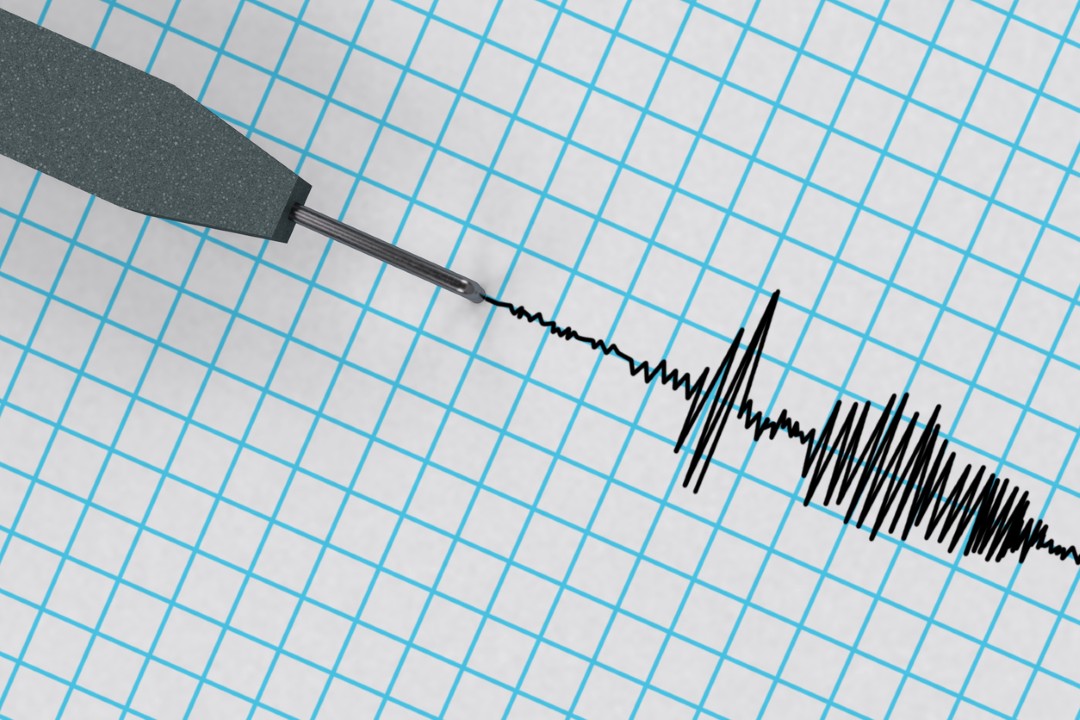
In recent months, a sequence of strong earthquakes in different parts of the planet has led many to question whether global seismic activity is on the rise. However, seismology experts claim that there is no evidence to prove a real increase in the frequency of earthquakes on a planetary scale, according to analyzes published on August 22, 2026. The perception that these events are more common may be linked to factors such as media visibility and the human tendency to identify patterns.
The record of large earthquakes in several countries
The global community has been following a series of high-magnitude tremors that have occurred recently, generating concern. These events, although geographically distant, raised doubts about a possible acceleration in tectonic activity.
- June 24th:Two earthquakes of magnitudes 7.2 and 7.5 hit Venezuela seconds apart.
- End of July:An earthquake measuring 7.1 was recorded in southern Japan.
- August 10:Colombia recorded a 7.4 magnitude earthquake.
- August 15:The island of Flores, Indonesia, was shaken by a magnitude 7.7 earthquake.
- August 18:Granada, Spain, and the Andalusia region recorded earthquakes of magnitudes 4.8, 4.2 and 4.0.
Understanding Global Earthquake Frequency According to Science
Despite the remarkable sequence of events, science finds no correlation between these distant shocks. The Earth’s surface is made up of tectonic plates that move continuously, accumulating tensions at their edges. When the rock’s resistance limit is exceeded, an abrupt rupture occurs, generating an earthquake.
More on this story: Are earthquakes increasing around the world? Experts explain
This geological process does not happen synchronously across the planet. Faults in regions such as the Andes, the Caribbean or the Iberian Peninsula respond to unique tectonic contexts. Experts say there is no known mechanism capable of accelerating the movement of tectonic plates globally and thus triggering a wave of large earthquakes in a short space of time.
/ Shutterstock.com
When are earthquakes really connected?
In some cases, the spatial and temporal proximity between earthquakes may indicate a geological relationship. After a large earthquake, it is common for the same region to experience “aftershocks”, smaller magnitude earthquakes that occur because the main rupture changes the stresses in the surrounding rocks. The frequency of these replicas generally decreases over time.
Another phenomenon is seismic pairs, characterized by two earthquakes of similar magnitude, with close epicenters and a short time interval between them. The Venezuelan example of June 24 can be classified as a seismic pair. In these cases, the rupture of the first tremor can redistribute tensions in the Earth’s crust, favoring or anticipating a new earthquake on a nearby fault already close to the rupture point, a mechanism known as Coulomb stress transfer. However, this mechanism does not apply to distant earthquakes, as stress variations decrease rapidly with distance.
Learn more: Scientific study clarifies whether the number of earthquakes is really growing in the world
The influence of human perception and news coverage
There is a significant factor that shapes our perception of the frequency of earthquakes: not all large tremors have the same impact or gain prominence in the media. Annually, there are on average about 16 earthquakes of magnitude 7 or greater, approximately one every three weeks. Many of these events, however, go unnoticed because they occur at the bottom of the ocean, at great depths or far from inhabited areas, without causing significant damage.
The magnitude of an earthquake alone does not determine its impact. The consequences can vary drastically depending on its depth, distance from population centers, terrain characteristics and, mainly, the vulnerability of buildings and infrastructures. What makes the recent succession of events so striking is the fact that several of them affected populated areas and resulted in considerable damage. If the same tremors had occurred in uninhabited regions, they would probably have received much less attention.
The human tendency to look for patterns also contributes to this perception. When a destructive earthquake makes the news, attention turns to the next one, and the association between them is natural, even if, geologically, they are independent phenomena. María Belén Benito Oterino, professor in the area of Mechanics of Continuous Media and Theory of Structures, reinforces that the succession of several destructive earthquakes in a short period can increase the perception of risk without there being, in fact, an increase in global tectonic activity.
Despite the recent series of events, the planet continues to be tectonically active and will continue to generate large earthquakes. However, this does not mean that the Earth has entered an unexpected “earthquake season.”