
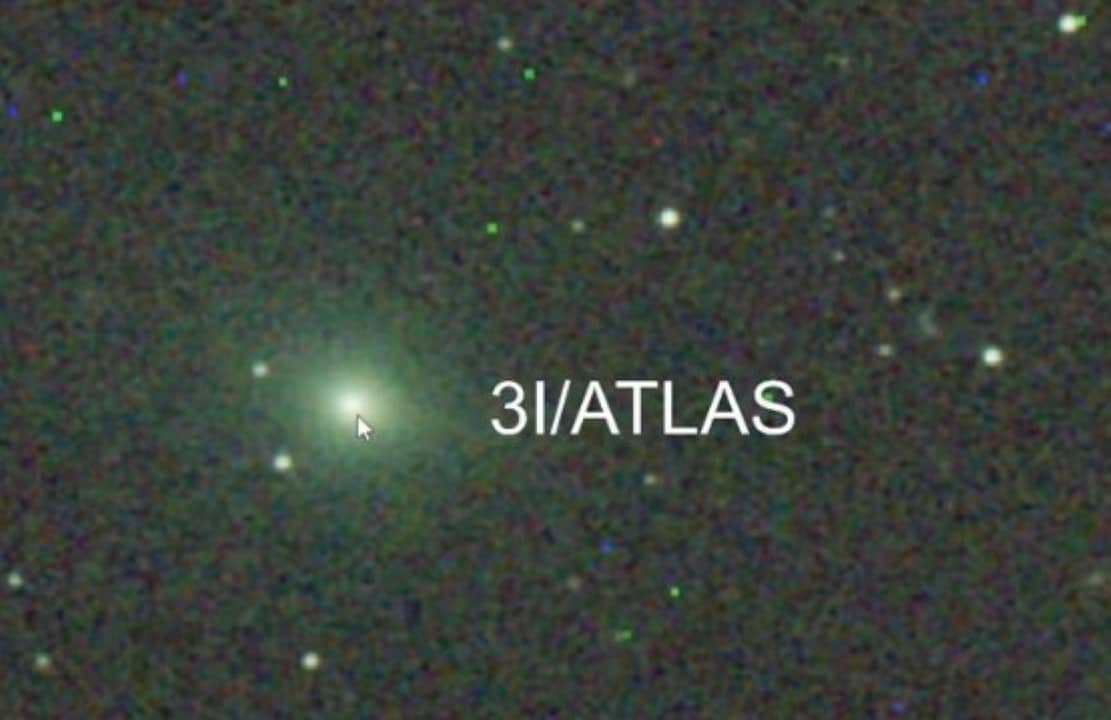
Scientists have identified a significant amount of methyl alcohol in 3I/ATLAS, consolidating the object as the third interstellar intruder to cross our cosmic neighborhood. Recent assessments indicate that the organic substance is released not only by the solid core, but also by the frozen fragments present in its outer cloud, drawing a unique chemical signature that suggests its formation in a remote and unknown region of the Milky Way.
This surprising composition was captured using the powerful sensors of the ALMA complex, positioned around five thousand meters above sea level, in the Chilean territory of Atacama. During the phase of greatest proximity to the Sun, the space traveler demonstrated extraordinary levels of this basic compound, reinforcing its status as a foreign body in our planetary system.
Published in June 2026, the discovery acts as a watershed for astronomers seeking to understand the building blocks of other stellar systems. Data collection took place precisely when the comet was directly impacted by solar heat, an event that forced the sublimation of its internal materials and allowed researchers to trace the exact profile of its elements in outer space.
Atypical composition of the new comet challenges current astronomical knowledge
The route traced by this object intrigues experts, mainly because the incursion of rocks formed outside our system is a very rare phenomenon to be documented. Before him, only 1I/’Oumuamua, detected in 2017, and 2I/Borisov, seen in 2019, carried the official title of interstellar nomads, with each exhibiting completely different physical and behavioral characteristics.
With the arrival of 3I/ATLAS, science gains a new and complex piece to this cosmic puzzle. If the previous visitor, Borisov, was very reminiscent of the celestial bodies native to our region, the current intruder stands out for its enormous amount of methanol, which points to a place of origin with chemical and temperature conditions completely different from those that formed the Earth and its neighbors.
Chilean radio telescopes record unprecedented levels of gases in space
The high-sensitivity antennas of the Atacama Large Millimeter/submillimeter Array (ALMA) identified clear traces of both methyl alcohol and hydrogen cyanide in the object’s provisional atmosphere. As these compounds generate very specific electromagnetic waves in the submillimeter range, the technical team was able to calculate with mathematical precision the amount of material ejected in a vacuum.
The factor that shocked researchers the most was the gigantic proportion of methanol compared to the rate of hydrogen cyanide. This chemical disparity transformed the interstellar comet into the celestial body with the highest concentration of this organic element ever catalogued, leaving behind any ice rock that had formed around our Sun.
Learn more: Telescope in Chile detects giant methanol cloud on interstellar comet 3I/ATLAS
Importance of prebiotic elements in the creation of planetary systems
When astronomy talks about “alcohol” in the cosmos, there is no relationship with the substances present in everyday life on Earth. The term refers to a fundamental molecule that serves as the basis for chemical reactions that precede life, functioning as an essential pillar for scientists investigating the emergence of complex materials in the frozen nurseries of future planets.
Molecules with this profile usually form on the surface of microscopic dust grains in the coldest areas of the galaxy, where time-consuming processes transform simple atoms into larger organic chains. Due to this formation mechanism, the compound acts as an impeccable historical record, providing clear clues about the temperature and density of the exact location where the star was born.
Melting of debris increases the emission of organic material into the vacuum
A highlight in the 3I/ATLAS analysis lies in the fact that emissions do not originate exclusively from its solid core. The information collected proves that a large amount of gas arises from tiny blocks of ice scattered throughout the coma, the cloud of dust and vapor that surrounds the comet as it begins to feel the thermal effects of our star.
The scientific community defines this phenomenon as extended release, a mechanism in which the icy fragments around the main rock gradually sublime, launching even more molecules into space. This behavior converts the traveler’s fog into a true factory of chemical compounds, allowing observatories on Earth to read its signals much more clearly.
More on this story: Telescope in Chile detects record level of alcohol in interstellar comet 3I/ATLAS
Difference in gas release indicates complex geology in the star’s core
Unlike methyl alcohol, which dominates the entire length of the coma, hydrogen cyanide showed an extremely focused release pattern. The instruments showed that this specific gas emanated practically only from the solid heart of 3I/ATLAS, a feature that perfectly mimics the dynamics observed in comets that inhabit our own planetary system.
The contrast in the way these elements detach from the rock proves that the materials trapped inside have independent reactions to heat. This makes it clear that the space nomad has a structure divided into different chemical strata, where each layer melts and releases its components at a particular rate during the encounter with solar radiation.
Previous infrared observations already indicated the peculiar nature of the traveler
Well before the Chilean observatory targeted methanol, the James Webb Space Telescope’s thermal sensors were already signaling that this intruder’s atmosphere was unusual. Preliminary analyzes found extremely high levels of carbon dioxide, which already supported the hypothesis that the composition of the rock was completely new by the standards of modern science.
On the same topic: Telescope in Chile detects giant methanol cloud on interstellar comet 3I/ATLAS
With the union of data obtained by terrestrial antennas and equipment in orbit, the mystery gained new contours. The endorsement of two of the most advanced astronomical projects in the world decrees that the chemical identity of this object breaks all paradigms, bringing a mixture of substances so unique that it becomes impossible to equate it with local celestial bodies.
Ice fragments act as time capsules from other solar systems
Analyzing the composition of 3I/ATLAS is like launching a virtual mission towards a star that humans would never be able to visit in person. As the object formed light-years away, the frozen matter in its core preserves pure information about the intensity of the radiation and the chemical ingredients present in the protoplanetary disk that gave rise to it.
Although science does not yet have the ability to track the exact star that expelled this rock into deep space, the massive amount of methanol highlights a chaotic formation process. The high levels of the gas indicate that the comet’s birth took place in the coldest boundaries of an alien system, governed by molecular dynamics that do not exist on the outskirts of our planet.
Unprecedented results force revision of theories about the formation of the universe
Continuing studies around this traveler assumes colossal importance, given that the list of known interstellar bodies is extremely short. With only three official records to date, each new substance detected requires academics to completely rethink the models that explain the agglomeration of dust and gas around other stars.
The retrospective analysis of these galactic nomads shows that there is no defined pattern, revealing an immense diversity in the cosmos:
More on this story: Radio telescope in Chile detects unprecedented heavy water on 11-billion-year-old comet 3I/ATLAS
- The first of them, 1I/’Oumuamua, surprised the community by presenting itself as an arid block without any gas emissions.
- The successor, 2I/Borisov, brought some relief to theorists by behaving almost identically to the local icy stars.
- The current 3I/ATLAS overturned previous certainties by displaying a massive alcohol cloud and an unprecedented molecular structure.
This radical swing in physical characteristics testifies that deep space travelers harbor much greater and more unpredictable geological complexity than researchers assumed when they began monitoring the skies for intruders.