
Hubble Space Telescope marks 200,000 Earth orbits while studying cosmic expansion
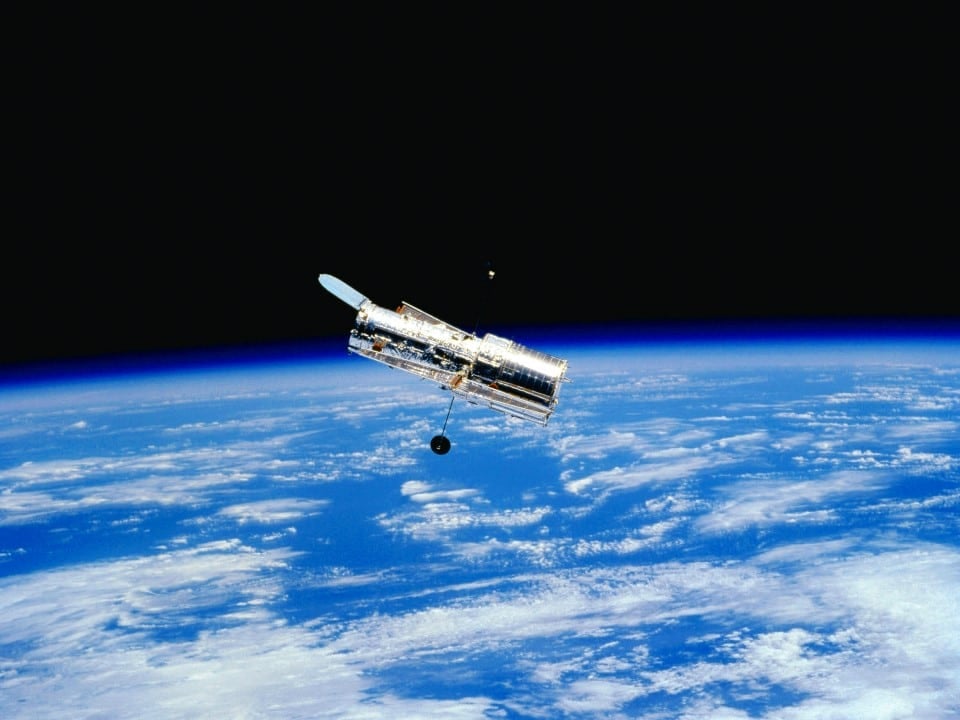
The Hubble Space Telescope completed its 200,000th orbit around Earth on September 19, 2026, surpassing 36 years of continuous scientific operations. The milestone was recorded while the instruments of the orbital observatory were pointed toward the massive galaxy cluster MACS J0417 to observe a distant stellar explosion whose light is split across deep space.
NASA confirmed that the spacecraft has now traversed more than 8 billion kilometers (exceeding 5 billion miles) since its deployment into low Earth orbit in 1990. During this operational lifetime, the telescope has executed more than 1.7 million astronomical observations, remaining an active instrument for global astrophysics despite technical constraints and the absence of crewed servicing missions for more than 17 years.
Hubble tracks supernova Athena through the MACS J0417 gravitational lens
The 200,000th orbit coincided with targeted observations of MACS J0417, a colossal galaxy cluster situated approximately 4.65 billion light-years from Earth in the constellation Eridanus. The immense gravitational field of the cluster warps the fabric of surrounding spacetime, functioning as a natural cosmic lens that magnifies, stretches, and bends the light originating from background objects that would otherwise remain undetectable.
Keep reading: NASA engineers blend bacteria and simulated space dust to manufacture tools on the Moon
Behind this cosmic amplifier lies supernova Athena, a stellar explosion discovered in 2025 by NASA‘s James Webb Space Telescope (JWST). Because light takes different paths of varying lengths around the dense cluster core, the explosion appears to observers at multiple separate times. Astrophysicists are using Hubble to monitor these predicted flashes, which will allow researchers to construct high-precision maps of matter distribution inside MACS J0417.
“Supernova Athena, discovered by NASA’s James Webb Space Telescope in 2025, is predicted to reappear between now and early March 2027. Measuring the timing of Athena’s reappearances can help researchers map the mass of MACS J0417, which acts as a magnifying, foreground lens for distant objects, and refine our understanding of the expansion rate of the universe,” stated the NASA Hubble Mission Team.
Measurements gathered from these arrival times will directly inform calculations of the Hubble Constant, the fundamental metric describing the expansion rate of the universe. UCLA researcher M. Pascale and image processing specialist J. DePasquale from the Space Telescope Science Institute (STScI) participated in processing the observation data obtained during this orbital milestone, as reported in science coverage by journalist Matthew Williams.
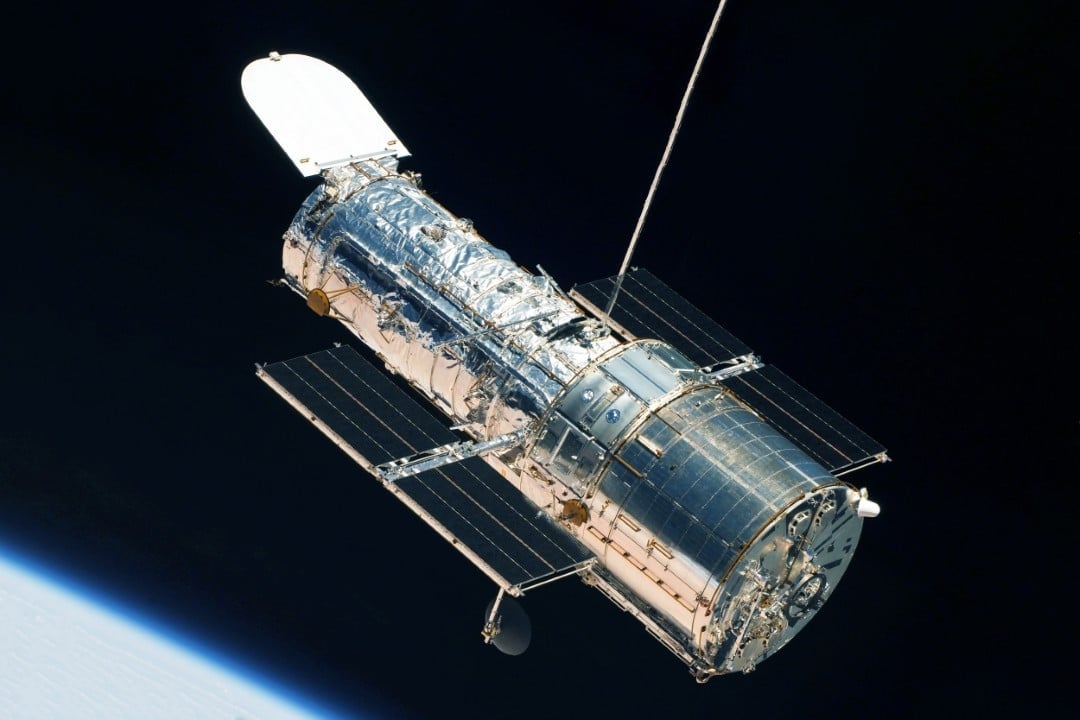
Key dates and flight metrics of the Hubble mission
Hubble operates at an average altitude of 483 kilometers (roughly 300 miles) above the surface of Earth. Flying outside the distorting interference of the terrestrial atmosphere, its optical assembly registers imagery and spectra across ultraviolet, visible, and near-infrared wavelengths at an orbital velocity of approximately 27,000 kilometers per hour (17,000 miles per hour).
Learn more: SpaceX Starship engine shutdown threatens NASA 2028 Moon landing
- April 24, 1990: Launch of the observatory aboard Space Shuttle Discovery on mission STS-31.
- August 11, 2008: Completion of orbit number 100,000 around Earth.
- May 19, 2009: Conclusion of STS-125, the fifth and final crewed shuttle servicing mission to the telescope.
- July 4, 2011: Execution of the observatory’s 1,000,000th scientific observation.
- September 19, 2026: Official completion of orbital revolution number 200,000.
- March 1, 2027: Estimated boundary of the window for detecting repeated light pulses from supernova Athena.
Single-gyroscope mode and mechanical adjustments on Hubble
Originally designed to operate for an initial design lifespan of 15 years, the observatory survived decades beyond its original specifications because of five astronaut maintenance flights conducted between 1993 and 2009. The servicing missions replaced degraded batteries, corrected mirror optics, installed upgraded cameras, and renewed gyroscopes used to orient the platform toward cosmic targets.
With no space shuttles operating to deliver replacement parts, flight controllers have adapted onboard software to bypass aging components. In 2024, NASA transitioned Hubble to operate on a single mechanical gyroscope after reliability issues compromised its primary pointing system. The change preserved celestial target pointing while keeping a reserve unit inactive for future contingency use.
Operating under this streamlined configuration did not halt complex imaging campaigns. In 2025, the platform marked its 35th anniversary by delivering a 2.5-billion-pixel mosaic of the Andromeda Galaxy. Scientific demand for the facility remains competitive, with research institutions submitting roughly seven observation proposals for every single available timeslot awarded by review committees each year.
Atmospheric drag and the projected end of the Hubble mission
Because Hubble completes a lap around Earth every 94 to 95 minutes, totaling about 15 revolutions daily, it remains subjected to faint friction from the outer fringes of the upper atmosphere. This continuous aerodynamic drag causes the spacecraft’s orbital altitude to decrease slowly over time, with no onboard thrusters available to boost its path back to higher altitudes.
See also: Comet 3I/ATLAS speeds at 66 km/s through solar system as NASA confirms safe orbital distance
Mission operators anticipate that the spacecraft will remain scientifically viable until at least the middle of the 2030 decade. Once its orbit decays past safe pointing thresholds, NASA plans to conduct a controlled engineering disposal to direct the remaining hardware into a remote oceanic impact zone rather than allowing an unguided reentry.
Astrophysicists have not yet determined the exact calendar date on which the light of supernova Athena will register on the instruments of Hubble. The observation window tracking the distorted light paths through MACS J0417 remains active, with the final expected appearance window extending through March 1, 2027.


