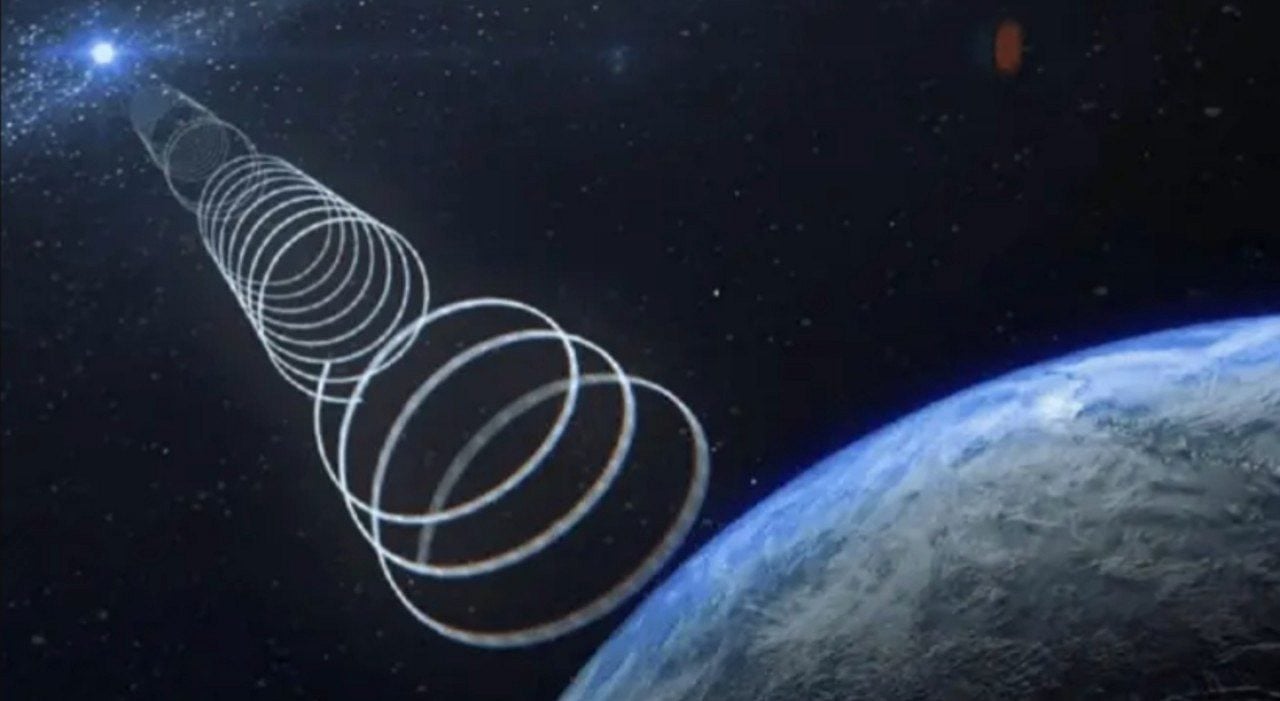
An international team of researchers directed by the University of Sydney has pinpointed the celestial home of the energetic transient designated FRB 20240304B. Traveling across the void for more than 10 billion years before reaching ground receivers, the signal establishes a new cosmic distance milestone for fast radio burst detections.
Detailed findings characterizing the burst environment and physical origin appeared on Thursday, October 8, 2026, in the journal Science. The flash was originally recorded on March 4, 2024, by the MeerTRAP instrument operating on the MeerKAT radio array in South Africa across frequencies ranging from 900 MHz to 1,700 MHz.
Signal from early cosmic history more than doubles previous distance records
Fast radio bursts represent sudden, millisecond-long blasts of electromagnetic energy that discharge as much power as whole stars release over days. First identified by observational astronomers in 2007, these transient occurrences generally dissipate long before ground-based arrays can triangulate their precise source coordinates on the celestial sphere.
Calculations show that FRB 20240304B originated when the Universe was barely 3 billion years old, less than one-fourth of its current estimated age of 13.8 billion years. Spectroscopic analysis documented a cosmological redshift of 2.148, a metric reflecting how space expanded during the light path that more than doubles the former record for confirmed radio bursts.
The light completed a journey across a lookback time exceeding 10.7 billion years before striking terrestrial antennas. “This is an extraordinary glimpse into the distant universe. We have caught a fast radio burst from a time when the universe was only about 3 billion years old, and we have used that brief flash of radio light to learn about the matter it has traveled through over billions of years,” stated lead author Manisha Caleb, an astrophysicist at the University of Sydney.
Infrared instruments on space observatory detect target missed by ground facilities
Confirming the precise point of emission required combining radio coordinate data with ultra-sensitive space instruments. Major terrestrial optical facilities, including the Keck Observatory in Hawaii, surveyed the target region thoroughly without detecting any optical counterpart due to the extreme faintness of the stellar system.
See also: James Webb Little Red Dots are overfed supermassive black holes
Visual confirmation and spectral measurements were subsequently achieved using the NIRCam and NIRSpec infrared systems aboard the James Webb Space Telescope. By collecting ancient infrared light stretched by cosmic expansion, the orbiting observatory measured the exact physical distance and gas composition surrounding the emission site.
“Our findings further demonstrate the remarkable capabilities of the Webb space telescope, allowing us to push horizons well beyond what was achievable in the past,” noted co-lead researcher Themiya Nanayakkara from the University of Sydney. The observatory supplied critical data after ground-based optical facilities spent extensive observation windows searching the coordinates without registering a visual detection.
Dwarf system undergoing rapid star formation hosts distant energy flash
Data gathered by the space observatory revealed an environment notably different from the typical galaxies associated with radio bursts. Rather than emerging from an older, massive spiral formation, the signal originated within a low-mass dwarf galaxy with very low concentrations of elements heavier than hydrogen and helium. In astronomical studies, these heavier elements are categorized as metals, and their low abundance points to an early cosmic environment that has not yet undergone multiple cycles of stellar deaths and rebirths.
The stellar mass of the newly resolved host is approximately 1,000 times lower than the typical host galaxies cataloged in earlier radio surveys. “The host galaxy stands out across our entire galaxy sample, and it was certainly not what we anticipated finding,” explained Ben Stappers, a professor at the University of Manchester and principal investigator of the MeerTRAP initiative.
Check out: Webb telescope detects ammonia on cold giant planet HATS-6 b
“The host galaxy for this burst is remarkably small, metal-poor, and undergoing an intense period of star generation,” noted co-author Laura Driessen, an astrophysicist at the University of Sydney. The elevated concentration of newly formed stars supports current scientific models linking fast radio bursts to short-lived massive stars.
A dense population of newborn stars supports the hypothesis that the flash came from an active magnetar, an intensely magnetized neutron star created after a supernova. The abundance of collapsing massive stars makes the magnetar model far more probable than slow neutron star mergers, though astronomers have not yet secured definitive visual proof of the physical object itself.
Traveling radio frequencies provide new map of diffuse cosmic matter
Covering more than 10 billion years of intergalactic space makes FRB 20240304B a valuable probe for testing broader cosmological frameworks. As radio emissions pass through diffuse plasma and ionized gas along the cosmic web, different wavelengths scatter and experience systematic delays. Measuring these dispersion variations gives scientists a direct calculation of otherwise invisible matter dispersed across the universe.
The research group included astrophysicist J. Xavier Prochaska, a professor at the University of California, Santa Cruz. Astronomers plan to coordinate future sweeps using the MeerKAT array alongside the James Webb Space Telescope to locate additional deep-space signals, mapping how gas distributions evolved throughout earlier cosmic eras.