
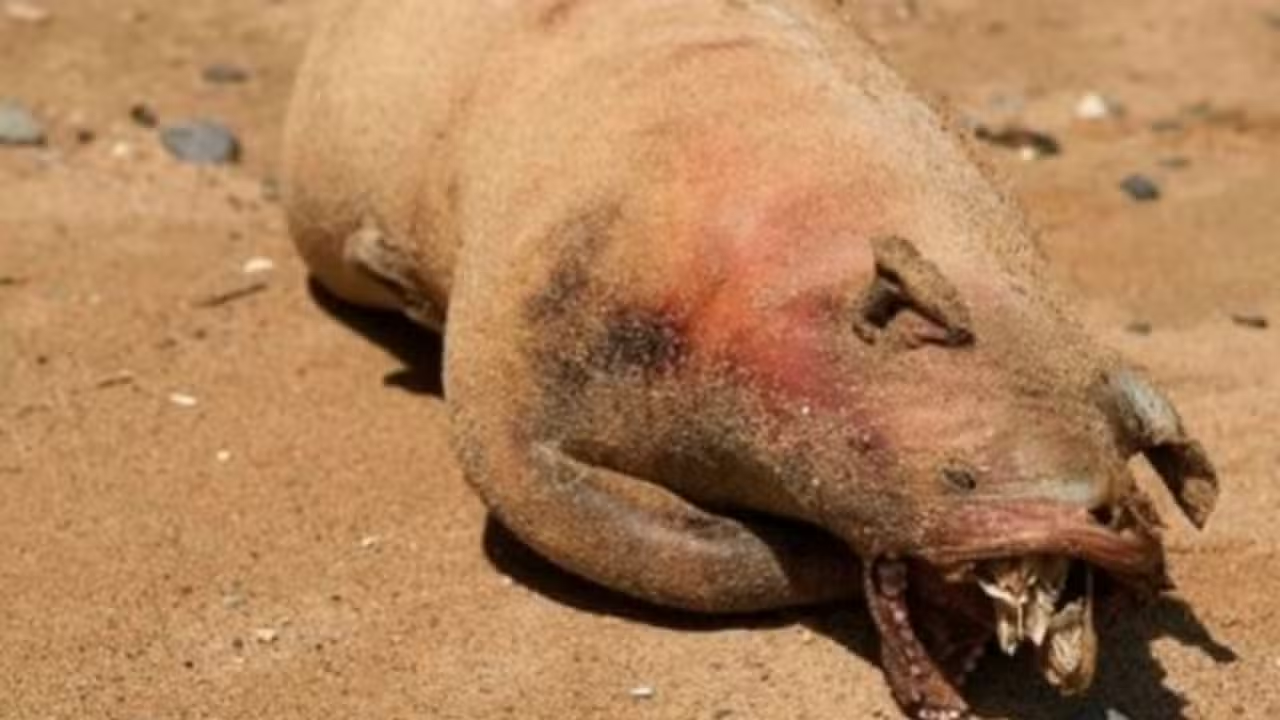
Biologists and wildlife specialists verified that the creature known internationally as the Montauk Monster was an ordinary northern raccoon subjected to prolonged marine decomposition. Beachgoers discovered the unusual carcass on July 12, 2008, along Ditch Plains beach within Rheinstein Estate park in East Hampton, New York, roughly two miles east of Montauk’s commercial district.
Local resident Jenna Hewitt spotted the remains while walking along the shoreline with companions and captured the photograph that quickly spread through global media channels. The image first reached print on July 23, 2008, in the regional newspaper The Independent under the headline The Hound of Bonacville. Observers described a discolored, hairless body swollen from ocean immersion, displaying sharp canine teeth alongside an unusual cranial projection that resembled a curved beak.
Anatomical evidence points to waterlogged northern raccoon
British palaeozoologist Darren Naish and Larry Penny, then serving as director of natural resources for the town of East Hampton, reviewed the visual documentation and confirmed the carcass represented Procyon lotor, the standard North American raccoon. Both specialists determined that every perplexing trait resulted entirely from natural taphonomic processes triggered while the dead animal floated at sea before washing ashore.
Continuous wave action stripped away the fur coat, exposing the swollen underlying hide. Rapid decomposition consumed the soft tissues around the snout and nasal cartilage, exposing the bare premaxillary bones of the upper jaw to generate the illusion of an avian beak. The surviving dental layout clearly showed terrestrial carnivore canine teeth, directly ruling out birds, sea turtles, or aquatic reptiles.
The morphology of the front paws served as conclusive proof against other popular theories, such as dogs, domestic pigs, coyotes, or shell-less turtles. Darren Naish documented the anatomical match during his detailed zoological review.
“It was the digits of the hands that gave this away for me: the Montauk carcass has very strange, elongate, almost human-like fingers with short claws,” Naish stated. “Raccoons are well known for having particularly dextrous fingers that lack the sort of interdigital webbing normally present in carnivorans.”
Proximity to research facilities sparked conspiracy theories
Before professional zoologists provided a rational explanation, the shoreline discovery triggered rampant rumors regarding illicit government genetic experiments. Ditch Plains sits along a stretch of eastern Long Island located near two government installations that already figured prominently in local folklore: the decommissioned Camp Hero military base and the federal Plum Island Animal Disease Center.
Camp Hero formerly housed United States Air Force radar installations and gave rise to the Montauk Project conspiracy narrative regarding clandestine psychological research, an urban legend that later provided creative inspiration for the television series Stranger Things. Meanwhile, the presence of the animal pathogen testing facility at Plum Island led beachgoers to speculate that an engineered biological specimen had escaped across the water.
“We joked that maybe it was something from Plum Island,” Hewitt commented during initial media interviews regarding her encounter on the sand.
Submerged mammal carcasses create recurring coastal illusions
The drift of terrestrial mammals into marine environments frequently produces distorted corpses along coastal regions throughout the United States. Prolonged saltwater soaking strips away exterior coats and facial flesh, fundamentally altering the visible silhouette of common carnivores and rodents in ways that confuse non-specialists.
A comparable incident occurred on July 22, 2012, under the Brooklyn Bridge along the East River in New York City. Photographer Denise Ginley documented roughly twenty images of a bloated carcass that washed ashore, sending the photographs to local news outlet Gothamist. The visuals prompted intense internet debate over whether the remains belonged to a bloated pig, a dog, a raccoon, or a giant mutated rodent before biologists reaffirmed the distorting effects of river water.
Unresolved disposal left carcass without formal laboratory examination
Despite intense public fascination and authoritative visual assessments, the original Ditch Plains carcass never underwent physical tissue sampling or an official laboratory necropsy. The remains vanished from the shoreline shortly after Hewitt and her companions documented the scene, and municipal authorities never compiled an official record tracing the final disposal of the specimen.