
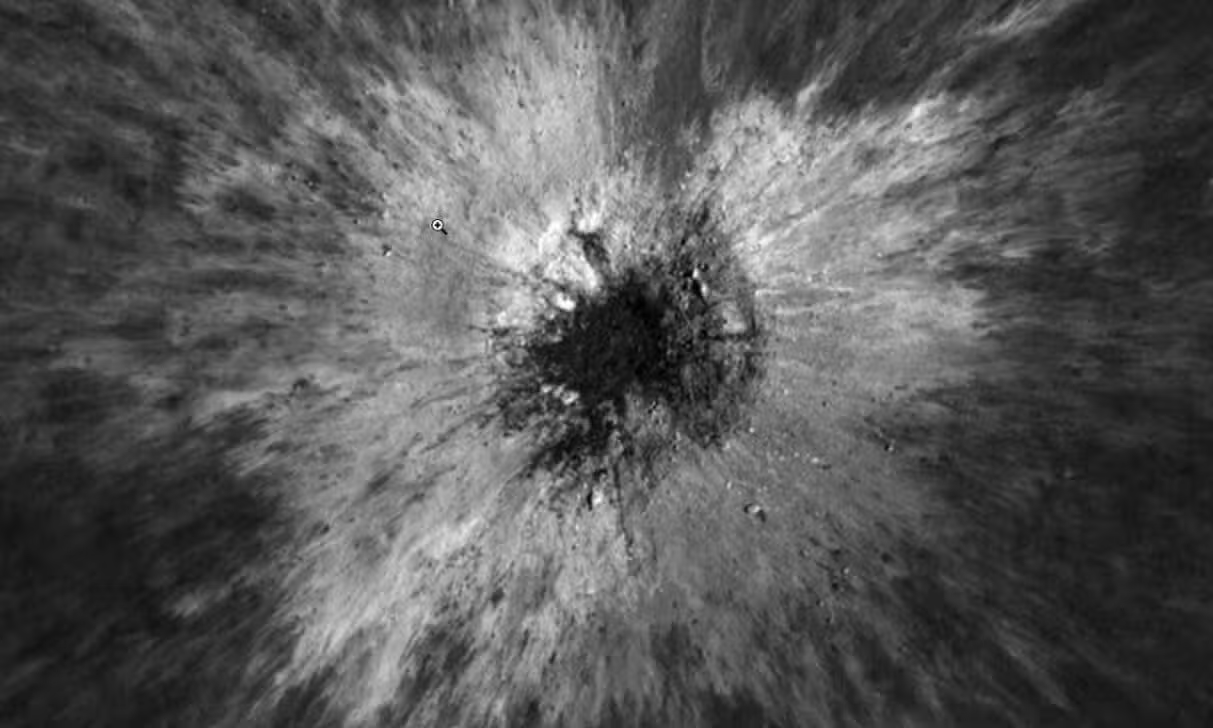
Instruments aboard NASA’s Lunar Reconnaissance Orbiter located a massive 222-meter-wide impact cavity on the surface of the Moon. The collision originated from an asteroid or comet between April and May 2024, marking the largest fresh impact basin discovered on the celestial body in modern observational history.
Planetary researchers formally designated the expansive geological feature as McGetchin crater. The name commemorates pioneering planetary scientist Thomas McGetchin, who made foundational contributions to understanding ejecta distribution across extraterrestrial surfaces.

Newly formed basin spans 222 meters across eastern lunar terrain
The resulting depression plunges 43 meters deep into the crust, creating a hollow large enough to stack three standard school buses vertically. Detailed geometric measurements indicate that the rim width rivals the total footprint of the Roman Colosseum. Computer models suggest the incoming projectile possessed dimensions equivalent to a three-to-six-story building before disintegrating against the rock.
Destructive strikes of this magnitude represent exceptionally uncommon occurrences on the modern Moon, taking place roughly once every century. The event provides an unprecedented baseline for measuring fresh structural damage and material displacement without centuries of solar weathering.
Surface regolith loosens and drops local temperatures by nine degrees
Kinetic force from the collision hurled pulverized debris and fine dust up to 100 kilometers across the surrounding landscape. Thermal monitoring identified a circular zone extending 7 kilometers where nighttime temperatures plunge 9 degrees Celsius lower than surrounding terrain. The shock wave loosened the upper regolith mantle, significantly reducing the ground’s ability to retain day-stored heat.
- A pronounced drop in nocturnal temperatures across a 7-kilometer perimeter.
- Loosened surface regolith showing reduced overall compaction and thermal inertia.
- Modification of the external lunar crust stretching over 100 kilometers.
- Altered ground density creating mobility variables for future surface exploration rovers.
David Paige, a planetary science professor at the University of California, Los Angeles, compared the extensive shock signature to the mechanical plowing of agricultural fields. Researchers now view large strikes as natural mechanisms that overturn settled sediment and expose buried sub-crust materials to the surface.
Follow: Nasa spots 220-meter McGetchin crater on Moon after comet hit
Orbital imaging specialists verify fresh crater from unusual bright spot
The breakthrough started when researcher Robert Wagner noticed an irregular bright feature while screening historical lunar map records. The specialist paused daily imaging tasks to carry out an exhaustive inspection of the unusual surface anomaly.
Wagner stated that he immediately stopped and set aside regular duties to investigate what generated the marker. By performing high-resolution optical comparisons with the spacecraft’s Narrow Angle Camera, the scientist separated genuine new topographic features from misleading shadows and sun angles that often trigger automated alerts.
Lunar mission planners assess debris hazards for human settlement bases
The Lunar Reconnaissance Orbiter has logged more than 1,000 newly formed craters and nearly 100,000 surface modifications since entering lunar orbit in 2009. Ongoing measurements prove that the uppermost two centimeters of lunar dust turn over entirely every 80,000 years, confirming that historical footprints left by Apollo astronauts will eventually erode away over time. Structural engineers currently incorporate these ejection distances to model surface vulnerabilities and design protective shielding for long-term habitats.
Long-term settlement planning depends on accurate strike probabilities to protect pressurized habitats and exterior solar infrastructure. Mission teams will continue tracking McGetchin crater to measure how lunar vacuum conditions alter fresh impact debris over coming operational phases.