
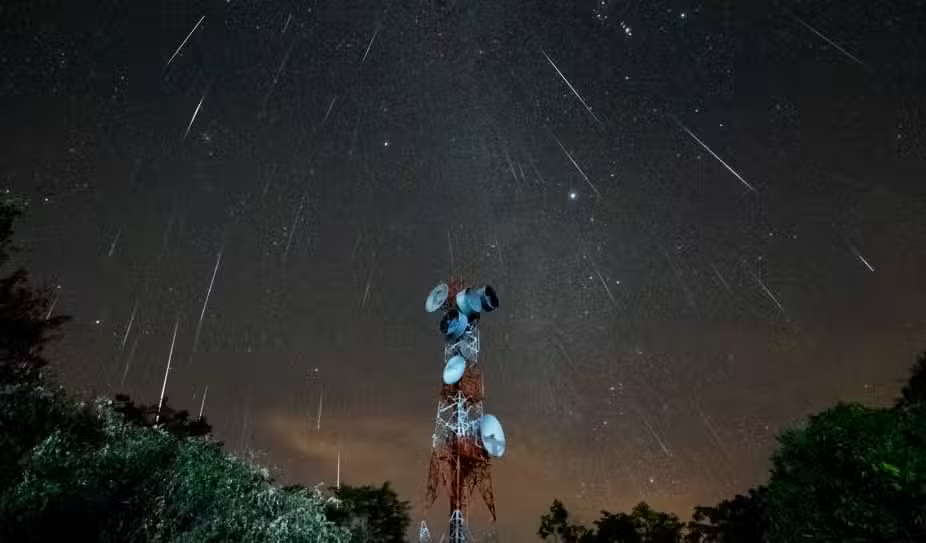
Skywatchers across the globe are tracking the Draconids and Southern Taurids meteor showers as they cross the night sky in October 2026, benefiting from optimal viewing conditions created by the astronomical new moon. The near-total lack of moonlight leaves celestial backgrounds deeply darkened, allowing subtle trails of burning cosmic dust to be observed as they vaporize in the upper atmosphere. Observers in rural and suburban areas are taking advantage of this favorable lunar cycle, which significantly increases contrast against the black backdrop of the night sky.
Peak activity for the Draconid stream concentrated between Thursday night (8) and the early hours of Friday (9), with the highest concentration of visual streaks calculated at 22:00 Brasília time. This annual pulse of cosmic dust coincided with the earliest observable activity of the Southern Taurids, an independent meteor current known for its deliberate velocity and periodic generation of blazing fireballs. While the sharpest concentration of the Draconid display has passed, lingering trails remain visible in tandem with the ongoing Taurid display.
Lunar alignment on Saturday provides dark skies across both hemispheres
The exact astronomical alignment of the new moon takes place this Saturday (10) at 15:50 UTC, an event corresponding to midday in Brasília. In this precise celestial configuration, the moon travels directly between Earth and the Sun, leaving its Earth-facing hemisphere unlit by direct sunlight. Because no reflected glare illuminates the night sky, observers are able to detect faint, millimeter-sized particles that would otherwise be overwhelmed by the lunar glow.

Viewing conditions this cycle offer a sharp contrast to October 2025, when observers faced severe interference from a brilliant full moon that drowned out the majority of trails and obscured faint shooting stars. In 2026, early October provides an unhindered stretch of dark nights that allows professional astronomers and casual stargazers to set up equipment far from urban light pollution. Observers are capitalizing on consecutive cloudless evenings to monitor both meteor showers under rare, unobstructed conditions.
Particle streams from Comet 21P generate slow atmospheric streaks
The Draconid meteors originate from a debris trail cast through space by the periodic comet 21P/Giacobini-Zinner, which completes an orbit around the Sun every 6.6 years. As this icy wanderer loops through the solar system, solar radiation warms its surface, releasing frozen volatile compounds, fine grains of dust, and rocky debris along its elliptical path. Whenever Earth’s orbital trajectory crosses this stream of comet remnants, microscopic grains collide with the planet’s atmospheric shield and disintegrate at high altitudes.
Check out: Orionid meteor shower peaks on October 21 as Comet Halley debris crosses Earth
Unlike many annual meteor showers that reach peak visibility in the late hours before dawn and travel at extreme velocities, the Draconids display distinct physical properties that alter traditional observing routines. Their speed and timing make them uniquely accessible to casual viewers immediately after twilight sets in across northern locations:
- Atmospheric entry speed reaches approximately 20 kilometers per second, a velocity considered exceptionally slow by standard meteor metrics.
- Activity rates range between 5 and 10 visible meteors per hour under dark skies during the height of the shower.
- The prime viewing window occurs during early evening hours right after dusk, rather than during the predawn hours.
- The radiant point sits toward the northern constellation of Draco, situated high above the northern horizon.
- The parent body is identified as Comet 21P/Giacobini-Zinner, an active periodic object completing an orbit every 6.6 years.
Because the radiant point lies within Draco, observers situated across mid-to-high northern latitudes enjoy the most favorable geometry for witnessing the shower. In contrast, skywatchers in the Southern Hemisphere, including most of Brazil, experience restricted visibility because the radiant barely skims above the local horizon. Only the northernmost regions of South America offer sufficient elevation for the radiant to yield reliable sightings of incoming Draconid particles.
Historic outbursts of 1933 and 1946 contrast with standard 2026 rates
Observational records of the Draconid shower include remarkable accounts of full-scale meteor storms documented during the twentieth century. In 1933 and again in 1946, observers recorded thousands of meteors entering the atmosphere every hour as Earth plowed through exceptionally dense pockets of debris freshly expelled by Comet 21P. A similar surge in activity occurred in 2011, when specialized radar and visual tracking networks registered meteor counts far exceeding ordinary seasonal rates.
Astronomical forecasts for October 2026 indicate no evidence of an exceptional storm, pointing instead toward low-to-moderate baseline activity across the shower’s operational window. Orbital calculations confirm that Earth is traversing older, more dispersed filaments of the comet’s dust trail, yielding an expected output of 5 to 10 visible streaks per hour under clean skies. Observers positioned in rural regions can still monitor these modest rates by maintaining an unobstructed view of the northern sky throughout the evening.
Follow: James Webb traces record radio burst FRB 20240304B to early dwarf galaxy
Key dates and viewing peaks for October and November skywatching
Running alongside the Draconid display, the Southern Taurids continue to build momentum throughout October, presenting a distinct class of slow-moving meteors capable of generating intense fireballs. These bolides occur when larger pebbles penetrate deep into Earth’s mesosphere, producing brilliant flashes of light that can briefly illuminate the surrounding landscape. Observational data indicate that the first activity peak of the Southern Taurid stream is projected across an extended window, spanning from Saturday (10) to the interval between Tuesday (13) and Wednesday (14).
Astronomy tracking networks and sky observation societies have established a precise operational timetable covering key viewing targets and lunar phases across the current quarter:
- Thursday, October 8, 2026: Peak intensity of the Draconid meteor stream estimated around 22:00 Brasília time.
- Saturday, October 10, 2026: Exact alignment of the astronomical new moon at 15:50 UTC, providing maximum nocturnal darkness.
- Tuesday, October 13, 2026: Approximate operational marker for the initial peak window of the Southern Taurids.
- Wednesday, November 4, 2026: Anticipated second peak for the Southern Taurid shower, historically characterized by heightened fireball production.
The dark nights surrounding the October new moon create an ideal environment for observers tracking these events using binoculars, long-exposure photography, or the naked eye. Astronomy groups recommend seeking out rural observation sites positioned far from artificial street lighting and allowing eyes at least 30 minutes to adjust fully to the darkness. Scientific institutions and tracking networks will continue gathering data over the coming days as Earth proceeds along its orbital path through the surrounding fields of cometary debris.