
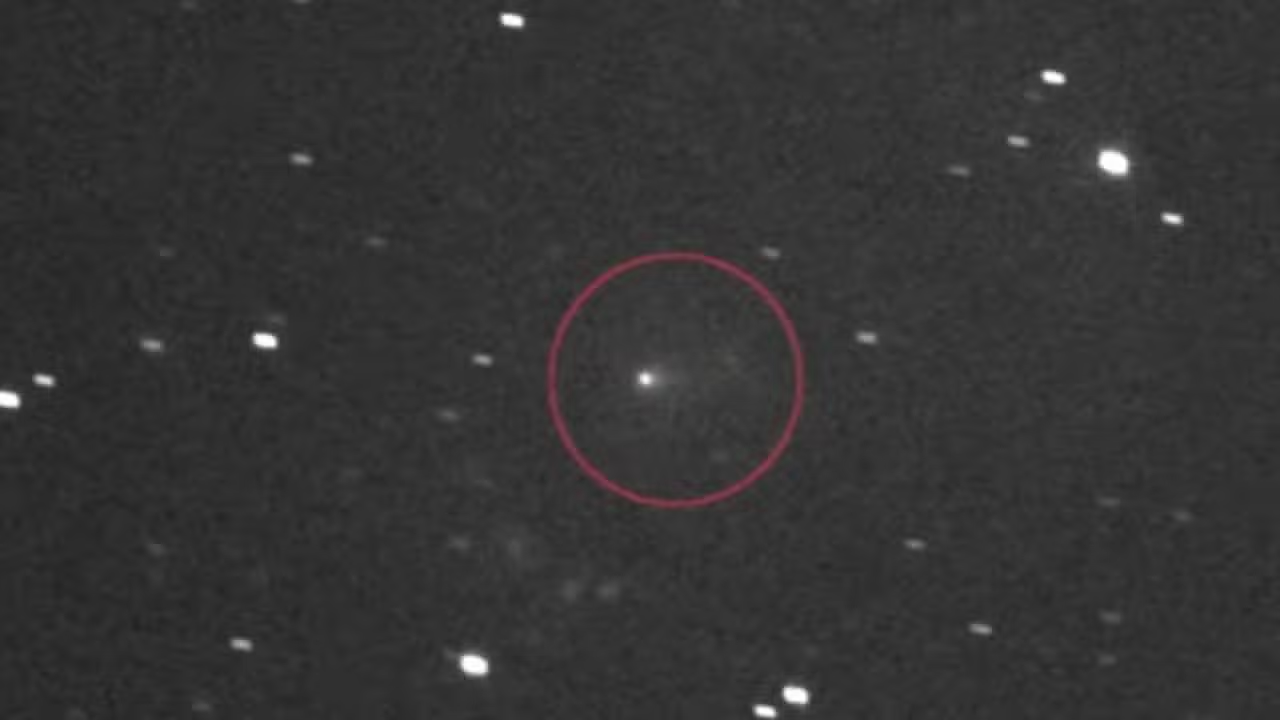
Measurements published in the journal Monthly Notices of the Royal Astronomical Society demonstrate that interstellar comet 3I/ATLAS consolidated its core under temperatures below 30 Kelvin in the distant fringes of another star system. The object represents only the third confirmed interstellar body discovered passing through our planetary system and examined directly by modern observatories. High-resolution optical instruments recorded preserved volatile gases that kept the original physical matter intact since the visitor first coalesced.
The extreme thermal deficit prevented molecular alterations within the rocky block and its ancient icy compounds. Because of this uninterrupted insulation across deep space, volatile elements survived across billions of years without undergoing meaningful chemical shifts.
Severe cold preserved primitive molecules in distant stellar frontiers
Spectroscopic measurements taken from the expanding coma of 3I/ATLAS revealed heavy concentrations of carbon monoxide along with volatile compounds that condense exclusively below 30 Kelvin, conditions typical of the outermost zones of alien protoplanetary disks. Reporting in Monthly Notices of the Royal Astronomical Society, researchers proved that the comet formed far from the heat of its parent star while cosmic dust gravitationally gathered, well before gravitational ejections hurled it into interstellar space for an odyssey lasting millions of years. The nucleus never encountered enough stellar radiation to alter its inner reservoir of frozen volatile elements. Unbroken sub-freezing temperatures protected every compound.

Read also: Interstellar comet 3I/ATLAS reveals origins below 30 Kelvin in outer reaches of another star
Research teams evaluated these baseline ratios of simple gases to retrace the probable location of the original circumstellar envelope. Ground observatories documented a progressive increase in sublimation rates as proximity to the Sun warmed the outer crust of the passing visitor.
Keep reading: Interstellar comet 3I/ATLAS formed below -240 °C around an ancient star with low metal levels
Rapid outgassing of carbon monoxide progressed with greater intensity than typical water ice sublimation seen in native Solar System comets. This violent vaporization built an expansive gaseous envelope around the nucleus long before the comet reached perihelion. Observatories across the globe oriented spectrometers toward the glowing coma to split emitted light into individual wavelengths, confirming the pristine makeup of the interstellar wanderer.