
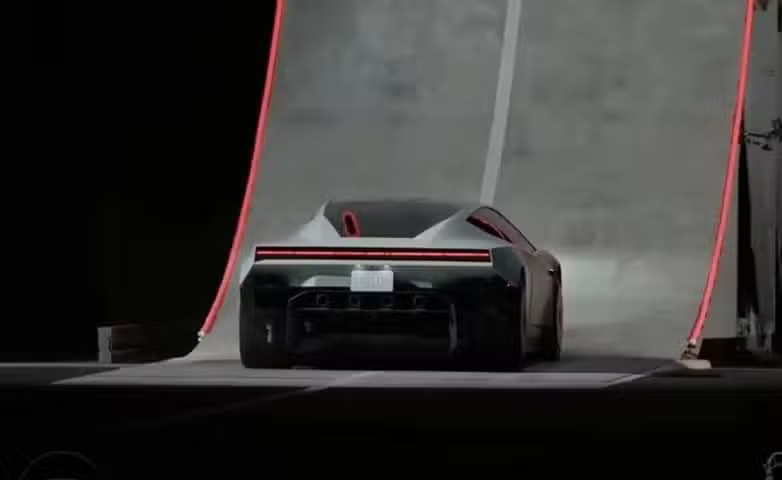
Elon Musk, chief executive officer of Tesla and SpaceX, demonstrated the redesigned second-generation Tesla Roadster prototype on Thursday, October 15, 2026, at a SpaceX testing facility in McGregor, Texas. Outfitted with compressed-air thrusters and an underbody suction fan system, the two-seat electric sports car drove upside down, executed midair flips, and had its commercial production start set for 2028.
Broadcast live on the social media platform X beginning at 9:30 p.m. Eastern Time (10:30 p.m. Brasilia time), the outdoor showcase had been postponed from October 1 due to inclement weather. On stage, Musk described the joint engineering effort between his two companies as “what happens when you collaborate with the best vehicle company in the world and the best aerospace company in the world.” Addressing the audience of investors and brand enthusiasts, the executive added: “Flying vehicles are real.” While noting that “success is not guaranteed” for this type of vehicle architecture, Musk stated that the project “will probably work.”

Inverted ramp run and SpaceX cold-gas propulsion figures
Operating autonomously without anyone inside the cabin, the white two-door prototype began the practical demonstration by climbing a curved, vertical ramp until the vehicle was completely inverted. Multi-mode fans and a ground-sealing skirt beneath the floor pulled air from under the chassis, generating enough suction to hold the car upside down against the overhead track. Upon exiting the structure, the sports car fired its SpaceX-supplied thrusters to rotate 180 degrees in midair before landing upright on all four wheels. During a second run shown on the broadcast, the prototype launched off the ground and performed an aerial barrel roll directly over a parked lineup of Tesla vehicles, clearing the Cybertruck, Semi, Model Y, Model 3, and Cybercab.
Rather than burning chemical rocket propellant, the propulsion unit relies on cold-gas nozzles integrated into the rear diffuser that are recharged on the go by onboard compressors. “It can basically fly like a rocket,” Musk told the crowd during the presentation. “It can do rolls, it can do crazy gymnastics”. Tesla Vice President of Vehicle Engineering Lars Moravy joined the showcase to detail the mechanical layout, which incorporates lightweight magnesium, titanium, and carbon fiber alongside fixed seats and a gold-glazed tinted glass canopy modeled after spacesuit visors. Specifications confirmed by the automaker and recorded during the Texas test include:
Learn more: SpaceX prepares $40B financing package led by Apollo for Nvidia chips
- Thruster array: 10 cold-gas compressed-air units developed with SpaceX and controlled by all-electric actuators.
- Air storage: 2 ultra-high-pressure composite tanks holding a combined 600 liters of compressed air.
- Combined thrust output: more than 80 kilonewtons of force.
- Aerodynamic suction: up to 2G of downward pressure (downforce) generated by the underbody fan system, allowing more than 2.0 lateral Gs in cornering even at low speeds.
- 0 to 60 mph (96.6 km/h) acceleration: 0.81 seconds recorded during the live thruster-assisted demonstration.
- Top speed: exceeding 230 mph (370 km/h).
Three trim levels, deposit rules and street-legal restrictions
Immediately following the McGregor presentation, Tesla updated its official portal to list the new Roadster in three distinct configurations. Musk confirmed during the broadcast that, over the long term, the two-seater will remain the only manually driven automobile manufactured by the company as the rest of its fleet transitions to full autonomy. The chief executive also acknowledged that the vehicle is not optimized for occupant safety and raised doubts about regulatory approval for the pneumatic boosters on public highways. “I am not sure if it will be allowed in all jurisdictions, but it will be an automobile that can be purchased,” Musk said. The three cataloged versions and their published performance targets are:
- Performance trim: a road-ready version without flight hardware that accelerates from 0 to 60 mph in under 1.6 seconds; North American reservations require an initial $5,000 refundable payment followed by a $45,000 wire transfer within 10 days, totaling $50,000.
- Thrust edition: a limited-production series equipped with rear cold-gas thrusters capable of reaching 60 mph in under 1.0 second, requiring a $250,000 reservation deposit.
- Rocket version: an invite-only, single-seat configuration featuring the full flight system and a listed 0 to 60 mph time of under 0.59 seconds, which is not approved for use on public streets.
Nine-year production gap and Wall Street reaction before Q3 earnings
Thursday’s rollout took place nine years after Musk first introduced the second-generation Roadster concept in November 2017, when the automaker promised customer deliveries by 2020, an estimated base price of $200,000, a 620-mile (1,000-kilometer) battery range, and Founder Series deposits of $250,000. Tesla’s original first-generation Roadster debuted in July 2006 and was produced between 2008 and 2012 on a chassis derived from the Lotus Elise; Musk later launched his personal red unit into orbit on February 6, 2018, as the dummy payload on the maiden flight of the SpaceX Falcon Heavy rocket. Across the broader automotive sector, efforts to merge road cars with aviation date back to 1917, when American pioneer Glenn Curtiss built the first winged Autoplane prototype, a concept that only gained practical traction over a century later through high-density electric batteries and electric motors.
See also: Elon Musk leads global wealth ranking with $936 billion in Forbes list
While the airborne stunts lifted Tesla shares by 5% in premarket trading on Friday, October 16, automotive and Wall Street analysts noted that the prototype performed brief assisted hops rather than sustained passenger flight. Gene Munster, managing partner at Tesla investor Deepwater Asset Management, called the demonstration an engineering showcase aimed at highlighting the technological overlap between Tesla and SpaceX
rather than a volume seller. Morningstar analyst Seth Goldstein projected annual deliveries of roughly 2,000 units—a fraction of the 1.6 million vehicles the company delivered in the prior year—serving primarily as a halo car to display the brand’s engineering. Musk himself had previously characterized the sports car’s financial contribution in 2023 as a “small potato situation” that would not substantially alter company revenue.Despite opening the reservation book, Tesla has not disclosed the final retail price for any of the three trims scheduled for 2028. The company also omitted official figures for battery pack capacity, total driving range per charge, maximum jump altitude, horizontal airborne distance, and how many times the air tanks can fire before requiring a recharge. The Texas demonstration was held six days ahead of Tesla’s third-quarter 2026 financial earnings report, scheduled for release on Wednesday, October 21.