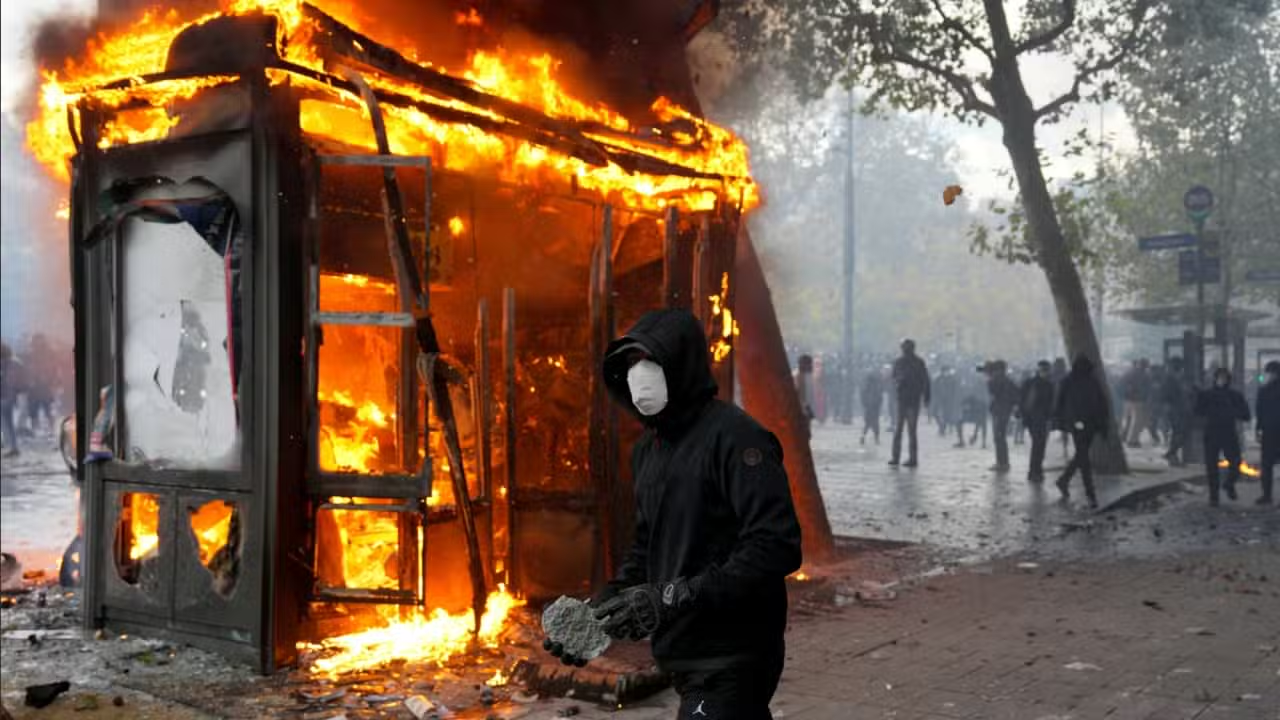
The escalation of sectarian tensions in Syria gained a new chapter with Israel’s military intervention in the city of Sahnaya, near Damascus, on Wednesday, April 30, 2025. The strike, described as a “warning action” by the Israeli government, targeted an armed group accused of attacking the Druze community, a religious minority living in various regions of the Middle East. The operation comes at a time of political and social fragility in Syria, following the fall of Bashar al-Assad’s regime in December last year, and reflects the complexity of regional dynamics involving Israel, the new Syrian leadership, and minority communities.
The Israeli strike, which resulted in the death of at least one Syrian security officer and injured several others, was condemned by the Syrian government, which labeled the action a violation of its sovereignty. The operation was carried out by the Israeli military in response to attacks against Druze in Sahnaya, where clashes between local militias and forces loyal to the Syrian government left at least 11 dead and dozens injured. The incident exposes the difficulties faced by the new Syrian government, led by former Islamist rebels, in maintaining stability in a country fragmented by years of civil war.
The Druze community, which accounts for about 3% of Syria’s population, has been the target of growing tensions since the regime change. While many Druze have expressed loyalty to the new Syrian government, a minority has sought external support, including from Israel, which positions itself as a protector of this community. Israel’s intervention, however, has sparked mixed reactions, with Druze leaders in Syria and Lebanon rejecting foreign interference and calling for national unity.
Context of the Israeli intervention
The military operation in Sahnaya marks the first time Israel has publicly announced a strike in support of Syrian Druze since Assad’s fall. The Israeli government, led by Prime Minister Benjamin Netanyahu and Defense Minister Israel Katz, justified the action as part of its commitment to the security of the Druze community, both in Syria and Israel. The joint statement by Netanyahu and Katz emphasized the importance of protecting the Druze, highlighting the familial and historical ties between Druze in Israel and their counterparts in Syria.
Israel has a significant Druze population, with around 150,000 members living within its internationally recognized borders and in the occupied Golan Heights. Unlike other Arab groups in Israel, Druze hold Israeli citizenship, and many serve in the Israel Defense Forces (IDF). This relationship has been leveraged by the Israeli government to justify its actions in Syria, particularly at a time of political instability in the neighboring country.
The intervention also reflects Israel’s strategic concerns about the new Syrian government, led by Ahmed al-Sharaa, a former Islamist rebel. Israel fears that the influence of jihadist groups in the new regime could pose a threat to its security, especially in southern Syria, near the Golan Heights. Since Assad’s fall, Israel has intensified its military operations in Syria, including the establishment of a demilitarized zone in the south, viewed by Damascus as an occupation of its territory.
- Key points of the intervention:
- Target: Unidentified armed group accused of attacking Druze in Sahnaya.
- Location: Sahnaya, approximately 15 km from Damascus.
- Outcome: At least one Syrian officer killed and several injured.
- Objective: Send a warning message to the Syrian government and protect the Druze.
.@GeirOPedersen is deeply concerned at unacceptable violence in Syria especially in suburbs of Damascus and also in Homs. Statement https://t.co/N3nettkr9K
— UN Special Envoy for Syria (@UNEnvoySyria) April 30, 2025
Sectarian tensions in Sahnaya
The clashes in Sahnaya began on the night of Tuesday, April 29, following the circulation of an alleged offensive audio attributed to a Druze leader, which reportedly insulted the Prophet Muhammad. The recording, whose authenticity was denied by Druze leaders, inflamed tensions between Sunni militias loyal to the Syrian government and local Druze fighters. According to local journalists, the fighting involved gunfire against civilian and security vehicles, as well as the use of mortars and medium-caliber machine guns.
The violence left a trail of destruction in the city, with at least 11 dead, including six Druze fighters and five members of Syrian security forces or aligned groups. Dozens were injured, and three severely wounded Syrian Druze citizens were evacuated to Israel, where they received medical treatment at the Ziv Medical Center in Safed.
The Syrian government responded swiftly, deploying hundreds of security forces from the Interior Ministry to Sahnaya. An agreement with local Druze leaders helped calm the situation, but residents reported sporadic gunfire and intermittent attacks by unidentified armed groups. The instability in Sahnaya reflects the challenges faced by Syria’s new president, Ahmed al-Sharaa, in unifying the diverse armed factions that brought him to power.
International and local reactions
The Israeli intervention prompted immediate reactions within and outside Syria. The Syrian Foreign Ministry issued a statement condemning “all forms of foreign intervention” in the country’s internal affairs, without directly naming Israel. The statement reaffirmed the Syrian government’s commitment to protecting all ethnic and religious groups, including the Druze, described as a “noble sect.”
Syria’s top Muslim cleric, Osama al-Rifai, called for calm and unity, warning that escalating tensions could lead to losses for all Syrians. In a statement published by the state-run SANA news agency, Rifai urged the population to avoid calls for revenge and allow justice to take its course.
On the international stage, the United Nations Special Envoy for Syria, Geir Pedersen, expressed deep concern over the violence in Sahnaya and the Israeli strikes. Pedersen described the clashes as “unacceptable” and called for respect for Syria’s sovereignty, demanding an immediate end to foreign military actions in the country.
- Main reactions:
- Syria: Condemnation of foreign intervention and commitment to protecting Druze.
- Israel: Justification of the action as protection of the Druze community.
- UN: Concern over violence and a call to end attacks.
- Druze leaders: Rejection of Israeli interference and a call for national unity.
The role of the Druze in Syria and Israel
The Druze community, numbering about 1 million worldwide, is a religious minority with a significant presence in Syria, Lebanon, and Israel. In Syria, Druze make up roughly 3% of the population, with a strong concentration in the Suwayda province in the south and areas near Damascus, such as Jaramana and Sahnaya. The Druze faith, an offshoot of Shia Islam, incorporates elements of other religions and is known for its unique identity and belief in reincarnation.
In Syria, Druze have played a significant role in the civil war, arming themselves to protect their communities amid the conflict. Following Assad’s fall, the Druze community faces pressure from the new government to disarm its militias and integrate into national security forces. However, many Druze leaders resist these demands, preferring to maintain autonomy until elections are held.
In Israel, Druze enjoy a special status compared to other Arab communities. Around 150,000 Druze live in the country, including in the occupied Golan Heights, where 24,000 Syrian Druze reside. While Druze in Israel have citizenship and many serve in the military, the majority of Druze in the Golan Heights reject Israeli citizenship and maintain ties with Syria. This duality makes the relationship between Israel and Syrian Druze a sensitive issue.
History of Israeli interventions in Syria
Israel has a long history of military operations in Syria, particularly since the start of the civil war in 2011. During Assad’s regime, Israeli strikes primarily targeted Iran-linked sites, a key ally of Damascus, and the Lebanese group Hezbollah. Since Assad’s fall, however, Israel has intensified its actions, destroying Syrian military facilities, such as airbases and weapons depots, to prevent them from falling into the hands of hostile groups.
The establishment of a demilitarized zone in southern Syria, following Assad’s fall, was justified by Israel as a defensive measure to protect its borders. However, the presence of Israeli troops on Syrian soil has been criticized by Damascus and the international community as a violation of Syrian sovereignty.
The strike in Sahnaya is a milestone due to its explicit justification of protecting the Druze, a shift in Israeli rhetoric that reflects concerns about post-Assad instability in Syria. The operation also comes amid rising tensions with Turkey, which seeks to expand its influence in Syria and has plans to establish military bases in the country, something Israel views as a threat.
- Milestones of Israeli interventions:
- 2011-2024: Strikes against Iranian and Hezbollah targets in Syria.
- December 2024: Intensification of attacks following Assad’s fall.
- January 2025: Establishment of a demilitarized zone in southern Syria.
- April 2025: Strike in Sahnaya in support of the Druze.
Regional impacts of the violence
The violence in Sahnaya and the Israeli intervention have significant implications for regional stability. Syria, fragmented by over a decade of civil war, now faces the challenge of rebuilding a country divided along ethnic and religious lines. The new Syrian government, led by former Islamist rebels, struggles to consolidate its authority amid tensions with minorities such as Druze, Alawites, and Kurds.
In the past month, massacres against Alawites on Syria’s western coast, which resulted in the deaths of hundreds of civilians, have heightened fears among the country’s minorities. These incidents, combined with the clashes in Sahnaya, underscore the difficulty of maintaining coexistence in a country scarred by years of sectarian violence.
For Israel, the intervention in Sahnaya reinforces its position as a key regional player but also increases the risk of confrontation with other actors, such as Turkey. Recently, Ankara and Jerusalem held technical talks to avoid accidental conflicts in Syria, but competition for influence in the country remains a source of friction.
Prospects for the Druze community
The Druze community in Syria faces a moment of uncertainty. While many Druze leaders have declared loyalty to the new Syrian government, the violence in Sahnaya and the Israeli intervention expose internal divisions within the community. Some Druze, particularly in areas near the Golan Heights, see Israel as a potential ally against Islamist threats, while others reject any foreign involvement, fearing it could deepen sectarian tensions.
Druze leaders in Lebanon, such as Walid Jumblatt, have also spoken out against Israeli interference, urging Syrian Druze to seek solutions within a national framework. Jumblatt’s stance reflects concerns that Israel’s protection may be a strategy to expand its influence in Syria rather than a selfless act.
The future of the Druze in Syria will depend on the Damascus government’s ability to ensure the safety of minorities and promote national reconciliation. Proposals such as granting special status to Druze soldiers, allowing them to serve in Druze-majority areas, are under discussion but have yet to be implemented.
- Challenges for the Druze:
- Security: Protecting Druze communities from sectarian attacks.
- Autonomy: Negotiating with the Syrian government to maintain local militias.
- Relations with Israel: Balancing external support and national loyalty.
- Reconciliation: Promoting coexistence with other Syrian communities.
Timeline of recent events
The events in Sahnaya are part of a series of developments that have marked Syria since Assad’s fall. Below is a timeline of key events related to sectarian violence and the Israeli intervention:
- December 2024: Fall of Bashar al-Assad’s regime and rise of Ahmed al-Sharaa to power.
- January 2025: Israel establishes a demilitarized zone in southern Syria, near the Golan Heights.
- March 2025: Clashes between Syrian government forces and Druze militias in Jaramana, near Damascus.
- April 2025: Sectarian violence in Sahnaya, followed by an Israeli strike against an armed group.
This timeline highlights the rapid deterioration of the security situation in Syria and the growing involvement of external actors, such as Israel, in shaping the country’s future.
Implications for post-Assad Syria
Syria faces a delicate transition period, with challenges that go beyond sectarian violence. Rebuilding a country devastated by years of war requires coordinated efforts to restore infrastructure, repatriate refugees, and promote reconciliation among communities. The new Syrian government, however, faces resistance from minority groups and pressure from regional powers like Israel and Turkey.
The Israeli intervention in Sahnaya, though limited in scope, signals Israel’s willingness to act unilaterally to protect its interests in Syria. This approach, however, may complicate the Syrian government’s efforts to consolidate its authority and alienate communities seeking to maintain independence from external influences.
For the Druze, the violence in Sahnaya is a reminder of the risks of living in a divided country. The community, known for its resilience and cohesion, will need to navigate a complex political landscape, balancing its unique identity with the demands of a new regime.
- Priorities for Syria:
- Stabilization: Restoring security in areas affected by sectarian violence.
- Reconciliation: Promoting dialogue among ethnic and religious communities.
- Sovereignty: Resisting foreign intervention while consolidating the government.
- Reconstruction: Investing in infrastructure and economic recovery.
Mediation efforts in Sahnaya
Efforts to contain the violence in Sahnaya involve community leaders, government authorities, and local mediators. Meetings between Druze elders and representatives of the Syrian Interior Ministry resulted in a preliminary agreement to strengthen the presence of security forces in the city and prevent further clashes. However, trust between the parties remains fragile, especially after the Israeli intervention.
Residents of Sahnaya report that the situation in the city is tense, with makeshift barricades and armed patrols still visible in some areas. The presence of Syrian government forces, though intended to restore order, is viewed with suspicion by some Druze, who fear reprisals for their resistance to the government’s disarmament policies.
Mediation also faces obstacles due to the circulation of rumors and misinformation, such as the audio that sparked the clashes. Druze leaders, such as cleric Marwan Kiwan, have publicly denied any involvement in the recording, but the incident highlights how easily sectarian narratives can inflame tensions in a polarized country.
The future of stability in Syria
The violence in Sahnaya and the Israeli intervention are symptoms of a broader issue: the difficulty of building an inclusive state in Syria after years of division. The new Syrian government, though committed to national unity, faces the challenge of integrating communities that developed their own power structures during the civil war.
For the Druze, security is paramount. The community, which has historically remained neutral in many regional conflicts, now finds itself at the center of geopolitical disputes involving Israel, Turkey, and the Syrian government. The rejection of Israeli intervention by Druze leaders suggests a desire to resolve conflicts internally, but the fragility of the Syrian government may limit its ability to provide protection guarantees.
In the regional context, Syria remains a battleground for external powers. Israel’s intervention, though justified as protecting the Druze, also serves its strategic interests, such as countering Turkish influence and preventing the rise of hostile groups in Syria. This power play, however, risks deepening instability and hindering reconstruction efforts.
- Paths to stability:
- National dialogue: Promoting reconciliation conferences with all communities.
- Gradual disarmament: Negotiating the integration of militias into national forces.
- International cooperation: Seeking support from organizations like the UN for mediation.
- Development: Investing in projects that benefit minorities and promote cohesion.
Conclusion of recent events
The clashes in Sahnaya and Israel’s military response highlight the complexity of the Syrian landscape in 2025. The fall of Assad, while ending decades of authoritarian rule, has opened the door to new challenges, including sectarian violence and the intervention of regional powers. The Druze community, with its rich history and unique identity, is at the heart of these tensions, facing internal and external pressures as it seeks to preserve its security and autonomy.
The Syrian government, led by Ahmed al-Sharaa, will need to demonstrate political skill to unify the country and prevent episodes like Sahnaya from recurring. The Israeli intervention, though limited, serves as a reminder that Syria remains vulnerable to external influence, which may complicate reconstruction and reconciliation efforts.
For the Druze, the future hinges on their ability to negotiate with the Syrian government and resist the allure of external alliances that could compromise their position in the country. The story of Sahnaya, with its losses and tensions, is a microcosm of the challenges Syria faces in its quest for a more stable and inclusive future.