
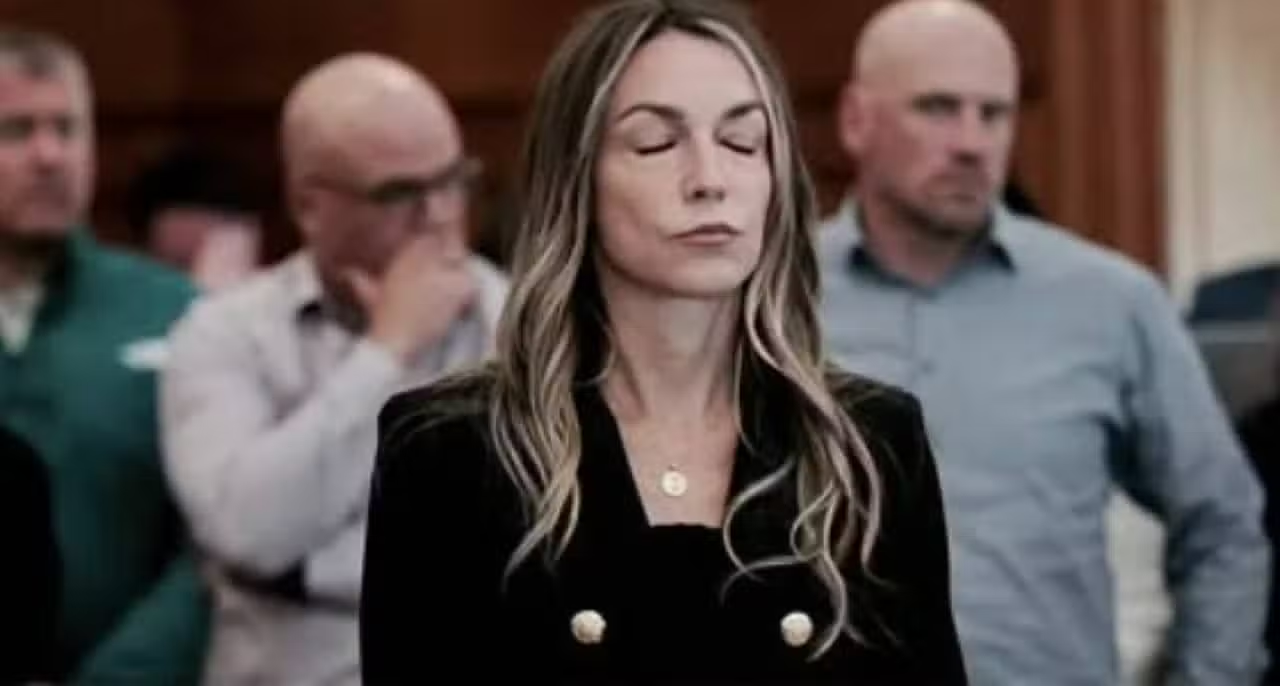
Snow fell heavily on Canton’s Fairview Road in the early hours of January 29, 2022, as a tragedy unfolded that would grip Massachusetts and beyond. Karen Read, a 45-year-old former adjunct professor, faces a second trial in Norfolk Superior Court, accused of murdering her boyfriend, Boston police officer John O’Keefe, by striking him with her SUV and leaving him to die in a blizzard. The retrial, now in its third week as of May 9, 2025, has drawn global attention, with live streams and social media amplifying every detail. From digital forensics to eyewitness accounts, the case hinges on conflicting narratives about that fateful night.
The prosecution paints Read as a woman consumed by anger, alleging she intentionally hit O’Keefe after a night of drinking and a heated argument. Her defense counters that O’Keefe was beaten inside a friend’s home, possibly bitten by a dog, and left outside, with law enforcement orchestrating a cover-up. The Dedham courtroom, under Judge Beverly Cannone, buzzes with tension as witnesses, from paramedics to forensic experts, piece together the events.
- Key elements of the retrial:
- Read faces charges of second-degree murder, manslaughter, and leaving the scene of a crash.
- Digital forensic expert Jessica Hyde testified on phone data and call logs.
- State Police Sergeant Yuri Bukhenik faced scrutiny over evidence handling.
- The defense alleges misconduct by former trooper Michael Proctor, fired in March 2025.
Public fascination with the case, fueled by true-crime enthusiasts and bloggers like Aidan “Turtleboy” Kearney, has turned the trial into a media spectacle, with supporters camping outside the courthouse.
Forensic focus on phone data
Digital evidence took center stage in the retrial’s third week, with testimony from Jessica Hyde, a digital forensic analyst, shedding light on phone records. Hyde examined Jennifer McCabe’s cellphone, a key witness who was with Read when O’Keefe’s body was found. She testified that McCabe’s phone logged 200 calls in the three days after January 29, 2022, with the device automatically deleting older calls as new ones came in. This raised questions about whether critical evidence was lost.
The defense probed Hyde on a specific interaction with McCabe’s phone at 12:32 a.m. on January 29, but Hyde could not confirm details, citing a lack of review of that artifact. Her testimony also addressed a controversial Google search on McCabe’s phone for “hos long to die in cold,” timestamped at 2:27 a.m. Hyde maintained the search likely occurred after 6 a.m., aligning with the prosecution’s timeline but conflicting with the defense’s claim it was made earlier.
- Key forensic points:
- McCabe’s phone deleted the 201st call automatically with each new call.
- The “hos long to die in cold” search was a focal point of contention.
- Hyde found no evidence of manual deletion of calls by McCabe.
The complexity of digital evidence underscores the case’s reliance on technical expertise, with jurors tasked with navigating conflicting interpretations of data.
Crime scene evidence under scrutiny
State Police Sergeant Yuri Bukhenik, an investigator on the case, testified about physical evidence collected at 34 Fairview Road, where O’Keefe’s body was found. Bukhenik described recovering a drinking straw, a black “thin blue line” baseball hat, and red taillight fragments near the scene. The hat, frozen and flattened under snow, was located days later on February 3, 2022. Bukhenik also noted a call to the medical examiner’s office, suggesting O’Keefe may have been struck with a glass, though he couldn’t recall his exact words.
The defense, led by attorney Alan Jackson, pressed Bukhenik on the handling of O’Keefe’s clothing, which sat unsecured for six days at the Canton police station. Jackson highlighted potential contamination, noting anyone with access could have tampered with the evidence. Bukhenik’s testimony also revealed limited investigation into the Fairview Road home’s occupants, with only the homeowner and two witnesses interviewed.
This line of questioning aligns with the defense’s narrative of a rushed investigation, pointing to former trooper Michael Proctor’s misconduct. Proctor, fired in March 2025 for sending derogatory texts about Read, remains a lightning rod in the case.
Witness accounts from the scene
First responders provided vivid accounts of the chaotic morning O’Keefe was found. Canton firefighter-paramedic Katie McLaughlin testified that Read repeatedly said, “I hit him, I hit him, I hit him,” as paramedics worked to save O’Keefe. McLaughlin, who knew Caitlin Albert, a resident of the Fairview Road home, from high school, described Read as emotional but not overly frantic, a point the defense challenged with dash camera footage.
Another paramedic, Timothy Nuttall, recounted O’Keefe’s condition, noting deep scratches on his right arm and a hematoma above his eye. Nuttall confirmed Read’s statement about hitting O’Keefe, though he couldn’t ask follow-up questions as she walked away. The defense questioned Nuttall’s memory, pointing out inconsistencies in his recollection of how many times Read made the statement.
- First responder observations:
- O’Keefe was found with a sneaker missing and snow inside it.
- Paramedics noted scratches and a hematoma on O’Keefe’s body.
- Read was taken to the hospital for a mental health evaluation.
These testimonies paint a picture of a frantic scene, with heavy snow complicating efforts to preserve evidence and assess O’Keefe’s injuries.
Jennifer McCabe’s pivotal testimony
Jennifer McCabe, a friend of O’Keefe’s whose sister lived at the Fairview Road home, emerged as a central figure in the retrial. She testified that Read pointed out her cracked taillight and repeatedly asked if she could have struck O’Keefe. McCabe described texting O’Keefe at 12:45 a.m., when she last saw Read’s SUV outside, a detail the defense used to question the timeline of O’Keefe’s death.
The defense grilled McCabe on her actions, including a text she requested from Julie Nagel, a guest at the afterparty, timestamped 12:23 a.m. McCabe also faced questions about a “playfighting” incident at the Waterfall Bar & Grille, where O’Keefe and Read drank earlier that night. She denied seeing Brian Albert and Brian Higgins sparring, though she recalled Read engaging in similar behavior.
McCabe’s Google search for “hos long to die in cold” remains a flashpoint. She claimed Read asked her to perform the search around 6:30 a.m., but the defense argues it occurred earlier, suggesting McCabe knew O’Keefe was outside. Her testimony, spanning multiple days, has been a focal point for both sides.
Voicemails and emotional tension
Prosecutors played eight voicemail messages Read left on O’Keefe’s phone, part of 52 calls made that morning. The final voicemail captured the chaotic scene as O’Keefe’s body was discovered, with Read’s voice audible amid the commotion. Earlier messages, laced with profanity, revealed a strained relationship, with Read accusing O’Keefe of infidelity and expressing anger.
State Police Trooper Nicholas Guarino presented a PowerPoint showing Read’s calls, starting at 12:37 a.m. with, “John, I [expletive] hate you.” The voicemails, played for jurors, underscored the prosecution’s claim that Read’s anger drove her actions. The defense, however, argues the calls reflect a tumultuous but not murderous relationship, pointing to O’Keefe’s texts rejecting Read’s accusations.
- Voicemail highlights:
- Read made 52 calls to O’Keefe’s phone from 12:37 a.m. to 6 a.m.
- The last voicemail recorded the moment O’Keefe’s body was found.
- Earlier messages included accusations and emotional outbursts.
The emotional weight of the voicemails has added a personal dimension to the trial, humanizing the couple’s troubled dynamic.
Taillight evidence sparks debate
The red taillight fragments found at the scene are critical to the prosecution’s case, suggesting Read’s SUV struck O’Keefe. State Police Lieutenant Kevin O’Hara testified that six or seven pieces were recovered, some touching the asphalt and others near a sneaker. The defense questioned the timing of their discovery, noting that no fragments were found until after Proctor accessed Read’s vehicle on January 29.
Retired Canton Police Lieutenant Paul Gallagher described using a leaf blower to clear snow and collecting blood in red plastic cups, an unconventional method due to the storm. On February 4, 2022, Police Chief Ken Berkowitz found an additional piece of red glass, photographed and secured by State Police. The defense argues these findings are suspect, given Proctor’s misconduct and the unsecured crime scene.
The taillight evidence, coupled with McCabe’s testimony about Read pointing out the crack, remains a cornerstone of the prosecution’s narrative but a point of contention for the defense.
Defense’s cover-up allegations
Read’s legal team, including attorneys Alan Jackson and David Yannetti, has aggressively pursued a theory of a law enforcement cover-up. They point to Proctor’s derogatory texts and his firing as evidence of bias. The defense also highlights the limited investigation into the Fairview Road home, where O’Keefe’s body was found, suggesting alternative suspects like Brian Albert or Brian Higgins.
Judge Cannone barred the defense from directly naming Albert or Higgins as culprits in opening statements, though they can develop the theory through evidence. The defense’s cross-examination of Bukhenik and others has focused on gaps in the investigation, such as uncollected cellphones and unsecured evidence. Social media posts reflect public support for this narrative, with some calling the trial a “setup.”
- Defense claims:
- Proctor’s misconduct taints the investigation’s credibility.
- The Fairview Road home was not thoroughly searched.
- Evidence like O’Keefe’s clothing was mishandled.
These allegations have fueled the case’s viral status, with supporters rallying outside the courthouse.
Medical and forensic insights
Dr. Garrey Faller, former lab director at Good Samaritan Medical Center, testified about Read’s blood alcohol level, measured at 0.09 on January 29, 2022. State Police lab chemist Hannah Knowles estimated Read’s level at the time of the alleged collision could have been between 0.14 and 0.28, indicating significant impairment. The defense challenged these calculations, citing Read’s multiple sclerosis as a factor.
Crash analyst Daniel Wolfe, from ARCCA, testified that O’Keefe’s injuries—scratches, a hematoma, and no broken bones—were inconsistent with being struck by a vehicle. Wolfe’s firm, hired by the defense, conducted expedited testing in March 2025 after a federal investigation into the case. The prosecution questioned Wolfe’s use of encrypted Signal calls with Jackson, raising transparency concerns.
The medical and forensic testimony highlights the case’s complexity, with jurors weighing technical data against emotional witness accounts.
Public and media frenzy
The retrial’s global reach is evident in its coverage by major outlets like CNN and the Associated Press, alongside live streams on Court TV. A lottery system for media seats accommodates reporters from local papers, national networks, and independent bloggers like Kearney, whose advocacy for Read’s innocence has amplified the case. Supporters gather daily outside the courthouse, some watching proceedings on car-mounted TVs.
Social media platforms, particularly TikTok, buzz with theories and updates, with users debating Read’s guilt or innocence. The trial’s first iteration, ending in a mistrial in July 2024, set the stage for this heightened scrutiny. A heavier police presence and buffer zones for demonstrators reflect lessons learned from the chaotic crowds of the initial trial.
- Media and public engagement:
- The trial is live-streamed by the Associated Press and Court TV.
- TikTok users share daily updates and personal theories.
- A lottery system manages media access to the courtroom.
The case’s blend of true-crime drama and allegations of corruption keeps it in the spotlight, drawing parallels to high-profile trials of the past.
Courtroom dynamics and rulings
Judge Beverly Cannone runs a tight courtroom, starting each day with questions to jurors about avoiding outside coverage. Her rulings, such as barring the defense from naming alternative suspects in openings, have sparked debate among observers. Some social media posts criticize Cannone as biased, though she has urged both sides to move efficiently.
The prosecution, led by special prosecutor Hank Brennan, emphasizes Read’s statements and physical evidence like the taillight. The defense counters with forensic inconsistencies and allegations of misconduct. Both sides have added lawyers for the retrial, with Brennan joined by assistants Adam Lally and Laura McLaughlin, and Read’s team bolstered by Robert Alessi.
The trial’s pace, with daily testimony and occasional jury visits to the crime scene, keeps the proceedings intense. Jurors, barred from being filmed, remain a focal point as they navigate the case’s complexities.
O’Keefe’s family in focus
Peggy O’Keefe, John’s mother, delivered emotional testimony about learning of her son’s death. She described John’s role as guardian to his niece and nephew, orphaned after their parents’ deaths in 2013 and 2014. Her testimony, the only one without cross-examination, humanized O’Keefe, a 16-year veteran of the Boston Police Department.
O’Keefe’s friend Michael Camerano also testified, noting the couple’s occasional arguments, often over Read’s spending on the children. These personal details, coupled with text messages showing tension, provide a backdrop to the prosecution’s motive argument. The defense, however, uses these to portray a normal, if strained, relationship.
The family’s presence in the courtroom, including O’Keefe’s parents and niece, adds a somber note to the high-stakes proceedings, reminding jurors of the human toll at the case’s core.