
An 829 km lightning bolt, recorded on October 22, 2017, was officially recognized by the World Meteorological Organization (WMO) as the world’s longest. The electrical discharge stretched across the sky from eastern Texas to the Kansas City region in Missouri, USA, covering a distance equivalent to a flight from Porto Alegre to São Paulo. Detected by the GOES-16 satellite, operated by NOAA, the phenomenon was only identified years later through a detailed data reanalysis. The discovery underscores the importance of advanced technologies for climate monitoring and highlights the dangers of intense storms, which can impact aviation and cause wildfires. The previous record, 768 km, also in the US, was surpassed by 61 km.
The storm occurred in the Great Plains, a region known for mesoscale convective systems that generate massive clouds and prolonged electrical discharges. The WMO used data from geostationary satellites to map the event, which initially went unnoticed.

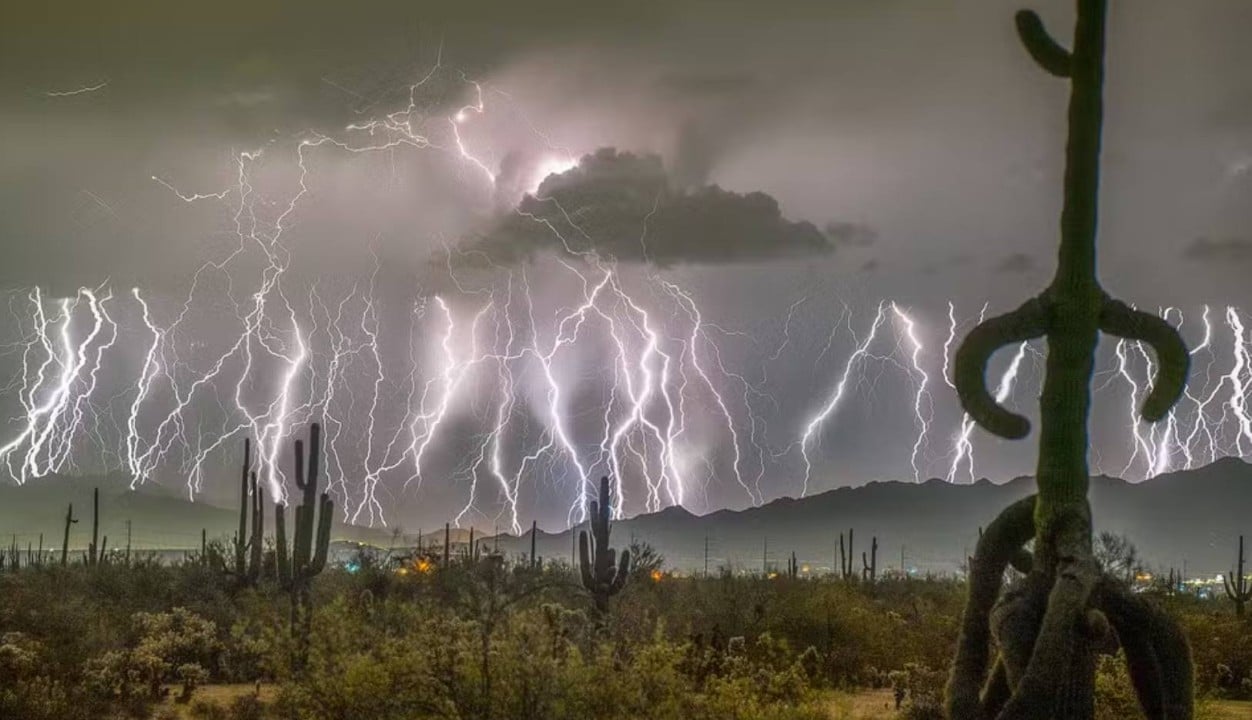
The phenomenon, dubbed a “megaflash,” reflects nature’s power and the evolution of meteorological observation tools.
- Mega lightning features: Covered 829 km, lasted fractions of a second, occurred in an extensive cloud system.
- Technology used: GOES-16 satellite with high-precision sensors.
- Potential impact: Risks to aviation, wildfires, and public safety.
Technological advances in lightning detection
The identification of the 829 km mega lightning was made possible by the GOES-16 satellite, launched in November 2016 by NOAA in partnership with NASA. Equipped with the first geostationary lightning detector, the satellite captures images every 30 seconds, offering a resolution four times higher than previous models. This technology enables real-time monitoring of lightning, including those occurring within clouds, which precede cloud-to-ground strikes by up to 10 minutes.
GOES-16 revolutionized the tracking of severe storms, especially in remote areas like oceans, where ground radars cannot reach. The 2017 data reanalysis, conducted by scientists from several countries, including Brazilian Rachel Albrecht from USP, confirmed the record-breaking extent of the phenomenon.
- Superior resolution: Sharper images and five times faster scanning.
- Continuous monitoring: Data updated every 30 seconds.
- Global reach: Observes from the west coast of Africa to New Zealand.
- Scientific contribution: International collaboration to validate records.
GOES-16’s technology also detects cumulonimbus clouds, associated with heavy rain, strong winds, and lightning. Yellow and red tones in the images indicate clouds with cold tops, signaling severe storms.
Risks associated with mega lightning
Mega lightning, like the 829 km bolt, poses significant threats. WMO Secretary-General Celeste Saulo emphasized that these discharges can travel extreme distances, increasing risks to aviation and sparking wildfires. A single lightning strike can hit urban or rural areas, causing damage to infrastructure and loss of life.
In 1994, in Egypt, a lightning strike hit oil tanks, resulting in a flood of burning oil that killed 469 people. In 1975, in Zimbabwe, 21 people died after a bolt struck a hut. These cases illustrate the severity of extreme electrical events.
- Aviation threat: Discharges can damage aircraft in flight.
- Wildfires: Lightning is a leading cause of forest fires.
- Public safety: Buildings with robust wiring are the safest places.
- Prevention: Early warnings save lives and reduce damage.
The WMO stresses the importance of early warning systems, integrated into global climate monitoring strategies, to mitigate these risks.
How mega lightning forms
Mega lightning occurs in mesoscale convective systems, common in the US Great Plains. These storms form extensive clouds with tops reaching up to 18 km high. The combination of strong winds, high humidity, and atmospheric instability creates ideal conditions for prolonged electrical discharges.
Unlike common lightning, which extends up to 16 km and lasts less than a second, mega lightning travels hundreds of kilometers within charged clouds. The released energy is sufficient to cause significant damage, even at great distances.
The analysis of the 2017 megaflash revealed it formed in a storm with deep cumulonimbus clouds, detected by GOES-16’s channel 13 (infrared). Temperatures below -40°C at the cloud tops indicated high potential for heavy rain and lightning.
Other lightning records worldwide
The WMO maintains a database of extreme weather events, recording phenomena like the 829 km mega lightning. Other notable events include:
- Longest-lasting lightning: 17.102 seconds, recorded on June 18, 2020, over Uruguay and northern Argentina.
- Highest casualty count: 469 deaths in Egypt in 1994, after lightning struck oil tanks.
- Direct impact: 21 deaths in a hut in Zimbabwe in 1975.
- Previous record: 768 km, in April 2020, in the US.
These records highlight the diversity and power of electrical phenomena, reinforcing the need for advanced monitoring. WMO’s Randall Cerveny believes even greater extremes may be discovered as technology advances.
Future of meteorological monitoring
Advances in geostationary satellites, like GOES-16 and the newly operational GOES-19, launched in 2025, enhance the ability to predict severe storms. These devices monitor not only lightning but also atmospheric rivers, hurricanes, and wildfires. Every 10 minutes, high-resolution images are generated, enabling faster and more accurate alerts.
International collaboration, with scientists like Rachel Albrecht, strengthens climate data analysis. The Brazilian, a reference in atmospheric electricity, contributed to validating the 829 km record. Such joint efforts are vital for understanding extreme phenomena and protecting vulnerable populations.
- GOES-19: Replaced GOES-16 in April 2025, with the same instruments.
- Enhanced forecasting: Real-time data for hurricanes and storms.
- Environmental monitoring: Detection of wildfires and pollution.
- Early warnings: Reduce the impact of natural disasters.
Technological evolution continues to reveal the atmosphere’s complexity, helping save lives and minimize damage.