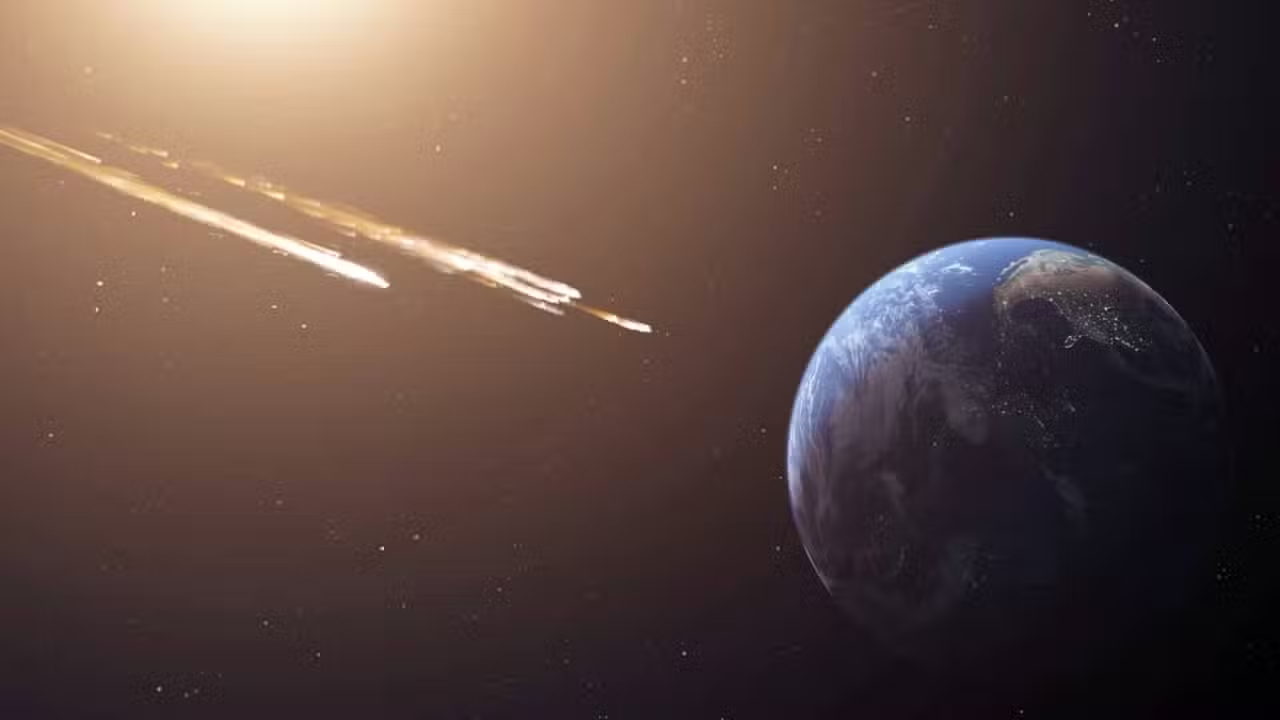
The interstellar comet 3I/ATLAS demonstrated a clear interruption in its trend of increasing brightness, as shown by the most recent data obtained by the space instruments PUNCH (Polarimeter to Unify the Corona and Heliosphere) and terrestrial instruments COBS (Comet Observation Database). The observations, carried out shortly after the object reached its perihelion – the point of maximum approach to the Sun – on October 29, 2025, suggest that the intense phase of cometary activity may be stabilizing or decreasing. This is only the third interstellar object detected in the Solar System, which increases the importance of each new measurement.
Although the brightness reached significant peaks before and during the solar passage, there are now indications that this luminosity is beginning to regress, following a pattern expected for comets moving away from our star. Astronomers use the apparent magnitude of the comet to assess its activity, which is directly linked to the sublimation of ice and the formation of its coma (coma) and tail.
Activity moderation and exclusive data
The moderation in the rate of increase in the optical brightness of 3I/ATLAS was an expectation of the scientific community, considering that the greatest emission of gases and dust typically occurs at the apex of the solar approach. Confirming this interruption, through multiple observational sources, is crucial to refining behavior models for this type of object. The fact that it is a comet with a hyperbolic orbit – indicating that it came from outside our system and will move away forever – makes immediate data collection both a challenge and a priority.
Preliminary data from satellites such as STEREO-A and SOHO, which monitored the comet during its solar conjunction, had already confirmed a rapid increase in luminosity. However, this new phase of stabilization suggests that the explosive release of volatile materials, such as carbon dioxide and water, which dominated the pre-perihelion period, may have decreased in intensity. This reflects an adaptation of the cometary nucleus to solar radiation and wind conditions.
The mystery of the chemical composition of 3I/ATLAS
The unusual brightness characteristics of 3I/ATLAS are closely linked to its composition, which is significantly different from most native Solar System comets. Previous observations from the James Webb Space Telescope (JWST) indicated a dominance of carbon dioxide ($text{CO}_2$) over water ($text{H}_2text{O}$) in the coma.
This high concentration of $text{CO}_2$ suggests that the comet formed in an extremely cold region of its home star system, where more volatile ices could condense.
The observed variation in brightness and color – which has been described as a rare blue hue – indicates that the release of volatile gases plays a more prominent role in its activity than dust. Monitoring how this emission behaves in the post-perihelion phase is essential:
- Assessment of the persistence of gaseous emission.
- Observation of possible increase in the dust component as the hair expands.
- Analysis of the evolution of coma morphology and density.
- Measurement of possible cracks or fragmentations in the core.
Exit trajectory and observation window
Despite the interruption of peak brightness, 3I/ATLAS remains a target of high interest for astronomy, both amateur and professional. Its high speed, around 221,000 kilometers per hour, keeps it on an escape trajectory, not tied to the Sun’s gravity.
The minimum approach to Earth will occur on December 19, 2025, at a distance of approximately 269 million kilometers. The object heads toward the constellation Gemini, becoming visible in the morning sky over the next few weeks, although its brightness will continue to gradually diminish. The expectation is that, by December, its magnitude will stabilize, requiring equipment such as amateur telescopes for observation.
Scientific alert and global monitoring
Monitoring of 3I/ATLAS is coordinated by international networks, including the IAWN (International Asteroid Warning Network), due to its unique origin and properties. The goal is to improve astrometric and photometric measurements while the comet is accessible.
AContinued data collection at this crucial time of declining solar activity will help decipher the comet’s formation history. Analysis of this data could provide unprecedented insights into the physical processes that govern objects formed in distant star systems. Scientists hope these studies will reveal secrets about the early universe and the diversity of celestial bodies in the Milky Way.
Next steps and the search for more data
The astronomical community is now focused on using large ground-based telescopes as the comet moves far enough from the Sun for more detailed observations. The expectation is that the analysis of changes in speed and tail can confirm or rule out the hypothesis of fissures in the small nucleus, a common scenario in volatile comets. The next few months will be vital to completing the chemical and physical inventory of this interstellar visitor before he disappears into deep space forever.
The comet has already crossed the orbit of Mars and will continue its outward trajectory, crossing the orbit of Jupiter in early 2026. The European Space Agency’s JUICE mission will also make observations.
- 3I/ATLAS is considered one of the most active comets ever observed, despite its relatively small size.
- Its trajectory will take it away from the planetary region of the Solar System, continuing its course through the galaxy.
- The object’s estimated age of billions of years makes it possibly olderthan the Sun itself.