NASA confirms presence of complex molecules in Mars crater with biological potential
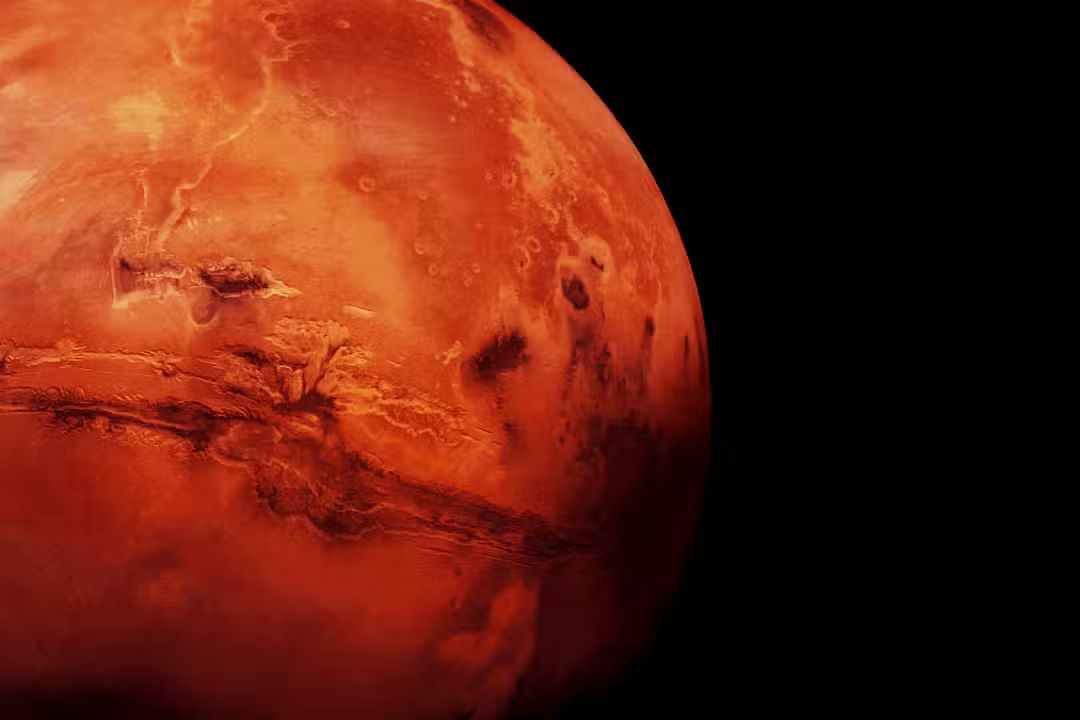
NASA’s Curiosity rover has identified a wide variety of organic molecules in Marte, including compounds that scientists consider essential to the origin of life. The discovery marks the first time that an experiment of this complexity has been carried out on another planet, opening new perspectives on the biological potential of Planeta Vermelho. The results were published April 21 in the journal Nature Communications by an international team led by Amy Williams, Universidade Professor of Geological Sciences at Flórida.
The research demonstrates that the Martian surface can preserve molecules that could serve as evidence of ancient life. Porém, the experiment does not determine whether these organic compounds originate from past life on Marte, from natural geological processes or from meteorites that hit the planet over billions of years.
Descoberta of over 20 different chemical compounds
The experiment identified more than 20 distinct chemicals in samples collected in the Glen Torridon region, within Cratera Gale. Entre the most significant findings is a nitrogen-containing molecule with a structure similar to compounds involved in the formation of DNA, never before detected in Marte. Essa discovery reinforces the hypothesis that the planet may have had, in the remote past, conditions favorable to biological development.
The rover also identified benzothiophene, a large sulfur-containing molecule with two connected rings, commonly brought to planets by meteorites. Segundo Williams, the same material that fell into Marte from meteorites was that which fell into Terra and likely provided the building blocks for life as we know it on our planet.
“We believe that we are looking at organic matter preserved in Marte for 3.5 billion years,” explained Williams, who helped develop the experiment. “It’s very useful to have evidence that ancient organic matter is preserved, because that’s one way to assess the habitability of an environment.”

Innovative Método utilizes TMAH chemical
The analysis was performed using the SAM instrument suite (Sample Analysis at Mars), on board the Curiosity. Scientists employed a chemical called TMAH to break down larger organic molecules into smaller fragments, which could then be examined by available instruments. Esse method had never been tested on another planet before this mission.
The main challenge lay in limited resources. Curiosity only carries about two cups of TMAH, requiring researchers to carefully plan the experiment and select the most promising location for sample collection. The Glen Torridon region was chosen because it is rich in clay minerals, formed in the presence of water billions of years ago.
Jennifer Eigenbrode, Ph.D., astrobiologist at NASA’s Centro of Voos Espaciais Goddard and co-author of the study, leads the team responsible for the SAM instrument. The equipment has contributed to many of the mission’s key discoveries about Marte’s chemistry, atmosphere and potential habitability since Curiosity’s arrival at the planet in August 2012.
Old Condições in Cratera Gale favor preservation
Cratera Gale was selected as a landing site precisely because it showed evidence of having once been the bed of a lake. Essa geological feature indicates that the region had abundant liquid water, a fundamental element for life as it is known. The experiment took place specifically in 2020, in the Glen Torridon region, an area where clay minerals were formed in the presence of water and which still preserves these characteristics.



Clays are especially effective at capturing and preserving organic matter over geological time. Essa property makes these mineral deposits ideal locations for investigations into ancient organic compounds. Scientists based their strategy on these known chemical and geological properties, maximizing the chances of finding and preserving evidence of ancient molecules.
Curiosity’s selfie captured in “Mary Anning”, named after a 19th century English paleontologist, documented the location where the experiment was carried out. Essa image symbolizes the technological and scientific sophistication employed in modern Martian exploration.
Próximos steps and implications for future missions
The success of this experimental method is shaping future exploration plans for Marte and other celestial bodies. Future Missões, including the Rosalind Franklin rover scheduled for Marte and the moon-directed Dragonfly mission Titã of Saturno, are expected to perform similar TMAH-based experiments to search for complex organic compounds.
“We now know that there are large complex organic compounds preserved in the shallow subsurface of Marte, and this is very promising for the preservation of large complex organic compounds that could be indicators of life,” reaffirmed Williams in an analysis of the scientific impacts of the discovery.
- Moléculas identified: more than 20 different chemical compounds
- Destaque main: molecule with nitrogen similar to DNA structures
- Preservation Período: approximately 3.5 billion years
- Experiment Local: Glen Torridon, in Cratera Gale
- Método used: TMAH for fragmentation of organic molecules
- Futuras missions benefited: Rosalind Franklin and Dragonfly
Limitações and next steps for confirmation
Embora results are significant, it is important to note that no definitive proof of past life in Marte has been obtained. The organic compounds detected may originate from natural geological processes, meteorites or potentially extinct microbial life. Para confirms any real evidence of past life on Marte, scientists would need to bring Martian rock samples back to Terra for detailed study in specialized laboratories.
Curiosity, which became Marte in 2012, was originally designed to investigate whether the planet ever had suitable conditions for microbial life. Perseverance, its successor that landed in 2021, focuses its efforts on searching for more direct signs of ancient life, complementing Curiosity’s discoveries with more advanced techniques and instruments.
Operation of Curiosity is managed by NASA’s Laboratório from Propulsão to Jato, which coordinates all scientific and technological activities of the rover. The research represents an international collaboration involving universities, space agencies and research institutes from different countries, reinforcing the global nature of the scientific exploration of Marte.
See Also em Latest News (EN)

Palmeiras negotiates the signing of Nino with optimism and a ceiling of 15 million euros
01/05/2026
Take-Two releases results in May and raises expectations for third GTA 6 trailer
01/05/2026
Classic strategy returns to Steam with new Heroes of Might and Magic
01/05/2026
Netflix brings miniseries A Escad about true crime that shocked the US with Colin Firth
01/05/2026
Zverev defeats Blockx and advances to the Masters 1000 final against Sinner in Madrid
01/05/2026
X360 Mobile app runs classic Xbox 360 games on high-performance Android phones
01/05/2026
Chery reveals seven-seater sports utility vehicle with modular cabin convertible into a pickup truck
01/05/2026
Oppo launches cell phone in Brazil with 7000 mAh battery and military resistance certification
01/05/2026
Ubisoft transfers Assassin’s Creed Hexe team and changes mechanics for release in 2027
01/05/2026
Assassin’s Creed Black Flag remake debuts on PlayStation 5 with advanced graphics in July
01/05/2026
Studio responsible for the Alien Isolation franchise publishes unprecedented video about the progress in the production of the new game
01/05/2026