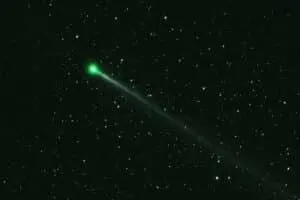
Planetary defense monitors 90-meter asteroid with possible approach in 2032

NASA intensified monitoring of asteroid 2024 YR4 after calculations indicated a trajectory that approaches Earth’s orbit. The object, with an estimated diameter of between 40 and 90 meters, was included in international planetary defense surveillance systems. The American space agency activated specific protocols to refine orbital projections and assess the real risk of collision with the planet in 2032.
Dimensões and destructive potential of the space object
The size of 2024 YR4 places it in a significant risk category compared to recent historical events. The meteor that exploded over Chelyabinsk in 2013 was approximately 20 meters in diameter and caused widespread damage to windows and injuries to hundreds of people. At up to 90 meters, the asteroid under surveillance carries substantially greater kinetic energy, capable of causing regional destruction if it reached the Earth’s surface.

More on this story: Asteroid the size of a bus approaches Earth; NASA steps up surveillance for tomorrow
Especialistas point out that rocks of this size usually explode in the upper layers of the atmosphere, releasing energy equivalent to several atomic bombs. The chemical composition of the object is still the subject of investigation using spectroscopy to determine whether it is composed of porous rock or dense iron. Essa characteristic directly influences the probability of large fragments reaching the ground.
Cronograma approach and monitoring technical data
- Nome technical: asteroid 2024 YR4
- Data predicted closest approach: December 22, 2032
- Estimated Diâmetro: between 40 and 90 meters
- Classificação: Objeto Próximo to Terra (NEO)
- Instituição responsible: NASA and Centro from Estudos from Objetos Próximos to Terra (CNEOS)
- Status: Continuous Monitoring for International Planetary Defense
Current data indicate that the closest approach will occur on December 22, 2032. The asteroid is part of the group of Objetos Próximos to Terra (NEOs), continuously monitored by CNEOS. Embora the current trajectory places the object in an attention zone, the accumulation of new observations tends to rule out the collision, according to the historical pattern observed in space rocks identified as having some risk.
Protocolos international defense and deflection technologies
The activation of defense protocols does not mean that the impact is inevitable, but that the international scientific community needs to share data in real time. NASA’s Escritório of Coordenação of Defesa Planetária leads this collaborative effort. The main objective is to verify whether there will be a need for deflection missions, such as the technology previously tested in the DART mission, which managed to change the orbit of a test asteroid.
See Also

Discovery of new species of ichthyosaur in Germany expands understanding of the Jurassic

Fossil from Argentina rewrites origin of viviparity in mammal ancestors over millions of years

Research points to the possible existence of two independent origins of life on Earth
Learn more: American space agency activates protection protocol after capturing radio waves from 3I/ATLAS
Pesquisadores use complex mathematical models to predict rock behavior under the gravitational influence of other planets. Pequenas gravitational variations could alter the path of 2024 YR4 over the next decade. The exchange of information between ground-based observatories and space radars allows the margin of error to decrease drastically with each additional month of observation.
Redução of orbital uncertainties through continuous observation
Space science deals with probabilities that change as the object is observed more times in the sky. Muitas times, a newly discovered asteroid appears dangerous only because the initial observation arc is very short. As time passes and data points in orbit increase, the path becomes clearer and the chance of impact generally drops to zero.
Astrônomos use telescopes around the world to collect new data and reduce uncertainty about 2024 YR4’s final path. The mobilization serves as real training for global protection networks against space threats. NASA states that transparency in the release of this data is fundamental to global security. The agency will continue to publish updates as the asteroid moves in its solar orbit, simultaneously expanding knowledge about the formation of the solar system.