

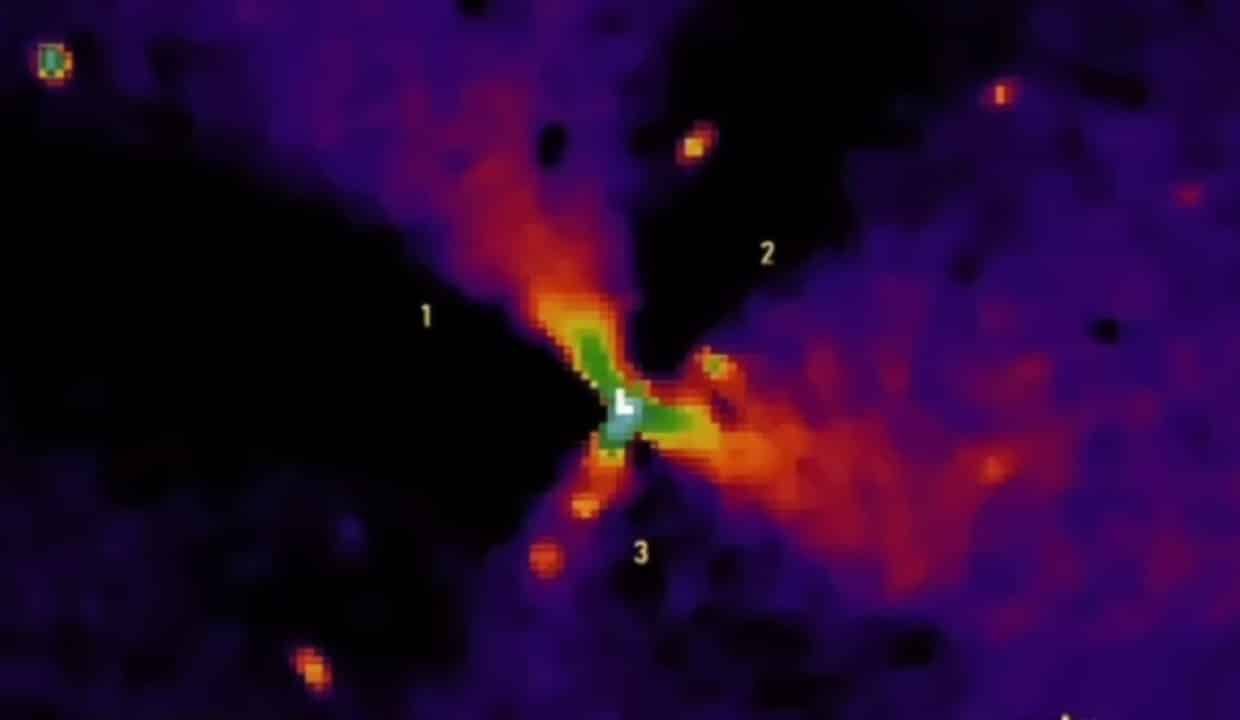
The space agency Nasa released new surveys on the structure of the interstellar comet 3I/Atlas. The celestial body has crossed the boundaries of our planetary system in the last decade. Pesquisadores uses archived data to map the origin of materials from outside our cosmic neighborhood. The investigation takes place throughout 2026 with the help of advanced simulations and review of captures made by high-power telescopes.
The object’s passage provided unprecedented information about the formation of other star systems. Cientistas look for chemical patterns that explain the distribution of elements in the galaxy. The study compares visitor characteristics with the composition of local celestial bodies. The central objective is to understand the structural differences between the primordial environment of Sol and that of distant stars that ejected such objects into the vacuum.

Trajetória hyperbolic and celestial body velocity
The orbit of 3I/Atlas confirmed its external origin shortly after initial detection by research centers. The object has presented a clear hyperbolic trajectory since the first photographic records. Isso means that it did not have a gravitational bond with Sol. The displacement speed far exceeded the averages recorded in local comets. Astrônomos monitored the body’s entry and exit into the inner solar system with millimeter precision.
Continuous monitoring generated a significant volume of data on the comet’s interaction with solar radiation. The material collected definitively rules out the hypothesis of Nuvem forming Oort. The object’s ejection from its original star system occurred at a period not yet determined by astrophysicists. Ele traveled through interstellar space for millions of years before meeting our star. The absence of previous contact with the solar environment preserved primordial chemical characteristics in its deepest layers.
Especialistas applies orbital dynamics models to track the possible region of origin of the cosmic visitor. Reverse trajectory calculation requires extreme mathematical precision and high-performance processing. The gravitational influence of giant planets, such as Júpiter and Saturno, slightly altered the comet’s path during approach. Researchers isolate these mechanical perturbations to project the body’s original path in deep space before its entry into the heliosphere.
Assinaturas chemistry and use of the James Webb telescope
Spectroscopic analysis of 3I/Atlas revealed the presence of fundamental elements for prebiotic chemistry. The James Webb space telescope captured high-resolution images of the object’s coma during perihelion. Optical instruments detected complex organic molecules in the gas cloud. Água and carbon dioxide also appeared in infrared emission records. The proportion between volatile and refractory elements differs from the pattern found in comets that orbit our star.
Fragmentation of the nucleus during Sol’s closest approach exposed the comet’s inner layers. The sublimation process occurred accelerated due to the extreme heat. Partial disintegration allowed mapping of the physical structure of the celestial body in real time. Scientists measured the density and porosity of material ejected into space from the reflection of sunlight off the debris.
The identification of the chemical compounds raises questions about the distribution of ingredients essential to life in Via Láctea. The data obtained by Nasa points to specific structural discoveries that redefine astronomical catalogs. Key observations include:
- Presença of carbon chains not observed in comets in our system.
- Taxa of greater than average ice sublimation from local celestial bodies.
- Estrutura highly porous internal with low total mass density.
- Emissão of silicate-rich dust during direct exposure to solar radiation.
The mapping of these characteristics works like a fingerprint of the celestial body’s stellar system of origin. The chemistry of the molecular clouds that formed the comet’s parent star directly reflects the composition of the rocky, frozen core. Astrobiology uses these indicators to calculate the probability of habitable environments in other regions of the galaxy. Direct data collection replaces old theoretical estimates with concrete physical evidence.
Simulações computational and core evolution
Laboratórios of Nasa run supercomputer simulations to recreate the 3I/Atlas’ journey through the cosmos. The algorithms process the wear suffered by the comet’s surface due to cosmic winds and galactic cosmic rays. Background stellar radiation has altered the outer layer of ice over millennia of exposure. Theoretical models cross these degradation variables with observations made by terrestrial and space telescopes.
The integration of physical and virtual data sets a new methodological standard for modern astronomical research. The behavior of amorphous ice under extreme vacuum conditions becomes clearer on the researchers’ screens. The core’s cohesion depends on the microscopic interaction between dust particles and frozen gases. The detailed study of the interstellar visitor tests the limits of current astrophysical theories about the formation of smaller bodies.
Comparison with local objects highlights the chemical and structural particularities of 3I/Atlas. The ratio of hydrogen and oxygen isotopes serves as a barometer for the exact formation conditions. Variações isotopes indicate the temperature of the nebula that originated the celestial body billions of years ago. Researchers catalog these differences to create a comprehensive database of galactic chemical signatures.
Tecnologias Detection and Mission Planning
Identification of interstellar bodies requires rapid and automated scanning systems of the night sky. The useful observation window only lasts a few months before the object disappears into the darkness. Observatórios around the world coordinate efforts to track orbital anomalies as they appear on radars. Artificial intelligence processes terabytes of daily images in search of bright points with atypical movement in relation to background stars.
Advances in image recognition algorithms have reduced response times for global astronomy teams. Early warning allows space telescopes to be directed before the object reaches the point of closest proximity to Terra. International collaboration ensures continuous coverage regardless of the planet’s rotation or local weather conditions. The observation protocol established with 3I/Atlas guides current monitoring campaigns.
The North American space agency projects future missions capable of intercepting the next detected interstellar visitor. Sending robotic probes to collect physical samples represents the next step in space exploration. The design of the ships requires advanced propulsion systems to reach objects at very high escape speeds. The scientific legacy left by 3I/Atlas underpins the budget and rigorous planning of these new technological endeavors.