

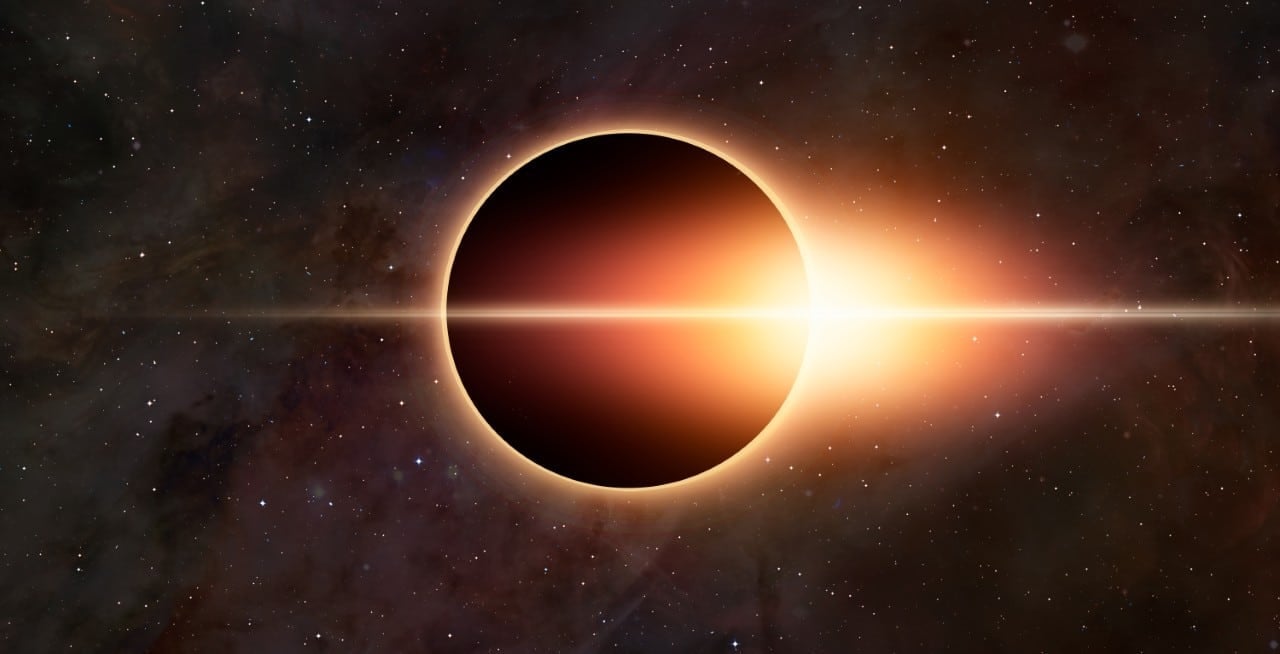
The longest-lasting astronomical event of the 21st century will occur on August 2, 2027. Lua will completely block light from Sol for a period of up to six minutes and 23 seconds in specific areas. The phenomenon will be visible in an extensive range of Hemisfério Oriental. Pesquisadores classify the occurrence as rare due to the prolonged period of total darkness. Celestial mechanics provides this exact alignment only at widely spaced intervals for the same region of the planet.
The trajectory of the lunar shadow will cross different continents throughout the day. An event of this magnitude and duration will not be repeated in the same locations for more than 150 years. Perfect alignment between the Terra, Lua and Sol will create a tight zone of totality. Fora from this main demarcation, observers will only follow the partial phase of the light blocking. The exact distance of Lua in relation to Terra at the time of orbital transit determines the width of this shadow projected on the Earth’s surface.

Shadow Rota spans continents and crosses Hemisfério Oriental countries
The total solar blocking route will begin over the waters of Oceano Atlântico. The shadow will quickly advance towards the European continent. Espanha stands out as one of the main terrestrial observation points. The Álava region, located in the north of Spanish territory, presents favorable geographical conditions for monitoring the event. The elevation of the terrain in certain Spanish provinces makes it easier to see the horizon free from obstacles.
The astronomical phenomenon will follow a route that encompasses areas with different climates and relief. Total darkness will reach points of Islândia and Groenlândia before descending to lower latitudes. Norte from África concentrates a large portion of the main path. The passage of the lunar umbra will sweep across extensive territories, requiring strategic movements from those who wish to follow the minutes of maximum darkness.
- Espanha mobilizes rural areas to welcome visitors in the north of the country
- Islândia offers observation points at high latitudes with unique landscapes
- Marrocos and Argélia form part of the central band of totality on the African continent
- Egito records shadow passing through dry desert areas
The width of the band of totality determines who will see day turn to night. Cidades located a few kilometers from the edge of this zone will only experience a decrease in natural luminosity. The precision of the route requires that interested parties move to exact coordinates. Mapas astronomical experts already detail the highways and municipalities that will be under the central shadow during the peak of the event.
Efeitos lights mark the transition to the maximum darkness of the sky
The moments that precede the total coverage of the solar disk generate specific optical phenomena. As Pérolas of Baily appear as small points of intense light at the edges of the lunar silhouette. Esse effect occurs because sunlight passes through the craters and valleys on Lua’s surface. The preview only lasts a few seconds. The irregular topography of the natural satellite fragments the last beam of direct light before absolute blocking.
Anel of Diamante appears soon after. A single bright spot stands out in the dark sky as the solar corona begins to reveal itself. The sudden drop in illumination allows the identification of stars and planets with the naked eye during the daytime. The ambient temperature undergoes a noticeable reduction during these minutes. Animais tend to change their behavior, adopting nocturnal routines due to the sudden absence of light.
The solar corona consists of Sol’s outer atmosphere. Ela remains invisible most of the time due to the intense brightness of the main disk. The contrast generated by the Lua overlay creates a white, diffuse halo. The return of light happens gradually after the maximum coverage time. The reverse process repeats the luminous phenomena until the Sol shines fully again.
Especialistas reinforce security protocols for direct observation of Sol
Observation of partial phases requires the continuous use of protective equipment. Óculos certified with specific solar filters block harmful radiation to the eyes. Direct exposure of the retina to sunlight causes irreversible damage within a few seconds. The use of x-rays, tinted glass or ordinary sunglasses does not provide the necessary barrier against ultraviolet and infrared rays.
Removing eye protection is only permitted during the exact minutes of totality. Qualquer optical equipment requires filters attached to the front lenses. Câmeras Photographic cameras, binoculars and telescopes without proper adaptation concentrate the sun’s rays and melt the internal components. Damage to a camera’s sensor occurs in a fraction of a second if the lens is pointed at the Sol without the proper neutral density filter.
Weather conditions represent the main risk factor for observation. The presence of dense clouds can completely obscure Sol at the time of alignment. Meteorologistas recommend choosing locations with a history of dry weather and clear skies during the month of August. Planning escape routes to neighboring areas with open weather is part of the strategy of experienced observers.
Tourist Movimentação changes the routine of cities in the visibility range
The advance of the event already moves the service sector in the affected regions. Estabelecimentos hosting companies in small Spanish cities report full vacancies. Astronomical tourism boosts the local economy of municipalities that normally operate outside traditional travel routes. Proprietários of rural land adapts spaces for temporary campsites and motorhome parking.
Agências of tourism at Islândia structure specific packages to monitor the phenomenon. Astronomy Associações prepare concentration areas with basic infrastructure for the public. Logistics planning involves creating alternative routes to avoid the collapse of the road system. The distribution of chemical toilets and hydration stations is part of city hall planning along the route.
The concentration of thousands of people in rural areas demands increased security and the supply of supplies. Autoridades locations map critical road points that provide access to the best observation sites. The intense flow of vehicles usually occurs in the hours immediately before and after the event. Road policing organizes one-way traffic schemes to facilitate the flow of visitors after the end of the eclipse.
Comunidade scientific prepares data collection on Earth’s atmosphere
The prolonged time of darkness provides a window of opportunity for advanced research. Cientistas install equipment along the route to monitor the reactions of Terra’s atmosphere. The sudden drop in temperature and changes in winds generate important data for climate models. Sensores high-precision barometric and thermometers operate autonomously during shadow passage.
The structure of the solar corona also undergoes detailed analysis during totality. Plasma behavior and radiation emissions are recorded by ground-based telescopes. The information collected in 2027 will serve as a basis for comparative studies with previous events. Espectrômetros analyze the chemical composition of the solar atmosphere through the light captured during the blocking minutes.
The astronomical calendar predicts the occurrence of a partial solar eclipse on January 26, 2028. The sequence of alignments maintains continued interest from research institutes. Monitoring these cycles allows for the improvement of orbital calculations and the understanding of the dynamics of the solar system. Photographic and telemetry records feed databases of international space agencies.