

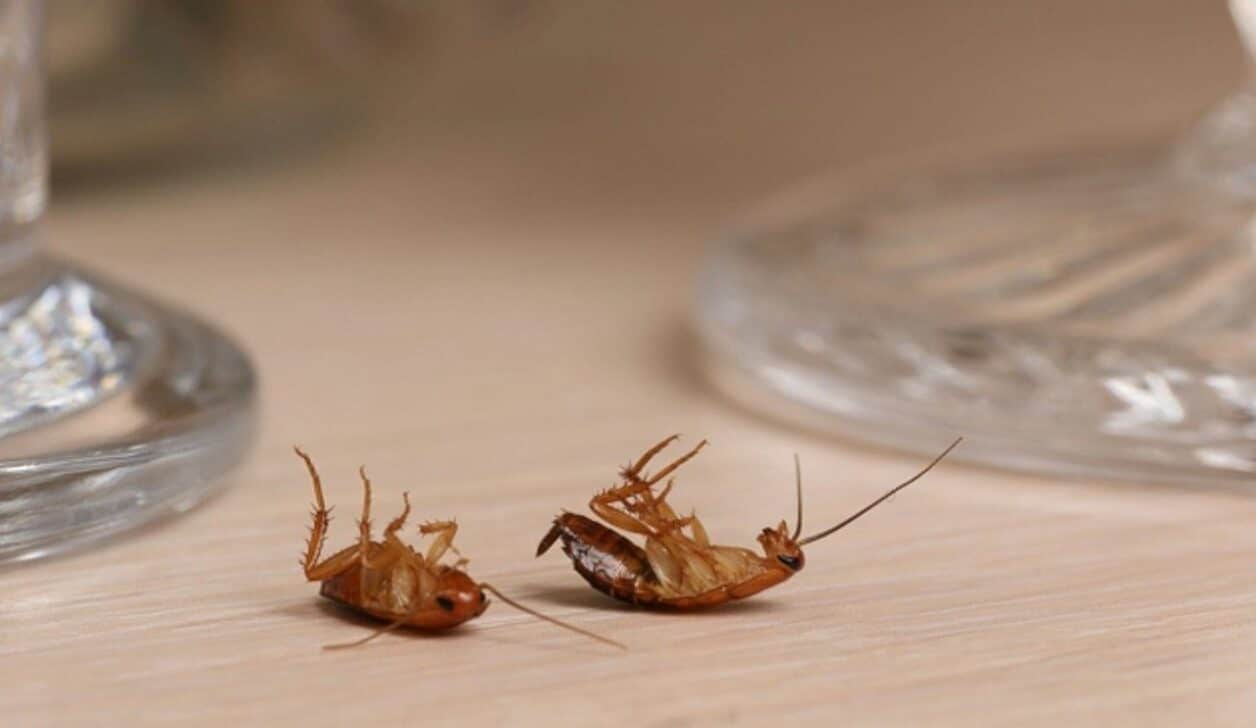
Encontrar Dead cockroaches with their legs facing the ceiling in kitchens or bathrooms is a routine scene in urban centers. Most people are unaware that this positioning results from the animal’s previous severe motor failure. The insect does not lose its life because it is on its back, but it ends up in that position precisely because it is weakened. Healthy Organismos reverses falls using leg muscles as rocking levers. Quando the neurological system fails, the self-recovery mechanism stops working completely.
The process of physical destabilization results from multiple environmental and biological factors that nullify the defenses of these animals. The definitive loss of locomotor control prevents the specimen from recovering its original balance point. Diante due to the inability to move, the animal becomes vulnerable to external threats and loses access to vital survival resources. Diversas severe conditions directly compromise the peripheral neurological response of cockroaches:
- Exposição direct to chemical pesticides and household poisons;
- Traumas mechanical and physical injuries to the carapace;
- Restrição severe water or food nutrient intake;
- Processo natural aging and cellular wear.
Ação neurotoxic insecticide alters movements
Poisons applied in residential environments act as the biggest inducers of this specific behavior in urban fauna. Essas chemical substances attack the neurotransmitters of the central nervous system, generating disordered impulses in muscle bundles. The insect suffers violent contractions, involuntary spasms and intermittent convulsions that destabilize its basic locomotion. The six legs begin to move in a frantic and random manner, causing the center of gravity to shift.
Esse collapse caused by toxic components nullifies any attempt for the animal to return to its normal position on the surfaces. Mesmo remains alive for a few hours after contact with the venom, the specimen loses its ability to respond to the environment. The tense muscles lock in an extended position, making it impossible for the friction necessary to turn the abdomen. The lack of mobility prevents the search for safe shelter, accelerating dehydration and the end of the animal’s life cycle.
Anatomia and circulation of fluids cause tipping
The physical structure of these arthropods plays a crucial role in determining the mechanics of their final fall. Entomologist Gary F. Hevel, linked to Museu of História Natural of Estados Unidos, detailed the dynamics of this phenomenon in the scientific publication Smithsonian Magazine. According to the expert, the oval shape and bulging top of the carapace make the balance inherently unstable when the legs fail. Body weight is mainly concentrated in the dorsal region, requiring continuous effort from the lower limbs for daily support.
Quando the body begins the process of generalized failure, the hemolymph no longer circulates properly through the extremities. Esse hydraulic fluid acts analogously to human blood, maintaining internal pressure that stiffens and moves the limbs. Sem the correct hemolymph pressure, the legs bend inward and lose contact with the ground. The weight of the back acts like a natural pendulum, forcing the body to inevitably tip backwards.
Estudos in laboratory proves mechanical resistance
Investigações published in the scientific vehicle Journal of Experimental Biology subjected different species of these insects to locomotor performance tests. The researchers evaluated the force generated by the articulated limbs on smooth and rough surfaces. The data demonstrated that healthy specimens demonstrate a high success rate when collapsing in areas with irregular textures. However, the scenario changes when the animals are on polished floors, such as residential tiles and ceramics.
Laboratory analysis proved that smooth surfaces make it difficult to find the support necessary for the recovery of the weakened animal. The tarsal nails do not find grooves for fixation, causing the legs to rotate in a vacuum without generating torque. A specimen affected by dehydration or aging spends its last energy reserves in these unsuccessful attempts at traction. Metabolic exhaustion consolidates the prone position until the total cessation of biological functions.