

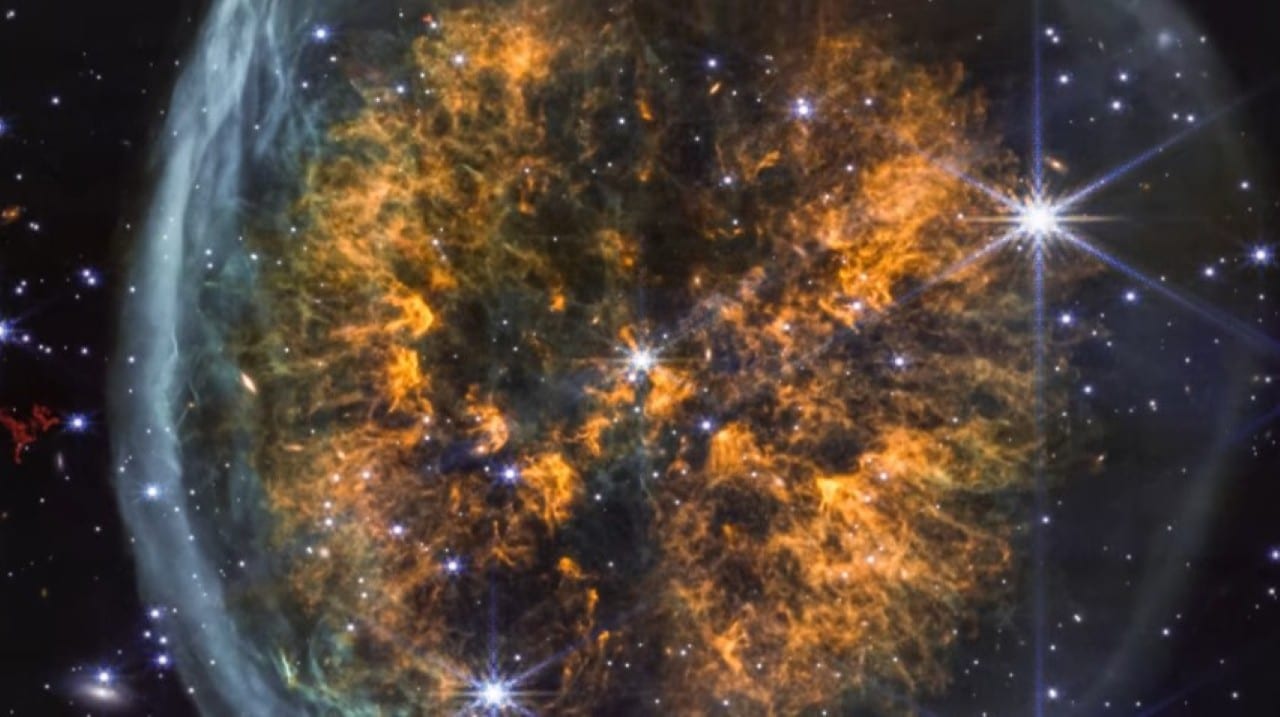
Telescópio Espacial James Webb recorded very high-resolution images of the planetary nebula PMR 1. The cosmic formation is located about 5,000 light-years away from Terra. The astronomical object is located in the constellation Vela. The equipment used near and mid-infrared light to capture unprecedented details of the structure. The peculiar appearance earned the formation the nickname exposed skull among researchers. The shape resembles a transparent bone structure that houses a luminous brain inside.
The visual phenomenon occurs during the final stage of the life cycle of a star with characteristics similar to Sol. The star ages and goes through a process of accelerated expansion. The star ejects its outer layers of gas and dust directly into deep space. The ultraviolet radiation emitted by the remaining nucleus ionizes all expelled material. Essa energetic interaction creates the intense and characteristic glow that defines the planetary nebulae observed by astronomers.
Dinâmica structural and visual cosmic formation
The outer layer of PMR 1 displays very light bluish tones in the new space captures. Essa peripheral region consists fundamentally of cold hydrogen. The element was the first to be ejected by the central star during the beginning of its collapse. The internal part of the structure has a vibrant color in shades of orange and white. Essa central area concentrates the hottest gases and cosmic dust released in the later stages of stellar death.
A vertical dark band runs right through the center of the planetary nebula. The feature divides the cosmic structure into two symmetrical halves. The resulting design considerably reinforces the similarity with the anatomy of a human brain. Experts associate this dark division with the presence of extremely powerful polar jets. The central star ejects these jets in opposite directions, continually and violently pushing the surrounding gas outward.
The complex morphology of PMR 1 directly results from these successive mass losses. The expelled material collides with the remains of previous ejections. The collision between layers of gas at different temperatures and speeds sculpts the three-dimensional shape of the nebula. Detailed observation of this cosmic architecture allows scientists to map the exact chronology of events that led to the disintegration of the dying star’s outer layers.
Tecnologia infrared and observation instruments
The success of the capture depends on the simultaneous use of different technologies on board the space observatory. The NIRCam instrument operates in the near-infrared range. The equipment can record the background stars and distant galaxies that shine through the transparent nebula. The near-infrared view perfectly highlights the clear outer bubble and inner clouds rich in structural detail.
The combination of different wavelengths reveals completely different aspects of the same astronomical formation. Data collected by the telescope’s sensors offers a comprehensive view of the ongoing cosmic phenomenon.
- The NIRCam instrument maps the distribution of cold hydrogen at the periphery of the structure.
- The MIRI sensor emphasizes the intense glow of hot dust located at the formation’s core.
- The combined images show the ejections of material at the star’s upper and lower poles.
- Overlaying the data allows for accurate three-dimensional reconstruction of the planetary nebula.
The differences in capture demonstrate the advanced technical capacity of the observatory. Joint analysis of the images provides crucial information about the dynamic processes involved in stellar death. Infrared technology can penetrate the dense clouds of cosmic dust that block visible light. The feature exposes the heart of the nebula and reveals the physical mechanisms operating in the circumstellar environment with a clarity unprecedented in the history of astronomy.
Processo Evolution and Stages of Stellar Death
The original discovery of the PMR 1 nebula occurred at the end of the 1990s. Previous observations conducted with Telescópio Espacial Spitzer already indicated the existence of a peculiar shape in the region. The old equipment operated in infrared, but had technical limitations. The new images captured significantly surpass old records in resolution and sensitivity. Technological advancement exposes the multiple layers of successive ejections that form the object.
The star located at the center of the formation continues to actively expel material. The uninterrupted process creates distinct regions that mark the different moments of the star’s mass loss. The dark central band suggests the occurrence of highly directional ejections. The continuous flow of particles shapes the nebula’s current morphology and alters its structure over the centuries. The visual distinction between areas captures multiple stages of stellar evolution in a single panoramic image.
The recent data helps the scientific community understand the final cycle of stars with a mass equivalent to Sol. The material ejected during the formation of the nebula enriches the interstellar medium with heavy chemical elements. Atoms forged in the core of the dying star travel through outer space. The dispersal process provides the essential raw material for the future formation of new planetary systems and stellar generations in the universe.
Destino of the central star and expansion in the universe
Determining the exact mass of the central star still requires precise measurements in future observations. The star will transform into a white dwarf if it has similar proportions to Sol. The hot, dense core will remain after the outer layers of gas have been completely expelled. The planetary nebula will continue to expand through deep space gradually. The luminous structure will eventually dissipate completely into the interstellar medium after tens of thousands of years.
The high-resolution images provide valuable evidence about the ultimate fate of intermediate-mass stars. The records show exactly the moment when the newly ejected material interacts with the environment around the star. Mid-infrared viewing reveals dust that glows brightly under ultraviolet radiation. Detailed observation enhances the overall understanding of the formation and evolution of planetary nebulae in Via Láctea.
PMR 1 serves as a perfect example of how dying stars shape gigantic structures visible thousands of light-years away. The continuous study of these cosmic formations reveals the dynamics of matter recycling in the cosmos. The space telescope maintains its mission of mapping the phenomena of the deep universe. Recent discoveries reinforce the importance of constant monitoring of regions of intense stellar activity for modern astrophysics.