

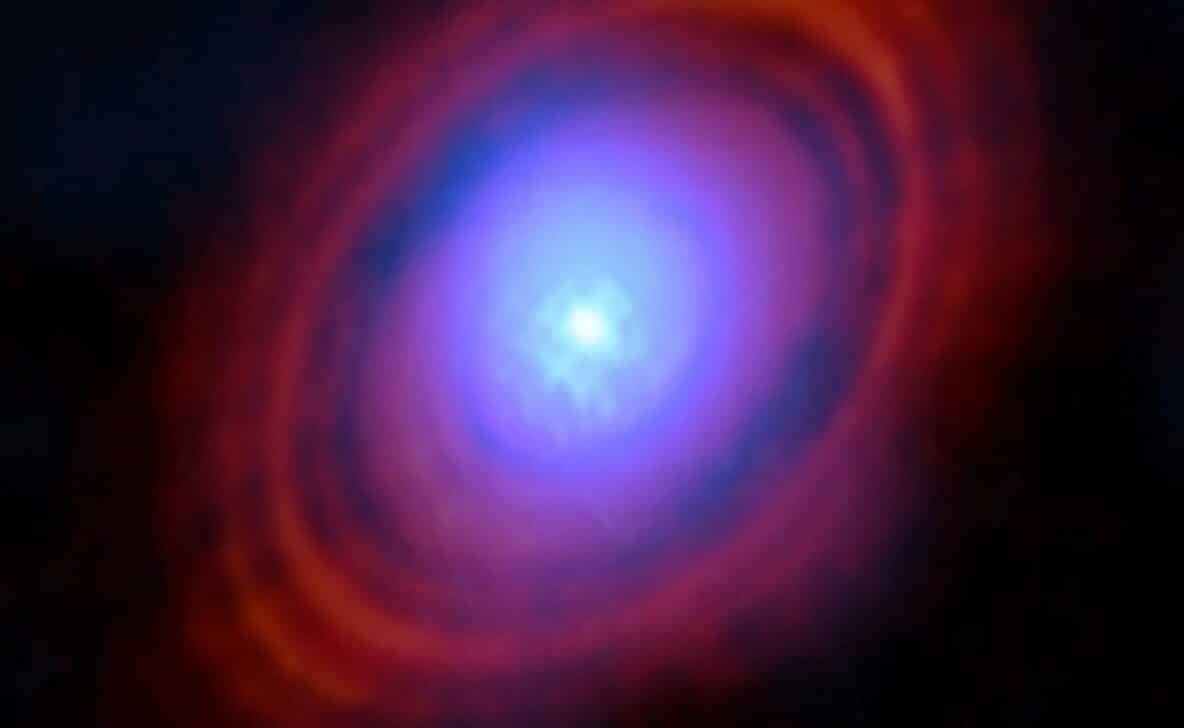
Astrônomos detected a significant amount of water vapor in the inner region of the protoplanetary disk surrounding the HL star Tauri. The observation was made with the ALMA telescope, at Chile. The volume is equivalent to more than three times the water present in all of Terra’s oceans. The discovery opens new perspectives on the role of water in the formation of planets.
Sul’s Observatório Europeu released the results of a survey that analyzed the HL Tauri system. Localizada About 450 light-years from Terra, in the constellation Touro, the young star is just a few hundred thousand years old. Seu disk of gas and dust already shows gaps that indicate the initial process of planetary formation.
ALMA maps water vapor in inner regions of the disk
The ALMA radio telescope array captured water vapor emissions in three different transitions. The areas with the highest concentration are close to the star, especially in the gaps in the disk. Essas regions are candidates for planet formation. The images show the vapor distributed in a concentrated manner in the internal part, up to around 17 astronomical units.
The team led by Stefano Facchini, Universidade and Milão, confirmed the presence of water in a relatively cold environment by protoplanetary disk standards. The detection took place in 2024, with processed data that allowed the spatial distribution to be mapped. ALMA’s previous Imagens, from 2014, had already revealed the rings and gaps in the dust disk.
- The vapor appears more intense in the vicinity of the central star
- Lacunas on the disk coincide with areas of greater presence of water
- Estimated minimum Quantidade exceeds three Earth’s oceans
- Emissões were recorded at specific frequencies of water molecules
Descoberta reinforces link between water and planetary growth
Teorias of planetary formation indicate that water facilitates the adhesion of dust particles. Quando freezes at low temperatures, helps matter clump together more efficiently. In the case of HL Tauri, the water detected in the gaps suggests a direct influence on the future chemical composition of planets that could form there.
Pesquisadores highlight that the finding helps to understand processes similar to those that occurred in Sistema Solar 4.6 billion years ago. The star HL Tauri serves as a natural laboratory for studying the early formation of rocky worlds. The detection of water in a gaseous state in internal regions is considered rare and valuable.
Imagens combine steam and dust data on disk
One of the visualizations released combines water vapor in blue tones with the distribution of dust in red. The strongest vapor glow occurs near the center. Estruturas in dust ring appear in previous observations. Essa overlay allows you to visualize how components interact on disk.
The study used observations in different bands from ALMA to capture emission lines from the H₂O molecule. Interferometric analysis confirmed that the water emission is confined within a prominent gap. Isso indicates specific conditions that allow vapor to be present even in a young, dynamic disk.
Implicações for understanding planetary systems
The amount of water detected provides a robust lower limit for the content available during planetary formation. Facchini and collaborators point out that water can affect not only the growth, but also the final composition of planets. Sistemas like HL Tauri offer clues about how water reaches worlds in the making.
Future Observações should refine the measurements and explore other similar disks. ALMA continues to deliver high-resolution data that transforms knowledge about the earliest stages of stellar and planetary evolution. The star HL Tauri, observed in unprecedented detail since 2014, remains a reference for astronomers.
Detalhes observation and system technicians
HL Tauri has an estimated mass of around 2.1 times that of Sol. The disk spans dozens of astronomical units and has multiple gaps. The age of the star is less than a million years. The new observations complement infrared data obtained by other instruments.
- Distância: 450 light years
- Idade approximate star: hundreds of thousands of years
- Quantidade of water vapor: at least 3.7 oceans of Terra in the inner region
- Instrumento main: ALMA, with multiple antennas in the Atacama desert
The research was published in the magazine Nature Astronomy. Ela represents an advance in the ability to map essential molecules in planetary formation environments.