

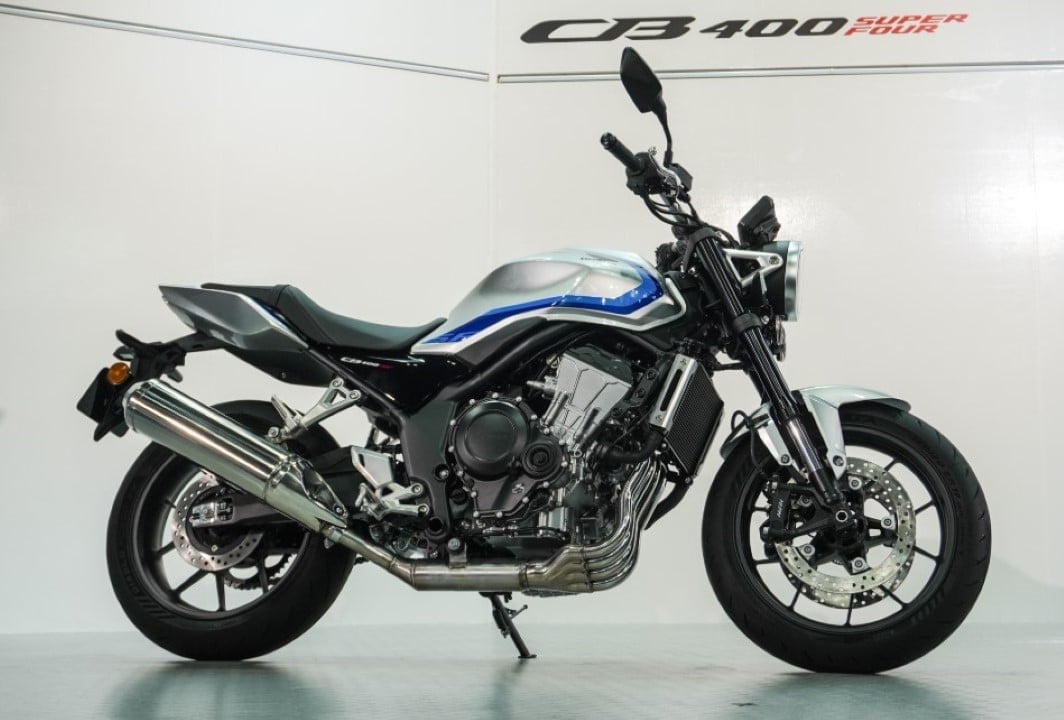
Japanese automaker Honda officially unveiled two new two-wheelers during the 42nd Salão of Motocicletas of Osaka, at Japão. The event took place this Friday, March 20, 2026. The manufacturer revealed the CB400 Super Four E-Clutch Concept and CBR400R Four E-Clutch Concept models to the global public. The machines mark the return of the in-line four-cylinder configuration to the medium-displacement category. The announcement surprised participants at the Asian fair.
The development of this new platform seeks to unite the brand’s traditional sports performance with recent transmission technologies. The integration of the Honda E-Clutch system represents the main mechanical innovation of the prototypes. The mechanism allows automatic control of the clutch during daily starts and stops. Especialistas from the automotive sector consider the launch a strategic move to attract both veteran motorcyclists and new urban drivers looking for practicality in heavy traffic.
https://twitter.com/HondaBike_hmj/status/2034804960949674453?ref_src=twsrc%5Etfw
Arquitetura mechanics revives tradition in the medium displacement segment
The introduction of a first-of-its-kind four-cylinder engine in 2026 challenges the recent trend in the global motorcycle industry. Most manufacturers focus their efforts on parallel-twin engines to reduce production costs. The Honda demonstrates that there is still considerable demand for engines that reach high speeds. The characteristic sound of the in-line four cylinders remains a decisive purchasing factor for many speed enthusiasts.
The company’s engineers designed a completely new platform to support the torque and power demands. The manufacturer implemented the throttle-by-wire system in the two versions presented at the event. Essa technology ensures that throttle response is immediate and precise across different engine speed ranges. The equipment eliminates traditional mechanical cables and uses electronic sensors to read the pilot’s intention in real time.
https://twitter.com/HondaBike_hmj/status/2034846014956589158?ref_src=twsrc%5Etfw
The physical structure of the motorcycles also underwent profound redesigns to accommodate the new mechanical assembly. The chassis was redesigned with a focus on offering greater torsional rigidity during driving. Agility in tight corners was a priority during the closed circuit testing phase. The engine’s internal components use lightweight, low-friction materials to optimize fuel consumption.
- The new 400 cc engines feature liquid cooling and dual overhead camshafts.
- The chassis has been redesigned to offer greater torsional rigidity and agility in tight corners.
- The front suspension uses high-performance inverted forks for better ground reading.
- High definition digital Painéis allows full connectivity with drivers’ smartphones.
The technical configuration presented in the prototypes indicates a clear focus on durability and thermal efficiency. The liquid cooling system sized for the four cylinders maintains the ideal temperature even in slow urban traffic conditions. The front suspension with inverted forks absorbs irregularities in the asphalt with greater precision than conventional models.
Design naked from CB400 Super Four preserves visual identity
The CB400 Super Four E-Clutch Concept variant was designed under the philosophy of maximizing the pleasure of daily riding. The design maintains the historical heritage of Japanese naked motorcycles. The designers preserved aesthetic elements that directly refer to the original model launched in 1992. The contemporary finishes update the look without losing the classic essence of the line.
Round headlights equipped with LED technology form the vehicle’s frontal light signature. The flowing lines of the body harmoniously connect the fuel tank to the rear. Essa visual identity is recognized globally as a standard established by the CB lineage over the decades. The absence of fairings exposes the four-cylinder engine as the central element of the design.
The seat structure and pedal position have been finely adjusted to provide superior ergonomics. Condutores of different heights can operate the machine safely and comfortably on long journeys. The engine has been specifically calibrated to deliver linear torque from low revs. Essa feature prevents sudden power fluctuations and facilitates directional control for motorcyclists with less experience in multi-cylinder vehicles.
Sporty Carenagem defines the aggressive look of the CBR400R Four
The sports version of the new family adopts a radically different visual approach to the naked model. The CBR400R Four E-Clutch Concept features full fairings inspired by the manufacturer’s competition motorcycles. The body surface features sharp aerodynamic creases that cut through the wind at high speeds. The finish simulates machined metal on several parts of the front assembly.
The engineering team’s objective was to create a vehicle capable of transforming routine journeys into high-level experiences. Durante use on closed tracks or winding roads, the driver has continuous support from the intelligent clutch. The electronic system constantly monitors engine speed and wheel speed. The technology acts preventively to avoid rear wheel locks during aggressive downshifts.
The integration between the four-cylinder engine and on-board electronics raises safety standards in the category. The driver can focus his attention exclusively on choosing the ideal trajectory and braking points. Gear changes are managed almost imperceptibly, keeping chassis stability unchanged even on extreme slopes.
Sistema E-Clutch eliminates manual use of the handle when stopping
E-Clutch technology is one of the biggest recent advances in the interface between the rider and the machine. The system uses compact electronic actuators to disengage the clutch in a matter of milliseconds. Gear changing occurs smoothly and without noticeable interruptions in the delivery of power to the rear wheel. The design differs from the fully automatic transmissions found on scooters.
The driver maintains the use of the traditional gearshift pedal on the left foot. Essa engineering decision preserves tactile sensation and full control over gear choices. The technical solution proves to be very useful in heavy traffic situations in large cities. Constantly operating the manual clutch lever often causes hand fatigue after long periods of urban driving.
The software responsible for managing E-Clutch has adaptive learning capabilities. The system analyzes the user’s riding style and adjusts the engagement speed according to the pressure exerted on the accelerator. The Honda manages to offer a product that is friendly for beginners and, at the same time, rewarding for veterans looking for pure highway performance.
Cronograma production and price estimation for the market
The vehicles displayed in Salão by Motocicletas by Osaka feature a level of detail that suggests proximity to the assembly line. The Honda follows its traditional global expansion schedule for mid-size models. The final production version is expected to appear at major motorcycling events at Europa in the second half of this year. The commercial launch at dealerships is scheduled to take place between the end of 2026 and the beginning of 2027.
Sales will begin in the Asian market before reaching other regions of the world. Financial projections indicate that the new 400cc machines will have a higher price positioning than the previous generation. Market values are expected to range between 1.15 million and 1.3 million yen. The cost reflects the investment in new materials and state-of-the-art electronic control systems embedded in the models.
Mass production will maintain the technical features seen in the prototypes, including the dual-channel ABS braking system. The exhaust system has undergone rigorous optimizations to maintain the classic four-cylinder roar while filtering pollutants through modern catalytic converters. The updates ensure compliance with current environmental emissions standards, ensuring the longevity of the mechanical platform for the coming years of global commercialization.