

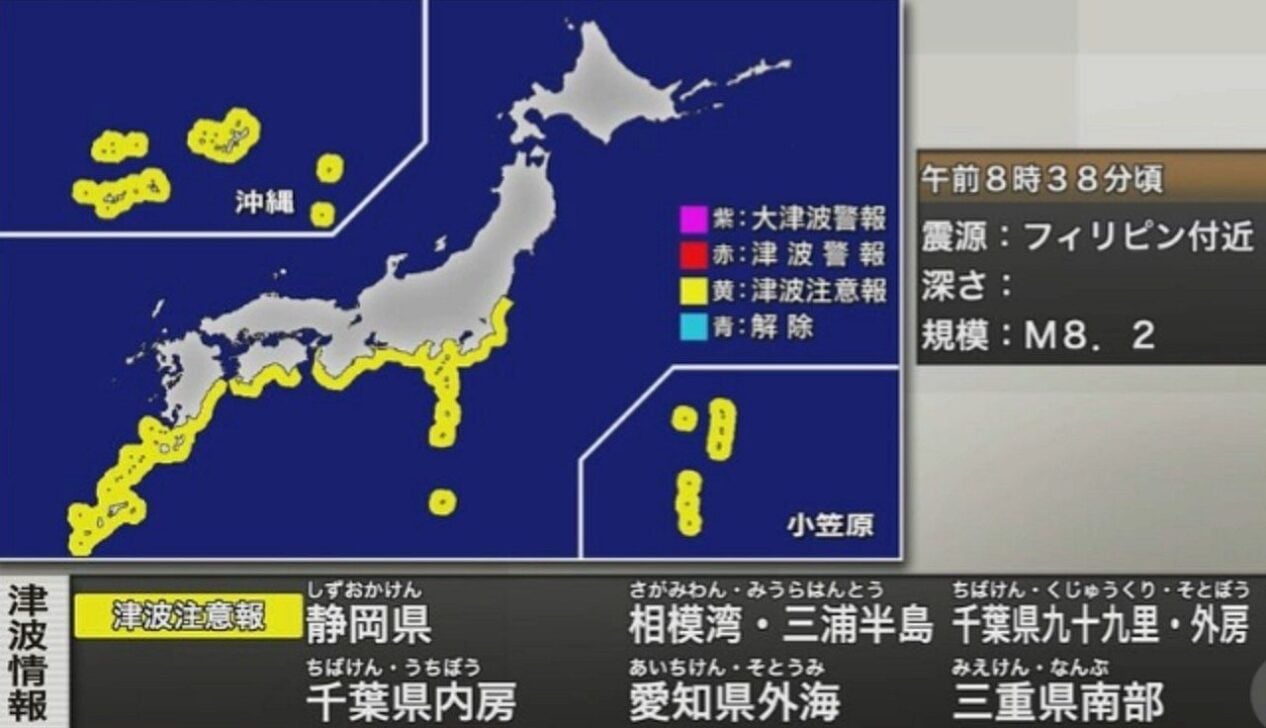
The city of Kawazu, located in Shizuoka province, issued a level 3 tsunami warning and recommended the immediate evacuation of elderly people on Thursday. The preventive measure affects five specific districts and was triggered by a strong earthquake recorded in Filipinas. Local Autoridades triggered emergency protocols at 12:39 pm local time. The main objective is to ensure the safety of the most vulnerable residents before the possible arrival of dangerous waves on the Japanese coast. Rescue Equipes already monitor sea level rise through coastal stations.
Zonas risk and population targeting
The evacuation order focuses primarily on people with reduced mobility and elderly residents. The municipal government advised this group to seek shelter on high ground or contingency centers designated by the city hall. The quick decision seeks to avoid tragedies if the sea advances over residential areas close to the beach. Moradores who do not fall into the risk group have also been instructed to maintain vigilance. The recommendation is that everyone prepare emergency kits containing documents, medicines and basic supplies. The police isolated access to beaches and promenades to prevent residents from approaching.
Risk mapping prepared by Japanese civil defense identified the areas most likely to flood. The topography of the coastal region of Shizuoka requires extra attention at points where sea levels can rise quickly. Public agents are roaming the streets to help move those who need physical help. Communication flows through speakers, sirens and text messages on cell phones. Japão’s early warning system has proven its effectiveness by mobilizing the population within minutes of official notification.
Distritos affected by emergency decree
The local government delimited the danger zone based on simulations of advancing ocean waters. The focus of the initial rescue occurs in areas of lower altitude and closer to the coastline.
- Yazu
- Mine
- Mitsutaka
- Hama
- Sasahara
The escape routes to these locations were previously inspected by security teams. Traffic on the access roads to the shelters flows under the coordination of the local police to avoid congestion. Voluntários and firefighters work together to receive evacuees in gyms and schools in the upper part of the city. The flow of vehicles was organized to prioritize ambulances and rescue cars. The city hall has provided circular buses to transport elderly people who do not have their own vehicles or family members nearby.
Impacto of tremor in Filipinas and reflexes in Japão
The alert in Japanese territory is a direct consequence of the seismic instability generated in the neighboring country. A large magnitude earthquake in Filipinas moved a vast amount of water on the ocean floor. Esse displacement creates waves that travel thousands of kilometers at high speed through the Oceano Pacífico. The Agência Meteorológica of the Japão monitors the trajectory of these sea currents in real time. Especialistas analyzes seismograph data to calculate the exact height and impact time of waves on Shizuoka’s coast. The accuracy of these calculations is vital in determining the alert level in each province.
Japão has one of the most advanced tsunami detection systems in the world. Sensores installed on the seabed transmit instant information to command centers in Tóquio. Essa technology allows smaller cities, like Kawazu, time to organize population evacuation. The culture of prevention is taught from childhood in Japanese schools. Constant training facilitates society’s response in times of real crisis. Annual Simulações ensure that every citizen knows exactly which way to go when the sirens sound.
Estrutura contingency and security protocols
The operation on Kawazu involves multiple government departments and public security forces. The crisis committee established an operations center to centralize information and coordinate rescue efforts. Equipes doctors are on standby in shelters to assist people who may become ill during their journey. The supply of drinking water, blankets and non-perishable food has already been guaranteed by municipal logistics. Electrical power in risk areas can be cut off preventively to avoid short circuits. Hospitais in the region operate with generators on standby to ensure continuous service.
Communication with the population occurs continuously and transparently. Emissoras radio and television interrupted normal programming to broadcast civil defense alerts. Aplicativos cell phones emit shrill beeps even when the devices are in silent mode. The official guidance is that no one should return to coastal areas until alert level 3 is officially downgraded or cancelled. Tide monitoring will continue for the next few hours. Fishing Barcos were advised to return to ports or seek deeper water, depending on distance from shore.
Coastal Prevention and Resilience Histórico
Shizuoka province has a long history of preparedness against natural disasters due to its geographic location. The region is situated in an area of intense tectonic activity known as Círculo of Fogo of Pacífico. Barreiras made of concrete and automatic floodgates protect the city’s river mouths and fishing ports. However, authorities emphasize that physical infrastructure does not replace the need for human evacuation. The Japanese government’s absolute priority is the preservation of life. Engenheiros constantly assess the integrity of coastal dikes.
Kawazu’s urban planning includes visual signage on all streets indicating the altitude in relation to sea level. Reflective Placas shows the direction to the nearest shelter in several languages. Cooperation between neighbors plays a fundamental role in community safety. Younger Moradores often take it upon themselves to knock on older people’s doors to ensure everyone has heard the warning. The city remains on high alert pending the normalization of oceanic conditions. Emergency teams will maintain observation posts throughout the night.