

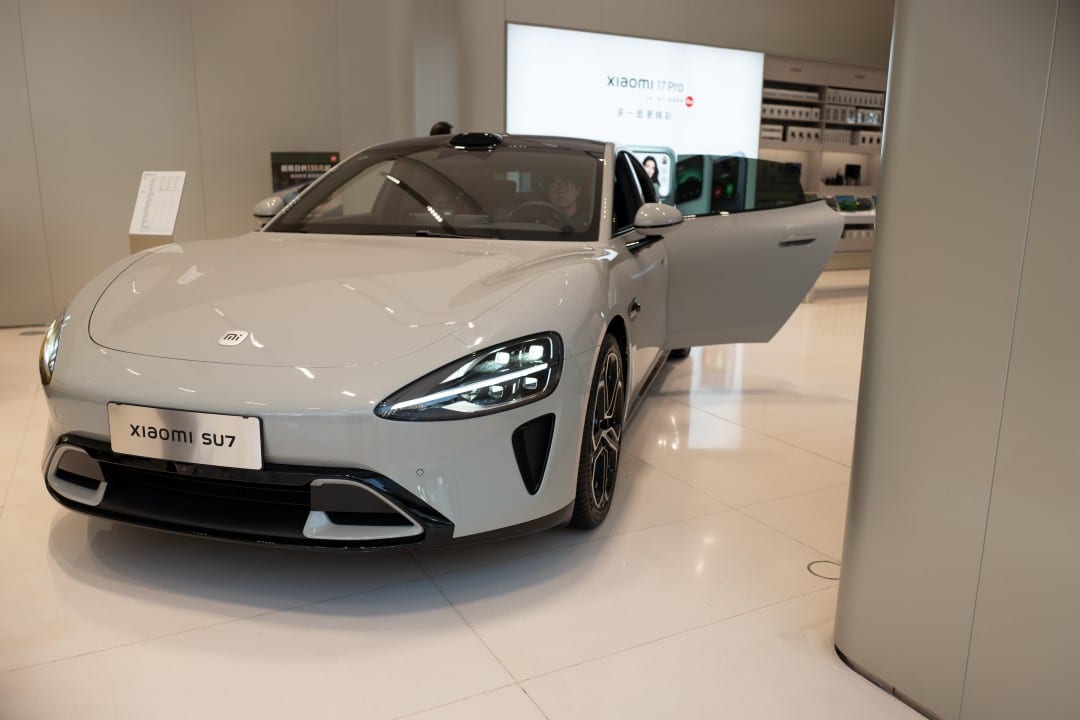
Chinese manufacturer Xiaomi presented the new generation of the SU7 electric sedan during an event held at Pequim this Wednesday (19). The vehicle arrives on the Asian market with significant updates to its technological architecture, offering up to 902 kilometers of autonomy in the CLTC test cycle. The automaker set the model’s starting price at 229,900 yuan, equivalent to around US$33,000, positioning the car in a lower price range than its direct competitors in the country. Mass deliveries to consumers begin immediately after the official launch.
The portfolio update comes after the company recorded the delivery of more than 360,000 units of the original version over a period of 21 months. With this volume of registrations, the brand surpassed sales of the Tesla Model 3 in the local market at the end of 2025. The new line seeks to consolidate the company’s leadership in the premium electric vehicle segment in the China, integrating advanced driver assistance systems as standard in all available configurations and maintaining financial competitiveness in the automotive sector.

Arquitetura electric and ultra-fast charging capability
The modifications implemented in the energy platform represent one of the main advances of the new generation of the sedan. The Standard and Pro variants now use a 752 V architecture equipped with silicon carbide inverters, which optimizes thermal management and powertrain efficiency. The top-of-the-line version, called Max, received an 897 V system, allowing it to withstand more intense electrical currents during stops at high-capacity public charging stations.
Performance at high-power terminals presents significant gains for drivers on long journeys. The Max model can recover up to 670 kilometers of autonomy with just 15 minutes of plugging in, a considerable leap compared to the 510 kilometers recorded in the previous generation. The supercharging capacity reaches level 5C, which makes it possible to increase the battery level from 10% to 80% in approximately 11 minutes when the vehicle uses compatible chargers from the Xiaomi’s own infrastructure.
Expansão of engine range and performance
The increase in autonomy covers all options in the catalog offered by the Asian automaker. The entry configuration, Standard, increased its range from 700 kilometers to 720 kilometers on a single charge. The Pro model achieved the biggest increase in the line, jumping from 830 kilometers to 902 kilometers, while the Max version now delivers 835 kilometers of maximum capacity. Esses numbers place the sedan among the most efficient options in its category in the current automotive market, surpassing the 400 real miles mark under normal driving conditions.
On the mechanical side, the company has standardized the use of the V6s Plus electric engine across the entire family of vehicles. Units equipped with a single engine registered an increase in power, going from 299 horsepower to 320 horsepower. The Max variant, which has an all-wheel drive system using two engines, reaches 690 horsepower. The chassis also received structural reinforcements to handle the new level of dynamic performance on highways and ensure stability at high speeds.
The double-chamber air suspension, which works in conjunction with a continuous damping control system, is no longer exclusive to the most expensive model and is now part of the equipment list of the Pro version. The undercarriage adopts wider tires, measuring 245 millimeters on the front axle and 265 millimeters on the rear. The braking system uses four-piston fixed calipers at the front, with the Max configuration receiving components from the Italian brand Brembo and ventilated and perforated discs for greater heat dissipation.
Advanced Sensores and autonomous driving systems
The strategy of democratizing safety technology is reflected in the electronic specifications of the electric sedan. The LiDAR sensor has become a standard item on all versions sold, working in synchronization with a 4D millimeter wave radar. The vehicle’s unified computing platform had its processing capacity increased to 700 TOPS, surpassing the previous limit of 508 TOPS. Essa hardware upgrade enables faster and more accurate reading of the car’s surrounding environment in real time.
The roadside assistance package, known as Highway Autonomous Driving, is factory-installed on the base model. The manufacturer’s decision changes the segment’s standard, where advanced assisted driving features are usually only offered as optional packages or restricted to the most expensive configurations. The integration of these systems aims to reduce the driver’s cognitive load on long journeys and increase preventive safety in heavy traffic situations in large Chinese cities.
Enhanced Estrutura and new design elements
Occupant protection led to profound changes in the construction of the automobile body. The brand’s engineering applied 2,200 MPa ultra-high-strength steel in critical impact absorption areas, replacing the 2,000 MPa material used in previous years. The compartment that houses the battery cells received a 1,500 MPa steel crossbar and a reinforced lower coating to prevent punctures in the event of debris on the track. The number of airbags increased from seven to nine, adding side protection bags for rear seat passengers.
The handles built into the doors have a redundant triple actuation mechanism, ensuring the doors open even in scenarios of total loss of electrical power after a collision. In the external design, the changes maintain the original visual identity, introducing redesigned headlights, 20-inch wheels with a new aerodynamic design and the unprecedented color Azul Capri. The aerodynamic drag coefficient was reduced to 0.21, directly contributing to energy efficiency gains. The interior adopts the Preto Noite Escura theme, with a redesigned two-tone steering wheel, revised center console and dynamic ambient lighting.
Posicionamento trading and value table on China
The pricing policy established by the automaker maintains commercial aggressiveness to sustain sales volume compared to North American and local rivals. The updated table reflects small readjustments in relation to the previous generation, justified by the inclusion of new standard equipment and higher capacity batteries. The values defined for the Chinese market follow the following sales structure:
- Standard: sold for 229,900 yuan, which represents an increase of 10,000 yuan over the old price;
- Pro: offered at dealerships for 259,900 yuan, with a 14,000 yuan increase in the final price;
- Max: positioned at the top of the line at 309,900 yuan, registering an increase of 10,000 yuan.
The Chinese brand’s entry-level model costs approximately 5,600 yuan less than the basic version of the Tesla Model 3 with rear-wheel drive, which sells for 235,500 yuan and delivers 634 kilometers of range in the same test cycle. The factory’s production line aims to assemble more than 16,000 units in March alone to meet the initial demand generated by the launch. The strategy of rapid product updates consolidates the sedan as one of the main references in the market range above 200,000 yuan.