James Webb detects methane for the first time on interstellar comet 3I/ATLAS
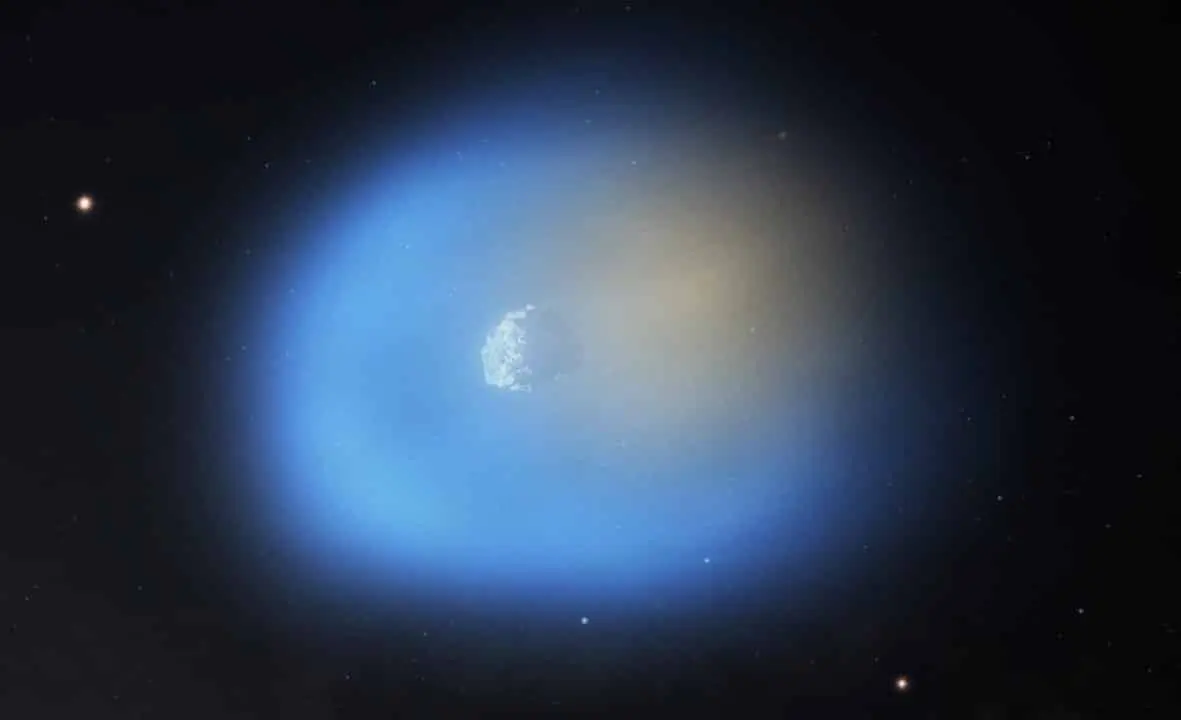
Even though it is already on its definitive exit route from the Solar System, the interstellar comet 3I/ATLAS continues to generate surprises for astronomers. A study published in The Astrophysical Journal Letters points to the release of methane by the object, which represents the first detection of this gas in a visitor from another region of the Milky Way.
The discovery gains even more relevance because the proportion of methane in relation to water exceeds what is observed in comets originating in the Solar System. The finding reinforces the hypothesis that 3I/ATLAS originated in an environment quite different from that responsible for the formation of the celestial bodies that surround the Sun.
The observations took place between December 15 and 16, 2025, with NASA’s James Webb Space Telescope (JWST), using the Mid-Infrared Instrument (MIRI). At the time, 3I/ATLAS was approximately 330 million kilometers from the Sun, after having made its closest approach almost two months earlier.
Part of the observation campaign faced technical difficulties and required repetition on December 27th. In this new session, the comet was already almost 380 million kilometers from the Sun. The setback ended up benefiting the researchers, by allowing the comparison of the object’s activity in different phases of its passage.
More on this story: JUICE probe detects interstellar comet 3I/ATLAS expelling tons of water into space
Approaching the Sun overheated the surface of 3I/ATLAS
Upon reaching perihelion, the closest point to the Sun on its trajectory, the comet suffered intense heating on the surface. This process increased the release of gases and frozen particles stored in its core.
During initial measurements, James Webb recorded large amounts of water vapor escaping from the coma, the cloud of gas and dust surrounding the nucleus. The phenomenon occurs when ice heats up and transitions directly from a solid to a gaseous state.
Learn more: Unprecedented detection of methane on interstellar comet 3I/ATLAS surprises scientists
Days later, as reported in a statement, scientists observed a significant change. Water vapor production fell sharply, signaling the weakening of the impact of solar heating. The comet had already crossed the snow line, a zone in which temperatures allow water to remain frozen.
While water emission receded, other gases continued to be released. According to the researchers, compounds such as carbon dioxide and methane sublime at lower temperatures and remain active even when the object moves away from the Sun.
In addition to methane, JWST detected carbon dioxide and nickel vapor. The data confirmed previous observations that already indicated an unusual volume of carbon dioxide compared to water in the comet.
See Also

PlayStation shows new GTA 6 commercial and heats up debate about graphics before preview on Netflix

PlayStation 5 launches global ‘It Happens’ campaign to celebrate unique gaming experiences

Discord blocks live broadcasts in Brazil as determined by the ANPD after investigation
The big news, however, was the identification of methane. Although common in the Universe, the gas had never been recorded in the two previous interstellar objects that crossed the Solar System — the asteroid 1I/’Oumuamua, seen in 2017, and the comet 2I/Borisov, discovered in 2019.
The aspect that most caught the attention of scientists was that methane appeared only after passing through the closest point to the Sun. The main explanation indicates that the gas remained hidden in deep layers of the core. The heat from the approach took time to penetrate the interior, heating these regions and releasing the methane only later.
On the same topic: Studies detail mysterious formation of interstellar comet 3I/ATLAS in distant planetary system
Researchers estimate that the comet’s surface layers lost much of its methane billions of years ago. Before being ejected into interstellar space, the object would have undergone heating in its origin system, eliminating the outermost deposits of this gas.
Comet has 40 times more methane than carbon
Scientists also noticed that, as methane emissions increased, carbon monoxide emissions increased in the same proportion. In December, the comet released about 40 times more carbon monoxide than carbon dioxide.
The analyzes revealed that both methane and carbon dioxide appear in high proportions in water. Although unusual by Solar System standards, this may be typical of the region where 3I/ATLAS formed.
More on this story: Interstellar comet 3I/ATLAS reaches record speed of 209 thousand km/h
The interstellar visitor is estimated to be around 12 billion years old. If the estimate is confirmed, it is much older than the Solar System, at 4.6 billion years old, and stores data about a remote phase in the galaxy’s history.
Interstellar objects attract the interest of science because they act as time capsules from distant planetary systems. They allow astronomers to examine environments impossible to study by other means.
The atypical proportions of methane, carbon dioxide and water detected in 3I/ATLAS confirm that it was born in conditions different from those that generated the Solar System’s comets. These variations contribute to understanding the diversity of planetary systems in the Milky Way.