

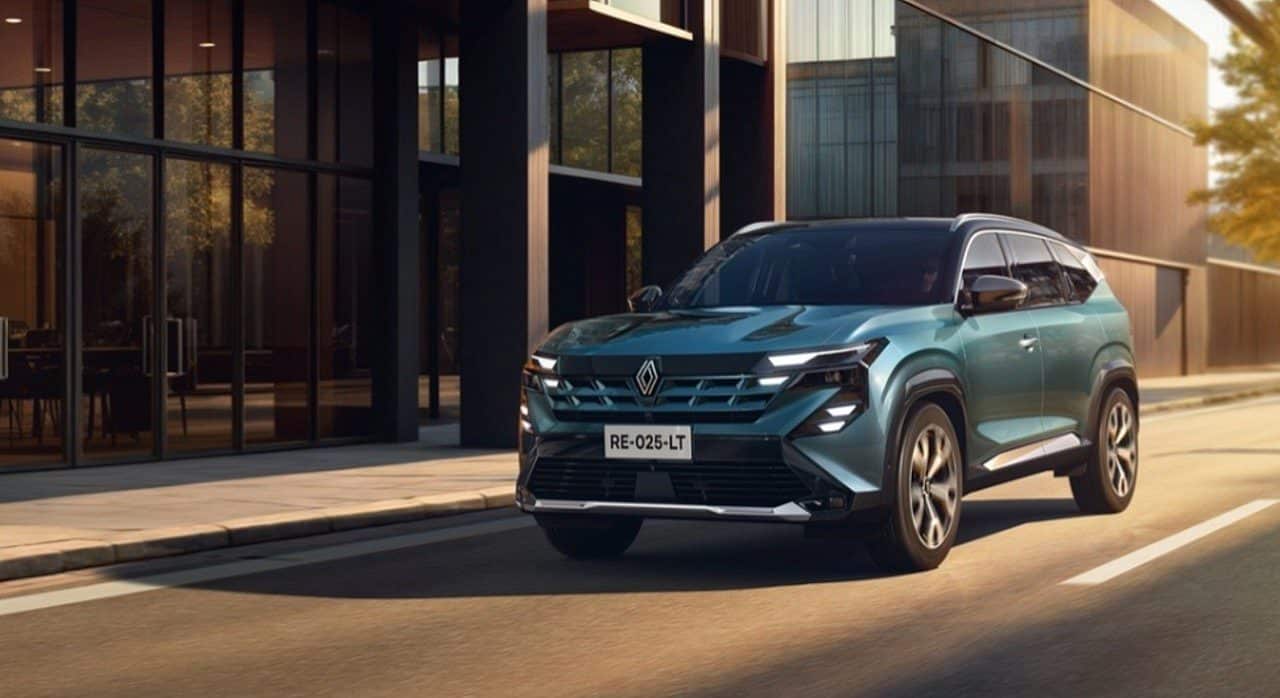
Renault has officially confirmed the launch of the hybrid version of the Boreal in Brazil. The president of the Renault Geely group in the country, Ariel Montenegro, detailed on the CBN Autoesporte program that the medium SUV will gain an innovative electrified engine.
The brand had already given hints about the hybrid Boreal in April. Now, the executive was direct in stating that the electrified version will come with a very innovative engine solution.
According to Ariel Montenegro, the hybrid Renault Boreal should reach the Brazilian market within a few more months. He made it clear, however, that the launch will not take place in 2026. The expectation is for the first half of 2027, which completes the line-up of the SUV elected Car of the Year 2026, currently only offered with a 1.3 TCe turbo flex engine with 163 hp and EDC dual-clutch automated transmission.
The executive reinforced that the model will come. “You can wait: it will arrive. We are working. We are not talking about 2026, there is still time to launch and the model is under development, but we are working. We are accelerating the project for the arrival of a hybrid solution that will be very innovative and we can wait a few more months for it to arrive”, he declared.
The novelty seeks to give new impetus to the Renault Boreal, which has not yet recorded large sales volumes since its launch. From January to May 2026, the SUV accumulated 4,775 registrations, according to Fenabrave, a number below direct rivals such as Toyota Corolla Cross, Jeep Compass and BYD Song Pro.
When the Boreal was launched, Renault prioritized a flex-fuel engine, which dominated the segment at the time. “The fact is that consumers are accelerating their electrification and we can prioritize these developments of hybrid models. There are development deadlines and homologation deadlines that have to be respected, but the hybrid Boreal will arrive in a few months, as soon as it is ready”, added Montenegro.
Even without taking off in sales, the Boreal fulfills a strategic role for Renault. According to the president, the model brought a 65% acquisition rate of customers who were not with the brand. This allows Renault to return to the C segment, where it has not operated since the Fluence, around 15 years ago.
For Ariel Montenegro, life at Boreal became more challenging due to the excess of launches in the segment. “We have counted more than 120 launches in the year 2026, and the majority are in the B Plus and C segments. So there is a lot of news in this segment. Boreal has the difficult task of being a reference in this market, which today is one of the most competitive. And it is managing to make itself known with familiarity, month after month, in this very competitive segment”, he assessed.

What will the hybrid Renault Boreal be like?
In March this year, the Boreal was caught testing in Europe with the 48 Volt mild hybrid system (MHEV) already applied to the Dacia Bigster. The SUV derived from the third generation Duster uses an unusual configuration in Europe: mild hybrid engine combined with 4×4 traction and rear electric motor.
The system works with a combustion engine at the front. In the European case, a 1.2 three-cylinder gasoline turbo with 140 hp and 23.5 kgfm. The transmission is the same six-speed EDC dual-clutch automatic used in the Brazilian Boreal. The rear electric motor delivers 31 hp and 8.9 kgfm, with a second set of two-speed clutches and the possibility of decoupling. Combined power reaches 156 hp.
The set includes a 48V lithium-ion battery with a capacity of 0.84 kWh, recharged by regenerative braking or the combustion engine. This allows the electric motor to assist in traction, especially in low gear or as a supplement.
The system allows running in electric-only mode with rear-wheel drive. Thus, the hybrid Boreal will have 4×2 front, 4×2 rear or 4×4 depending on demand. In Europe, light hybrid 4×4 Duster and Bigster can run up to 60% of the time in electric mode in urban use.
In Brazil, the Boreal will use the 1.3 TCe turbo flex four-cylinder engine with 163 hp and 27.5 kgfm instead of the European 1.2. Together with electrified technology, the combined power should be around 180 hp. Internally, the system is called e-4WD by Renault.