

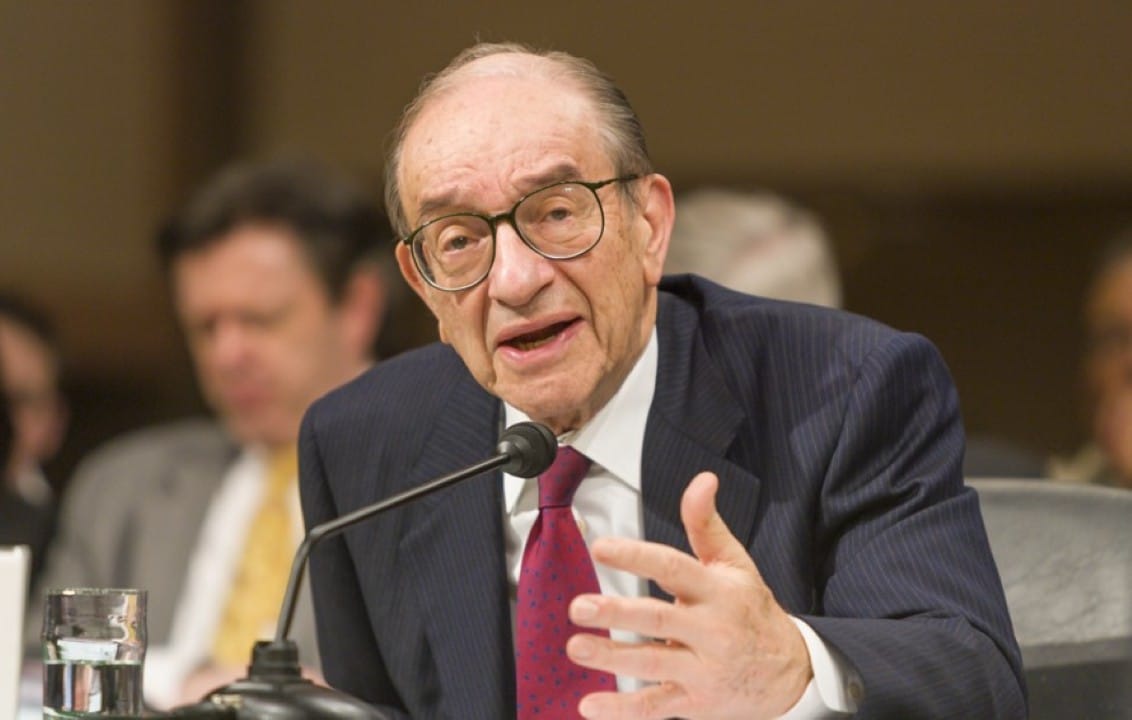
Alan Greenspan, a central figure in the global economy for nearly two decades as chairman of the Federal Reserve, died last Monday at his home in Washington, aged 100. His long tenure at the head of the central bank was marked by a period of remarkable prosperity, interspersed with economic crises, and he stood out as an influential, if polarizing, advocate of market-friendly policies.
Andrea Mitchell, Greenspan’s wife and chief Washington correspondent for NBC News, said in a statement that the cause of death was complications related to Parkinson’s disease.
Recognized as the most prominent economic policymaker of his time, and arguably the best-known economist globally, Greenspan ran the United States central bank between 1987 and 2006, serving under four presidents, both Republican and Democrat.
Much of his time in office coincided with a cycle of strong economic growth. During this period, Greenspan embodied an optimistic vision of post-Cold War American capitalism, demonstrating great faith in the power of markets to raise living standards, a fascination with technological innovation, and an aversion to government regulation.
However, the deep ideological mark he left on economic policies also began to be linked to the negative repercussions of trends that were consolidated under his leadership. Among them, the deregulation of the financial sector, which encompassed banks and Wall Street, the reduction of jobs in the United States due to commercial globalization and the continued concern about speculative bubbles in the stock and real estate markets, points that today form the core of the debate about the long-term effectiveness of their choices and the true cost of a less regulated economy.
While Greenspan masterfully managed interest rates to maintain economic stability, he harbored concerns about a danger he knew well: the possibility that the low-inflation, money-abundant scenario he had helped create could expose the United States to unsustainable investment cycles. Despite this, he demonstrated hesitancy to act as banks and investment firms adopted new and complex trading techniques that would eventually cause significant damage.
As head of the Fed, he achieved remarkable success in his main mission as a central banker: controlling inflation. Greenspan also played a crucial role in helping the United States overcome periodic economic shocks, such as the stock market crash shortly after his inauguration, the near-collapse of Asian financial markets a decade later, and the economic fallout from the 2001 terrorist attacks.
It was only after his departure from office in early 2006, and more intensely after the Wall Street crisis of 2008, the near collapse of the mortgage market and the deep recession that followed, that his legacy and philosophy were systematically questioned.
At that time, a number of critics pointed out his responsibility for not having prevented the real estate bubble by raising interest rates. Others accused him of promoting a radical interpretation of the free market, which allowed the financial system to operate without proper oversight, adopting increasingly risky practices.
After presiding over a period of intense wealth creation, he was often associated with those responsible for the 2008 crisis and the economic and political shocks that followed.
Greenspan’s failure to prioritize the stability of the financial system, as he had already demonstrated an ability to control inflation, “constituted Greenspan’s most serious error, a mistake he need not have made”, concluded his biographer, Sebastian Mallaby.
Analyzing his record—and the extent to which he truly deserves the praise or criticism heaped upon him—remains a subject of intense debate. Unquestionably, he was a figure of great relevance during a period of considerable economic turmoil and deep ideological divergences over financial management.
At the height of his popularity, when the American economy was prospering in the late 1990s, a single sentence of his had the power to cause significant fluctuations in the markets. His image, with thick glasses, was as recognizable as that of any movie celebrity.
Publicly, he often expressed himself in evasive language that was difficult for even other economists to interpret.
Behind the scenes in the American capital, Mr. Greenspan mastered the art of the political power game. His experience as an advisor to Richard M. Nixon’s 1968 presidential campaign and as chief economist to President Gerald R. Ford shaped him into a shrewd operator. He skillfully protected the independence of the Federal Reserve, while influencing the agendas of successive presidents and shepherding legislative proposals on Capitol Hill.
His predecessor, Paul A. Volcker, had established that the central bank could resist political pressure for lower interest rates by implementing a restrictive monetary policy strategy in the late 1970s and early 1980s. In doing so, Volcker gave the Fed enormous credibility in financial markets, giving Greenspan broad autonomy to set monetary policy in Washington.
Mr. Greenspan used his influence shrewdly on issues that, strictly speaking, went beyond his mandate at the Fed, intervening regularly to shape tax policy, budget deficit management, and trade policy. Although he was a Republican with strong libertarian tendencies — having been a disciple of Ayn Rand in his youth and appointed to the Fed by President Ronald Reagan — he managed, paradoxically, to displease both Republicans and Democrats, even though he was reappointed to the position by presidents of both parties.
Allies of President George Bush held Greenspan partly responsible for Bush’s defeat to Bill Clinton in the 1992 presidential election, arguing that the economist had kept interest rates too high during the economic recovery from the recession. Greenspan later established close ties with Clinton and his team, helping to instill in the Democratic administration a clearly market-friendly stance on financial regulation and encouraging Clinton from the beginning to embrace deficit reduction despite objections from liberal wings.
However, in 2001, when Mr. Greenspan supported President George W. Bush’s robust package of income tax cuts, Democrats vehemently expressed their protest, accusing him of having abandoned his own convictions about deficit containment to secure the support of the new Republican administration.
The trajectory and influence in Washington
Alan Greenspan knew how to explore all possible avenues, cultivating alliances on both sides of the political spectrum and along Pennsylvania Avenue. A constant presence in Washington’s high society, he was an affable but reserved figure as he interacted at social events with Supreme Court justices, secretaries of state, and journalists, always displaying a discreet smile and a gentle handshake.
He had a relationship with Barbara Walters of ABC News in the late 1970s — “I don’t feel threatened by a powerful woman,” he wrote in his autobiography. In 1997, he married Mrs. Mitchell, who, he says, never completely forgave him for discussing antitrust policy on their first date many years earlier; the wedding ceremony was officiated by Justice Ruth Bader Ginsburg. Mrs. Mitchell is Greenspan’s only living close relative.