

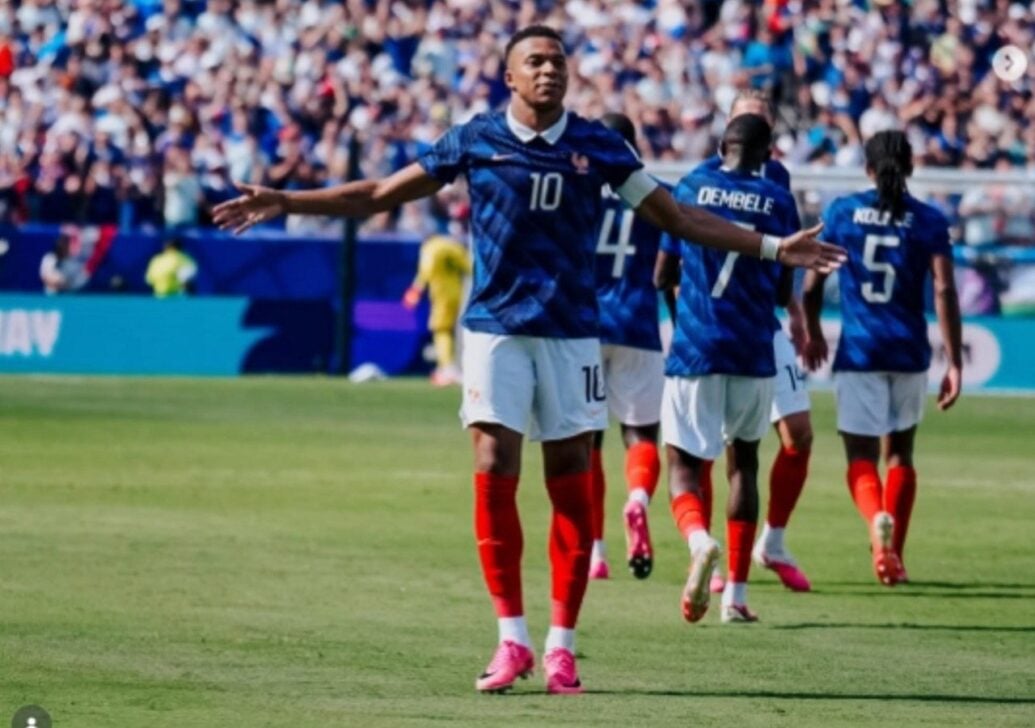
The starting eleven for the clash between the football teams of France and Iraq are officially defined for this Tuesday’s clash, valid for the second round of Group I of the 2026 World Cup. Scheduled to start at 6pm Brasília time, the sporting event is consolidated as the main attraction of the current round. Sports fans around the planet await the moment when players step onto the pitch to defend the colors of their respective countries.
The stage chosen to welcome the athletes is the Lincoln Financial Field, a large arena located in the city of Philadelphia, in the United States. Adding three points at this point is a vital task for both squads, who need to secure a comfortable position on the tournament leaderboard, now expanded to 48 participants. The atmosphere in the stands promises a lot of pressure, as neither nation can afford to stumble at this early stage.
The release of the list of starters allows an in-depth reading of the tactical intentions drawn up by commanders Didier Deschamps, on the European side, and Graham Arnold, responsible for the Asian bench. Each athlete selected went through a rigorous performance analysis process, aiming to nullify the opponent’s strengths. The Brazilian public will have the opportunity to follow all the action of the match through the Prime Video streaming service.
Strategies designed by coaches to dominate the midfield
The European squad steps onto the pitch structured in a system designed to suffocate the opponent without losing security at the rear. Using the 4-2-3-1 tactical design, the French coaching staff guarantees immense fluidity in the creative sector, allowing the midfielders to constantly change positions behind the reference man. The main objective of this format is to retain possession of the ball in the central circle and activate the wingers at maximum speed, generating constant danger through infiltrations from the sides.
On the Asian side, the drawing board points to a conservative 4-5-1, making it clear that the absolute priority will be to congest the entrance to the area and punish the opponent’s mistakes with quick transitions. By populating the midfield sector with five players, the intention is to destroy the favorites’ passing lines and force hasty crosses. This low marking block also acts as a shield for defenders, setting the stage for long throws aimed at the lone attacker up front.
Clash of talents between European attack and Asian hope
The course of the ninety minutes will depend directly on the performance of the main stars of each delegation, players who tend to unbalance truncated matches. Wearing the shirt of the two-time world champions, Kylian Mbappé carries the status of the greatest offensive threat, combining a rare physical explosion with a lethal instinct in the small area. The number 10’s ability to break the last line of defense will be the Europeans’ main resource in opening the scoring in the opening minutes.
Representing the team that runs on the outside, Amir Al-Ammari takes on the responsibility of governing his nation’s offensive actions, delivering a completely different dynamic from the rival star. Even though he plays further away from the goal, the midfielder is the brain behind any attacking attempt by his team. His precision in long passes and spatial intelligence are mandatory requirements for the team to be able to exploit the holes left by the French full-backs, optimizing rare ball possessions in the attacking field.
Current situation of the Europeans in the tournament leaderboard
Provisionally occupying second place in Group I, the popular European team enters the arena carrying the weight of being the big favorite for the title. With a dressing room full of athletes who play for the biggest clubs on the planet and the weight of the global achievements of 1998 and 2018, the goal is to command respect from the opening whistle. The team’s recent history demonstrates enviable solidity, proving why they are considered an unquestionable power on the sporting scene.
Maintaining the level of excellence of the latest competitions is the obsession of the current generation of players. The continuity of the work of the technical committee guaranteed rare stability, directly reflected in the third overall position in the world ranking of teams. Overcoming tonight’s opponent means taking a giant step towards the knockout stages, avoiding any type of drama in the last round of the qualifying phase.
Challenges faced by the Asian team in the current phase of the competition
At the bottom of the table, in fourth place in the group, the Middle East squad sees the match as a true final to keep their dream of qualifying alive. Having only lifted one major trophy in its continental trajectory, going head to head with a European superpower is the definitive test for this generation. The group’s focus is to deliver an impeccable performance in defense and prove that they can compete at the highest level of physical demand.
Treated by experts as the underdogs of the clash, the players have enough tactical discipline to turn the game into a test of patience for the favorites. The resilience capacity implemented by coach Graham Arnold will be pushed to the maximum limit during opposing attacks. Parked in 57th position in the global ranking, the delegation sees the ninety minutes as the perfect showcase to show technical evolution and, who knows, achieve a historic point.
Names chosen to start the match in the United States
The official documents submitted to the arbitration reveal the identity of the twenty-two professionals who will begin the clash. The final lists are the result of weeks of closed training and tactical simulations focused exclusively on the opponent’s characteristics.
France national team starting line-up
- Goalkeeper: M. Maignan (16).
- Defense line: J. Koundé (5), W. Saliba (17), D. Upamecano (4) and L. Digne (3).
- Containment and exit flywheels: M. Koné (6) and A. Rabiot (14).
- Point guards and wingers: M. Olise (11), O. Dembélé (7) and B. Barcola (12).
- Shooting man: K. Mbappé (10).
Eleven initials chosen to represent Iraq
- Goalkeeper: A. Basil (22).
- Defensive quartet: H. Ali (3), Z. Tahseen (4), A. Hashem (5) and M. Doski (23).
- Midfield sector: Z. Ismail (24), A. Al-Ammari (16), Z. Iqbal (14) and I. Bayesh (8).
- Offensive link: A. Qasem (11).
- Isolated striker: A. Hussein (18).
Calendar of clashes that move the week of world football
The schedule for the biggest sporting event on the planet continues at full steam, delivering a marathon of decisive matches for lovers of the sport. Away from the spotlight of the city of Philadelphia, other teams will take to the field in the coming days to define their fate in the competition, ensuring clashes of a high technical level.
The tournament organizers confirmed the following schedule for the group stage matches:
- The agenda for June 22nd reserves the duel between Norway and Senegal, scheduled to start at 9pm.
- On June 23rd, the ball rolls to Jordan and Algeria at midnight, followed by Portugal and Uzbekistan at 2pm.
- Still on the 23rd, England plays against Ghana at 5pm, Panama faces Croatia at 8pm, and Colombia ends the night against DR Congo at 11pm.
- On June 24th, Switzerland and Canada will meet at 4pm, the same time as Bosnia and Herzegovina against Qatar.
- Following on the 24th, Scotland and Brazil play at 7pm, simultaneously with Morocco and Haiti.
- The end of the round on the 24th features the Czech Republic against Mexico and South Africa against South Korea, both at 10pm.
Structure that welcomes fans in the city of Philadelphia
The imposing Lincoln Financial Field arena was the facility designated by the organizing committee to host this international spectacle. Famous for its bold architecture and for being the home of major American sports franchises, the complex offers impeccable lawns and state-of-the-art locker rooms. The ease of access and the impeccable track record in welcoming crowds justify the choice of location for a game with global broadcast.
The stands should pulsate with the presence of thousands of immigrants and tourists, creating that cultural mosaic that only this tournament can provide. The stadium already has an intimate relationship with the expansion of Breton sport in the North American market, and hosting a clash of this magnitude only consolidates its importance. The deafening noise of the organized fans will act as extra fuel for the athletes seeking victory on the field.
Classification scenario and the fierce competition for places
The current format of the competition does not allow for planning errors, and the configuration of Group I perfectly illustrates the level of tension involved. Adding points in this initial stage is a mathematical obligation for anyone who dreams of playing in the knockout games, where the level of difficulty increases drastically. A simple draw could mean the difference between advancing to the next stage or packing your bags early.
The bracket presents a cultural clash of playing styles, forcing coaches to adapt their tactics every three days. While Europeans deal with the pressure of confirming the favoritism imposed by the media, Asians play with the lightness of those who have nothing to lose. This dynamic transforms each midfield challenge into a crucial moment for the group’s outcome.
Sports market projections and escalated arbitration
With the cards on the table and the teams defined, the sports analysis market points to absolute dominance for the team in blue. Platforms specializing in statistics offer minimal returns for a European victory, highlighting the technical gulf between the squads. Despite the cold numbers, the history of the sport is built on historical obstacles, and a well-executed defensive system can frustrate the favorites’ plans.
The tactical design suggests a monologue of ball possession on the part of the two-time champions, forcing the opponent to defend themselves within their own area for most of the time. Individual talent will be the key to breaking through. To control the players’ tempers, FIFA appointed Canadian referee Drew Fischer, an experienced professional who carries a historical average of 3.49 cards applied per match, indicating that harsh fouls to stop counterattacks will be punished with immediate severity.