

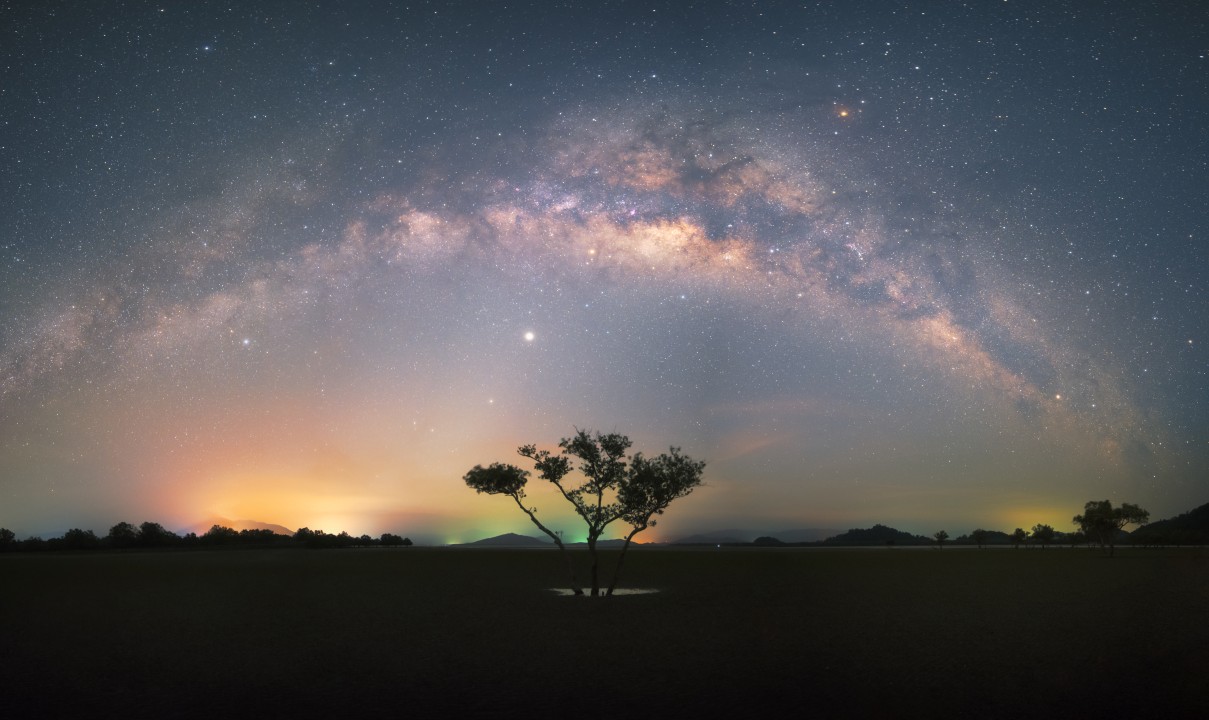
Researchers from Harvard and Smithsonian universities have identified a gas-rich area at the center of the Milky Way with ideal conditions for the birth of new stars. The announcement of the discovery was made during the 248th meeting of the American Astronomical Association, taking place in Pasadena, California. The finding was detailed by researcher Rojita Buddhacharya.
This location, observed with the assistance of the ALMA telescope, considered the most advanced in the world, represents a fundamental environment for the formation of future generations of stars in our galaxy.
Detailed analysis of gaseous movement at the center of the galaxy
The study used the high resolution capacity of the telescope located in Chile to monitor the movement of dense gas in the central region of the galaxy. Rojita Buddhacharya explained that the data obtained revealed in detail how the gas transitions from an extremely turbulent state to a calmer condition on reduced physical scales.
In this same area, the scientific team observed a structure that resembles a filament, or a thread of gas, that exhibits random movements on a small scale. This characteristic suggests the existence of a stability necessary for matter to group together, an essential factor for star formation.
Ideal conditions for the emergence of new stars
Scientific research has proven that the gravitational force in this specific area is strong enough to hold the gaseous mass together. This factor elevates the region to a strong candidate for being a star nursery. Although this gaseous filament can dissipate or accelerate at certain times, the local density favors the maintenance of its structure, according to information published by Correio Braziliense.
The main focus of the analysis is on primordial gas, which serves as the foundation for the development of young stars in the universe. This type of direct observation of current dynamics offers unprecedented insight into stellar renewal processes in our own galaxy, functioning as a real-time laboratory.

Machine Learning Tool for Future Discoveries
Due to the vast volume of information contained in the Central Molecular Zone, which encompasses more than ten million spectral points, scientists have employed new technologies in their research. Senior astrophysicist Qizhou Zhang, who is also a co-author of the project, revealed that the group is developing a machine learning tool. The goal is to identify other similar “islands of calm” throughout the central area of the Milky Way.
“We are investigating the quietest gas regions that can give rise to star formation,” Zhang said. He added that “as the Central Molecular Zone has more than ten million spectral data points, we are creating a machine learning tool to discover these ‘islands of calm’ throughout the Galactic Center”, detailing the ongoing automated mapping process.
Until now, scientific knowledge was limited to identifying regions of calm gas only in areas of the galaxy located close to the Sun. However, the Sun and most of the stars we know formed about 4.5 billion years ago, in a period when conditions in the universe were considered more extreme and less conducive to direct observations of stellar gestation. The current discovery allows for a more precise observation of the dynamics present in the galactic heart.