

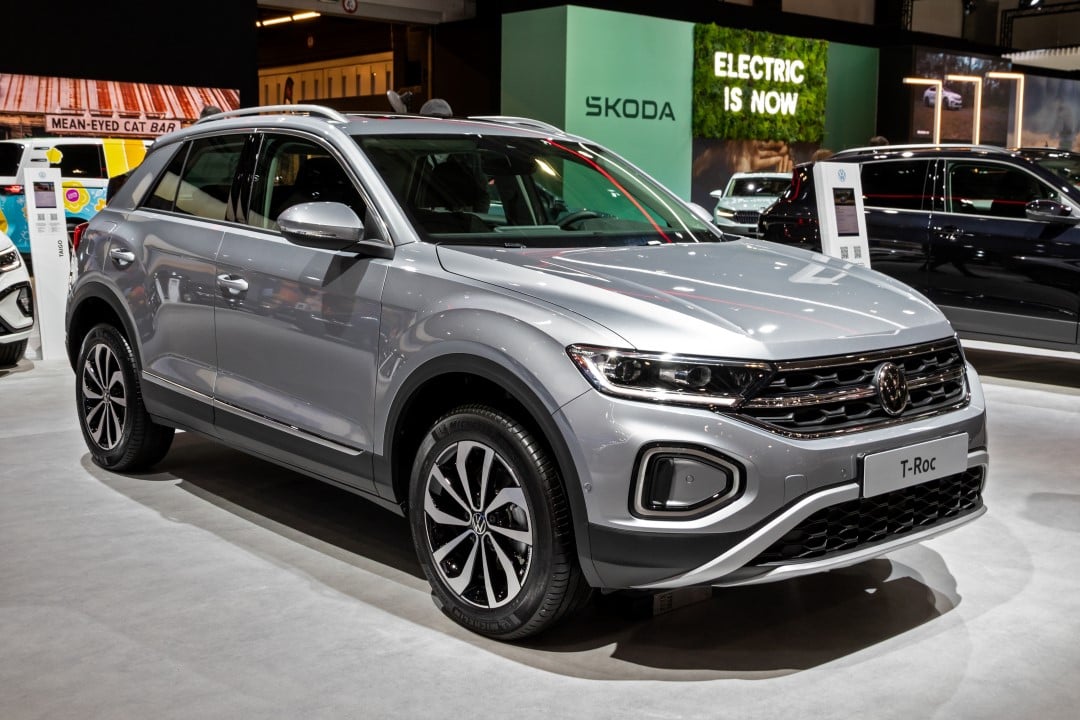
Prototypes of Volkswagen’s new line of SUVs are in an advanced testing phase in Brazil, intensifying preparation for future launches. Recently, after the sighting of the new generation of Taos, the T-Roc model was spotted on national soil by the profile @placaverde, accompanied by the Tukan pickup truck. This SUV of European origin will play a crucial role, functioning as the platform for the future Saga project, an unprecedented crossover with a sporty design and hybrid powertrain destined for the Brazilian market.
Mechanics and hybrid production of the new T-Roc in Brazil
In terms of propulsion, the latest T-Roc will provide its Brazilian counterpart with 48 Volt mild hybrid (MHEV) and high voltage full hybrid (HEV) powertrain technologies. Both configurations will be based on the 1.5 TSI Evo2 engine. Initially, this engine will be imported from Mexico, but Volkswagen plans to nationalize its production at the São Carlos (SP) unit from 2031, as revealed. This strategy was confirmed by Volkswagen’s global CEO, Thomas Schäfer, in an exclusive interview given in September 2025.
In addition to the hybrid systems, Project Saga, internally known as Nivus NF or VW213, will share the MQB Evo architecture with the T-Roc, also referred to as MQB 37. This suggests that the version manufactured in the country will maintain dimensions very similar to those of the European model. It is estimated to have a length of 4.37 meters, a width of 1.83 m, a height of approximately 1.60 m and a wheelbase of 2.63 m, with a trunk of 465 liters.
Sports look and national identity for the Saga project
Regarding design, the Saga, still a project codename, will display an aesthetic developed specifically for the Brazilian market. The lines will be designed by the team led by designer JC Pavone, known for his contribution to the Nivus and Tera projects. A projection created by João Kleber Amaral anticipates visual characteristics, including wider rear wheel arches, thinner headlights interconnected by a fillet and a C-pillar finished in the same shade as the body. Although there are inspirations from the T-Roc, the national model is expected to present several modifications.
Unprecedented comfort and technology features in the national SUV
As for the list of equipment, the future Saga stands out as one of the most sophisticated vehicles ever manufactured by Volkswagen in Brazil, introducing features never before seen in the brand’s national line. Previous information indicates that the SUV will feature items such as an electronic parking brake and a rotary gear selector, which will replace the conventional lever. These innovations represent a significant advancement for locally produced Volkswagen models.
Additionally, the Saga’s highest-value configurations will include a sunroof, a feature that will make its debut on cars manufactured at the São Bernardo do Campo plant. Currently, the exclusive production of vehicles with this equipment in Brazil resides in the São José dos Pinhais (PR) industrial complex.
Parallel development of the A-SUV project, the new Taos
In a simultaneous effort with the Saga, Volkswagen is also dedicating significant resources to another important SUV project for the Brazilian market, the A-SUV, also identified as the VW226. Details about this development have been revealed exclusively, including the strong possibility that the model will be launched under the name “new Taos”. Initially, there was speculation about the name “new T-Cross”, but the size and design of the vehicle position it, in fact, as the successor to the brand’s current medium SUV.
Similar to Project Saga, the A-SUV will also use the T-Roc’s MQB Evo platform and employ the same hybrid systems. Both models will share the assembly line in São Bernardo do Campo (SP), with the adoption of MHEV and HEV hybrid sets expected. These developments are part of a total investment of R$20 billion that Volkswagen allocates to the modernization and expansion of its vehicle range in Brazil, a strategic move to boost the brand’s electrification and competitiveness in the national automotive scene.
The expectation is that the Saga will be introduced to the market first, in 2027, characterized by its sporty design and coupe-type body, aiming to compete directly with the Omoda 5. On the other hand, the A-SUV, which could be the “new Taos”, will be launched in 2028, presenting a profile more aimed at families, with an emphasis on internal space and comfort.