

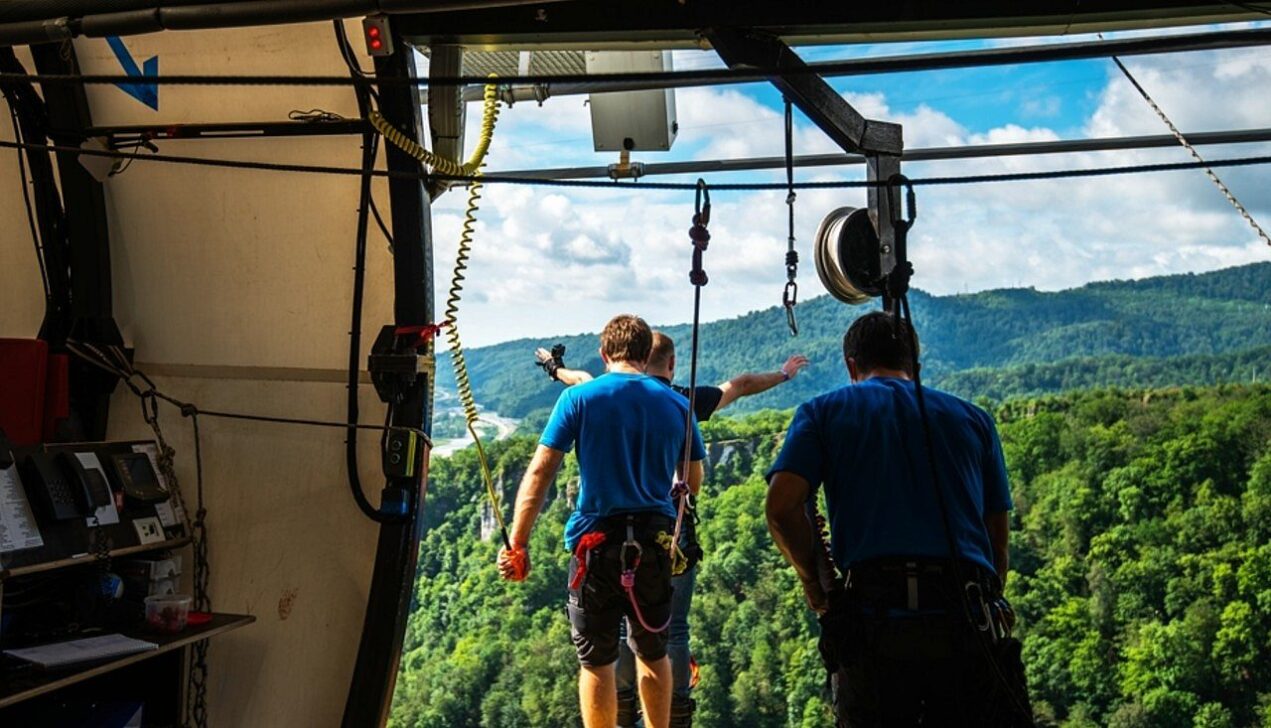
The death of Maria Eduarda Rodrigues during rope jumping, which occurred a week ago, reignited the debate about safety in extreme sports in Brazil. The young woman was thrown from a height of 40 meters in free fall, without using the safety ropes essential for the sport, while the team performed a series of jumps on Ponte do Esqueleto, in Limeira, São Paulo.
The investigation into the case is still ongoing, but the incident brought great visibility to a jumping method that, although already popular among adrenaline enthusiasts, was little known to the general public. To clarify the aspects of the sport and the likely failures that culminated in the tragedy, the portal spoke to Adelino Martins, a rope jump specialist and representative of the Barramansense collective “A Vida nas Cordas”.
Understand the history and current state of the sport in Brazil
Rope jumping is classified as an extreme adventure sport that shares characteristics with bungee jumping, mainly because it involves jumping from high altitudes. Unlike bungee, it uses non-elastic ropes, designed to provide the sensation of free fall, culminating in a swing in the air similar to the movement of a pendulum when reaching the limit of the rope’s length.
Despite having gained a base of loyal practitioners, the sport still operates without official regulation in Brazilian territory. Currently, rope jumping does not have a set of standards, specific protocols or a government inspection system, even in places where the practice is legally permitted.
Adelino Martins explains that rope jumping is a relatively recent activity in Brazil, with around 15 years of existence, and that its execution requires highly complex planning. “In ten years, we have made a lot of progress, but it is still little. Many companies operate without CNPJ, for example. The ideal would be a team that follows the standards: CNPJ, adventure insurance and professionals trained in working at heights, rescue and first aid”, explains the professional, highlighting that his team includes civil firefighters and nurses on every jump day.
A significant advance towards the consolidation of rope jumping in Brazil was the founding of the Brazilian Rope Jump Association just over two months ago. Currently, the entity has three affiliated companies and a growing demand. According to Adelino, the organization is responsible for establishing safety standards and penalizing companies that do not comply with established conduct, such as anchoring protocols and techniques for fixing to surfaces.
At the moment, the implementation of punishments by the Association is still in the development phase, given the recent nature of the entity. The regulation provides for an initial “tolerance”: companies that disregard the requirements receive a penalty but maintain their membership; in case of a second infraction, they are excluded. “As the association grows, we will be able to control security and offer courses to qualify companies”, projects Adelino, highlighting the importance of self-management for a sport that lacks state regulation.
Essential requirements for safety when practicing sport
Safety in rope jumping is guided by work protocols similar to those required for other adventure sports. As the activity can be carried out in different environments – such as bridges, cliffs and quarries –, assembling the jumping structure requires personalized strategies that respect the particularities of each location.
The essential equipment for assembly and safe practice includes semi-static or static ropes, carabiners for fixing, helmet, a “little chair” attached to the practitioner’s body, chest harness and braking mechanisms for the moment when the ropes reach their maximum length. The weight limit supported by the ropes varies between 2,500 and 3,000 kilos.
The expert warns that the majority of individuals seeking rope jumping have little or no prior experience in the sport, which can make it difficult to understand the safety standards adopted by the company providing the service. Adelino advises that interested parties always check the company’s reviews on platforms such as social networks and Google, in addition to confirming the existence and authenticity of the CNPJ.
The serious failures that led to the tragic accident with Maria Eduarda
Adelino Martins emphasizes that, in incidents like the one that killed Maria Eduarda Rodrigues, the responsibility does not fall on the victim, but on the company. “[The victim] was under no obligation to do anything. The only thing she did was buy a jump with insurance. And this company was fake, they invented a CNPJ and presented it to the bridge organization”, explains the expert.
Analyzing the irregularities in the accident, Adelino points out that the company had been operating for a few months and had an inexperienced team. He details the multiple steps of a safety protocol that were completely ignored: “In every team, there are several functions. The first of them is to put on the individual equipment [on the athlete], which is the seat and harness. After that, another person needs to check if everything was done correctly. When the athlete goes to the jumping area, there will be someone to offer instructions on how to jump and ask how the practitioner wants to do that jump. There a second ‘checkup’ is carried out to see if the anchors and ropes they are the correct size and height. When the athlete arrives on the platform, there is another person to place the rope and another to check the rope: whether the block is ready, whether it is at the right height below and whether we are in a position to release the jump, none of this was done”, he concludes.