

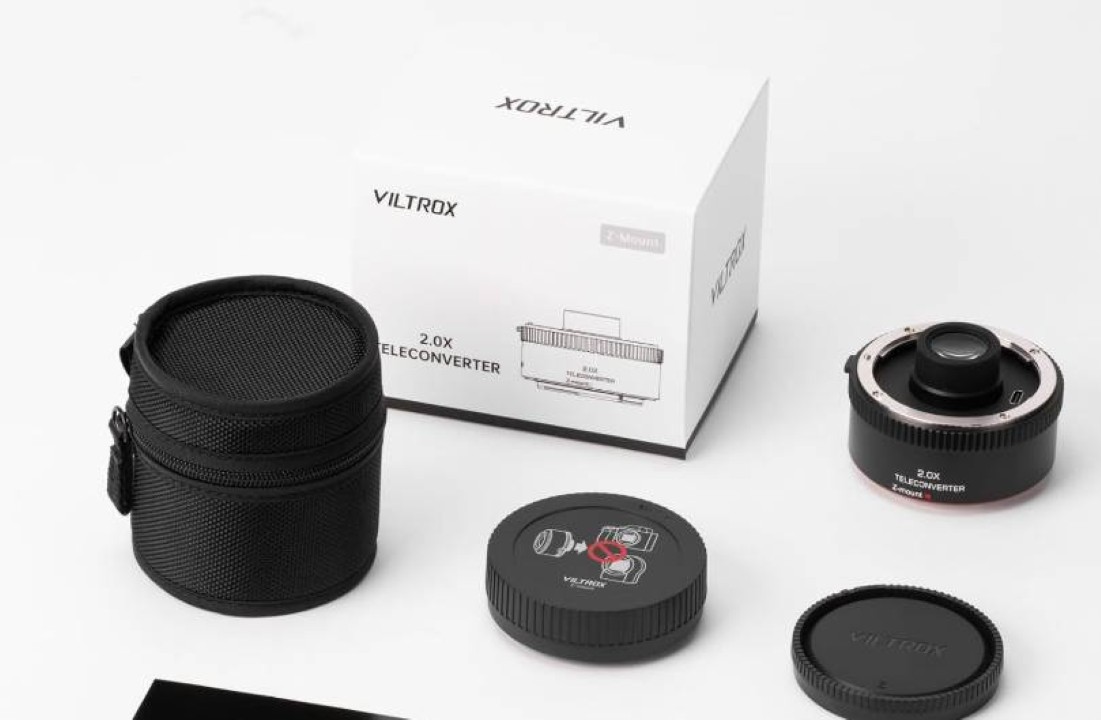
Viltrox, a company specializing in photographic equipment, announced the launch of two new teleconverters on the Japanese market, developed for E and Z mounts.
Among the devices presented, the Viltrox Teleconverter 2.0x stands out, which offers full compatibility with cameras equipped with full-frame sensors.
The commercialization of Viltrox’s new accessory, called “Viltrox Teleconverter 2.0x”, will be led by Eizo Arashi Co., Ltd., with a launch date scheduled for June 23, 2026, a Tuesday. The suggested retail price for the public is ¥59,000, including all taxes.
This 2.0x teleconverter from Viltrox is designed to couple between the camera body and the lens, doubling the focal length of the lens in use, especially on full-frame models.
The device’s internal optical configuration is made up of nine elements arranged in five groups. The project uses three high refractive index lenses, ensuring that resolution and image quality are maintained even with twice the focal length.
Equipped with electronic contacts, the device ensures full transmission of vital information such as autofocus (AF), EXIF data and aperture control, when used with compatible camera bodies and lenses.
Mounting systems compatible with the new teleconverter include the popular Sony E and Nikon Z mounts.
Developed with telephoto photography in outdoor environments in mind, the teleconverter has a robust structure, resistant to dust and splashes, providing greater durability and reliability in the field.
A USB-C port is also present, facilitating future firmware updates. This feature is crucial for optimizing compatibility with new camera bodies and lenses that may appear on the market.
The Viltrox 2x teleconverter, which had already received very favorable reviews in other countries, is now officially available for purchase in Japan.
This optical accessory has been widely praised, achieving high scores in reviews such as Sony AlphaBlog. This assessment highlights that its performance can be “equal to or slightly better than that of the original lenses”, a notable difference. Additionally, the ability to work with lenses from other manufacturers, something that private-label teleconverters generally don’t allow, elevates its appeal to photographers. However, uncertainty persists regarding official licensing with major camera manufacturers, which raises questions about the potential management of future operational or compatibility issues.