Star Wars: Galactic Racer emerges with inspiration from Burnout, combining speed and narrative in the Outer Rim
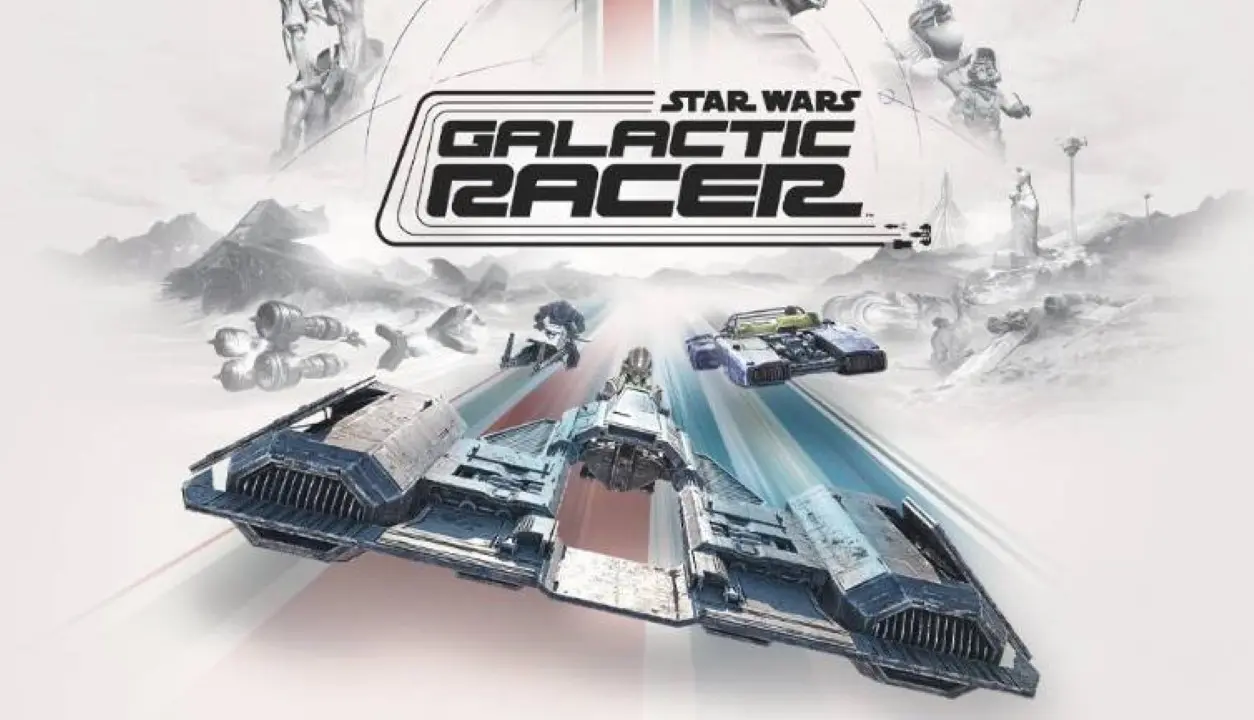
After a hands-on experience with Star Wars: Galactic Racer at Summer Game Fest (SGF), it was clear that Fuse Games goes beyond reviving the nostalgia of the saga’s races. The studio is building a dynamic, competitive, story-driven arcade racing game that has its own identity, but is heavily inspired by the Burnout series.
Speed has always been a central element in the Star Wars universe, from the tense races in ship trenches to the intense speeder bike chases and the pure adrenaline of pod races. Despite this, it had been a long time since a racing title in the franchise generated so much expectation and did not seem like a significant event. After testing Star Wars: Galactic Racer at SGF, the long wait for a game like this seemed rewarding.
Developed by Fuse Games and published by Secret Mode, Star Wars: Galactic Racer presents a high-speed adventure set in the Outer Rim. This region became a lawless area after the fall of the Galactic Empire. While the New Republic still struggles to find its feet, the criminal underworld thrives, and a new obsession dominates the galaxy: the Galactic League, an underground racing circuit. In it, unions finance pilots, rivalries become dangerous and each race seems ready to end in a major accident.
What impressed most during the in-person test was the richness and depth of the game’s universe. There are characters with well-developed stories, NPCs interacting in garages between races and a third-person exploration mode that allows you to visit completely accessible base camps. The title reveals itself to be much more than a simple arcade racing game, although it also incorporates all the essential elements of the genre.
Campaign focuses on narrative and rivalry
In the game, players take on the role of Shade, a skilled racer who is recruited into the League by Darius Pax, an experienced mechanic with a passion for racing. Pax tries to give legitimacy to a sport that has become dangerously influenced by Kestar Bool, the current League champion. The campaign appears to be structured around something beyond merely winning events. There’s an explicit rivalry, a cast of drivers and mechanics, and a genuine effort to make the racing circuit feel like a part of the Star Wars universe worth exploring.
Burnout influence evident on gameplay
One of the most captivating aspects is the freedom to drive extremely aggressively during races. This includes the possibility of colliding with other vehicles, watching them explode when they hit barriers and even being the target of abuse for your unconventional driving. The crashes, explosions and the hallucinating sensation of speed are the points where the essence of Burnout manifests itself most strikingly.
Professionals with experience in renowned titles such as Burnout and Need for Speed participated in the development of Galactic Racer, and its brand has been notable since the first contact. Far from being a technical or restricted science fiction racing game, it embraces an audacious and intuitive proposal. This aggressive and visceral approach, which focuses on the thrill of almost losing control as the environment turns into a blur of speed, fills an important gap in today’s market, where games of this intensity are increasingly rare. Vehicles slide through curves, jets of power propel the player into risky areas, and the tracks are designed to value daring, without ignoring the consequences of recklessness.
Highlight the iconic pod races
Pod racing, as expected, represents one of the game’s biggest attractions. There is a particular fantasy associated with these competitions that is intrinsic to the history of Star Wars, and Galactic Racer seems to capture that essence. Podracers are loud, unstable and deliver just the right dose of excitement. They’re not just there to please fans; they seem like a natural extension of a game built on the pillars of danger, high speed and almost uncontrollable machines.
When Galactic Racer reaches its top speed, with players dodging obstacles and fighting to stay on track as the track disintegrates into chaos around them, the game captures precisely the kind of energy that made the idea of racing in the Star Wars universe so fascinating in the first place.
Leia Também
VAR decides to cancel Colombia’s goal against Portugal after a thorough analysis of the tip of the boot, impacting the classification in Group K of the 2026 World Cup
Lautaro Martínez simply scores a great penalty in Jordan x Argentina at the 2026 World Cup

Rota officer and family member of Eloá Pimentel is ambushed by gunfire at a traffic light in ABC Paulista
“We always play to our strengths. We have a specific sensitivity to how we like to create games. I’m sure that if you’ve played any of our projects, that DNA will be present here, as it is in everything we do.”
“And that’s one of the foundations of the studio, this mutual understanding and long history of shared love for certain types of mechanics and experiences around fast-paced, exciting arcade racing games,” said creative director Kieran Crimmins in an interview with IGN.
Ambitious campaign structure with roguelite elements
The campaign structure also proves to be more ambitious than that of a traditional arcade racing game. Galactic Racer uses a phase-based campaign, organized into a Galactic Tour divided into three acts. Players progress through a sequence of events on different planets, with races, heats, field trials and unexpected encounters shaping each stage. Routes can be changed, rewards are crucial, and defeat can result in the loss of League Entry Tokens. Accumulating too many chip losses means the end of the tour, although certain forms of meta-game progression are maintained.
This structure gives the game an atmosphere reminiscent of a roguelite, but without disqualifying it as a racing title. After each event, players have the opportunity to collect rewards, install improvements, equip new parts, apply skills and optimize their vehicle configuration.
“We want every decision to matter, every upgrade to matter, every vehicle to matter, every race to matter, and the race-based structure allows us to do that like we’ve never done before in an arcade racing game.”
“Not only do you have to stay at the forefront in terms of construction, skill and knowledge of the track, but you also have the opportunity to start over each time,” added creative director Kieran Crimmins in an interview with TechRadar.
Expectations for the official launch
There are still important considerations to keep in mind as the launch approaches. The full campaign will need to demonstrate that its race-based structure maintains excitement beyond the initial novelty. Multiplayer mode will have to prove that the chaos can be sustained with the maximum number of participants. The vehicle customization and construction system will need to be meaningful without compromising the sense of immediacy that is fundamental to how arcade racing games work. Despite these issues, the base of the game looks quite promising.
Star Wars: Galactic Racer is scheduled for release on October 6, 2026, and will be available for PlayStation 5, Xbox Series X|S and PC. After playing it, the biggest compliment possible is that the desire to participate in another race immediately arose. As soon as he got home after the event, the tester turned on his original Xbox to satisfy his nostalgia with Burnout 3: Takedown.