

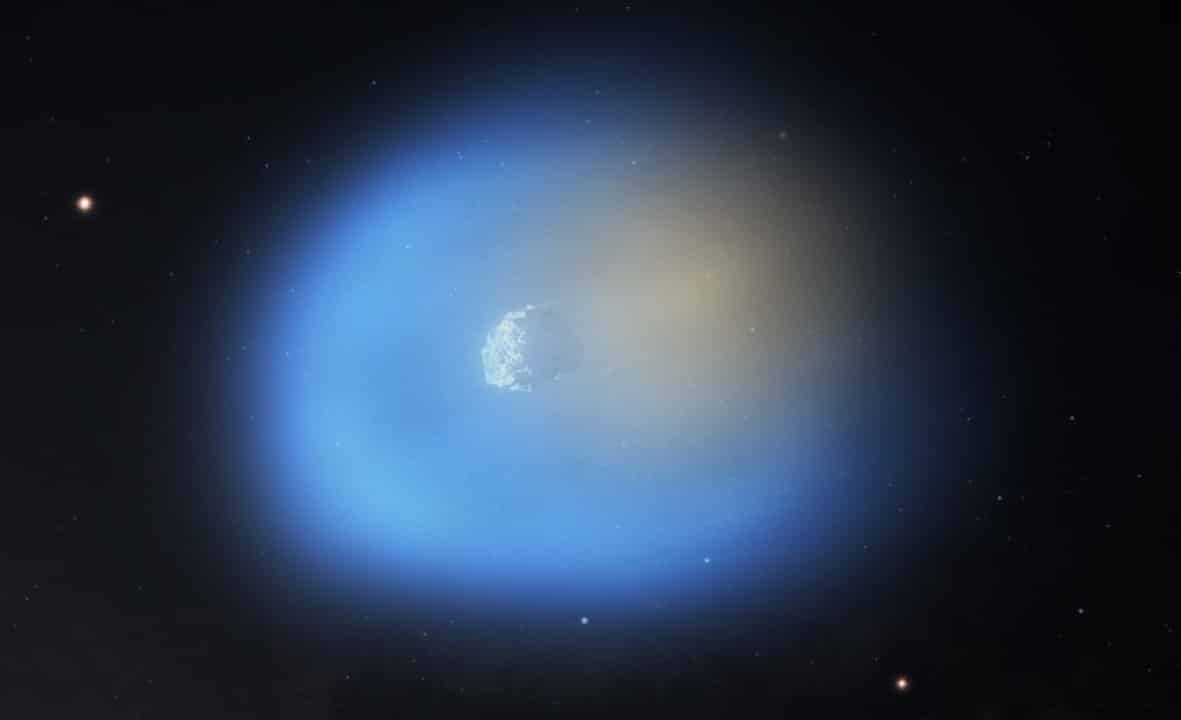
A comet passing through the Solar System could be one of the oldest celestial bodies ever observed, offering new insights into the formation of our galaxy. Observations from the James Webb Space Telescope indicate that the interstellar object known as 3I/ATLAS possibly originated even before the Sun.
Research points to an estimated age of between 10 and 12 billion years, a period that dates back to the early stages of the formation of the Milky Way. This feature positions the comet as a valuable fossilized record of a primordial stage of the galaxy, preserving crucial information.
The singularity of the interstellar comet 3I/ATLAS in the Solar System
3I/ATLAS is the third interstellar object confirmed by astronomers. Unlike comets that orbit the Sun, it has its origin in another star system and will continue its cosmic journey after crossing the solar vicinity.
To investigate its composition, researchers analyzed the gases released when the Sun’s heat caused its ice to transform into vapor. The NIRSpec instrument, attached to James Webb, was essential in identifying the comet’s unique “chemical signature.”
New chemical markers suggest formation in the early Milky Way
The comet showed concentrations of deuterium, also known as heavy hydrogen, that are approximately 30 times greater than those found in comets native to the Solar System. This data suggests that it formed in an extremely cold environment, with temperatures below 30 kelvin.
Furthermore, variations in carbon composition were identified, with a reduced presence of carbon-13. This particularity indicates a probable formation in a remote era of the galaxy, when its elemental chemistry was different from that observed today, which offers direct evidence about the availability of light and heavy elements in the early days of galactic star formation.
The telescope also made the first detection of methane in an interstellar object, released due to solar heating, and recorded a high concentration of carbon dioxide.
Each of these detected components is considered crucial by scientists to reconstruct the conditions of the environment where the comet formed. There is also the hypothesis that the star that gave rise to it may have extinguished a long time ago.