

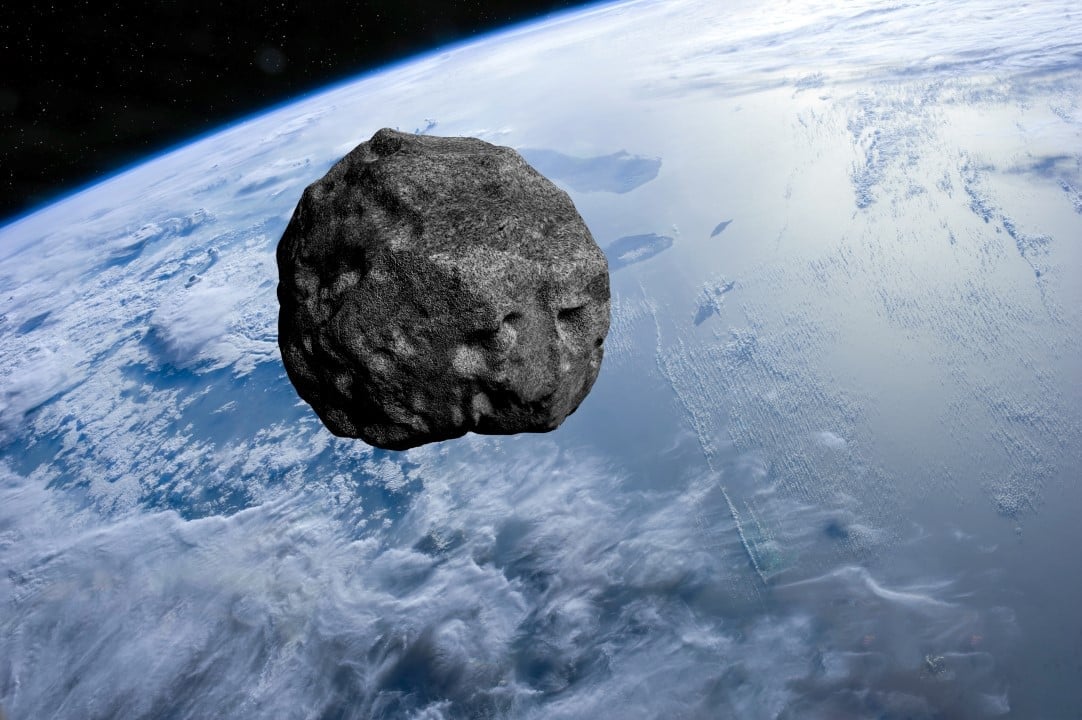
A space rock of considerable dimensions, with a diameter estimated between 750 meters and 1.6 kilometers, will make a pass close to our planet on Saturday, the 27th. The information was released through projections by the European Space Agency (ESA).
The celestial body will reach its closest point to Earth at 8:14 am, according to the Brasília time zone. Its travel speed is estimated to reach an impressive 8.9 kilometers per second.
ESA data indicate that, at the peak of its approach, the asteroid will be at a distance of 2,559,461 kilometers from the planet. This measurement is equivalent to around 6.66 times the distance that separates the Earth from the Moon, guaranteeing a zero probability of impact. Following trajectories like this, even without risk, is vital for the continuous improvement of planetary defense strategies and for understanding near-Earth objects.
As Juan Luis Cano, member of ESA’s Planetary Defense Office, explained, it is rare for an object of such dimensions to come close to Earth, something that happens “only every few years”. He also highlighted that the presence of a bright Moon in the sky, in its close phase, could make observation of the asteroid more challenging at the time of its closest passage.
Origin and discovery of the asteroid (152637) 1997 NC1
The celestial body, named (152637) 1997 NC1, was discovered in 1997, completing almost three decades since then. During the period of its approach, it can be seen in certain areas of the Northern Hemisphere.
At its closest proximity to the planet, the asteroid will offer visibility to almost all regions of the Earth. However, at the moment he begins his departure, his observation will be restricted exclusively to the Southern Hemisphere.
The European Space Agency reported that, in locations where night coincides with the asteroid’s passage, it will be possible to observe it using telescopes or long-range binoculars.
What are asteroids and their composition
Asteroids are characterized as rocky and metallic formations that revolve around the Sun, although their dimensions are insufficient to be categorized as planets. Often called “minor planets”, these bodies represent the remnants of the formation of the Solar System, which occurred more than 4.6 billion years ago, constituting elements that did not acquire enough mass to unite and give rise to a larger planet.
The diversity among asteroids is remarkable, ranging from small boulders to rocks of colossal dimensions, which can measure hundreds of kilometers in diameter. Due to their small size, they typically do not exhibit a perfect spherical shape, presenting irregular contours. Additionally, these rocky bodies often contain an abundance of valuable minerals such as silicates, iron, and nickel.
Most asteroids are found in the region known as the Asteroid Belt, located between the orbits of the planets Mars and Jupiter. However, it is important to note that there are also many of these celestial bodies distributed across several other areas of the Solar System.