

Recently, the European Space Agency (ESA) presented the most comprehensive and detailed photograph of the Milky Way’s core, captured in visible light.
This visual representation, obtained by the Euclid space telescope, highlights a density of more than 60 million stars, located in the region known as the galactic bulge, which constitutes the luminous center of our galaxy, together with nebulae and star formations.
This image was obtained in March 2025, after approximately 26 hours of continuous observation, being the final product of the combination of nine different records.
The amplitude of each individual segment exceeds the observable surface of the full Moon. By way of comparison, a large Earth-based telescope would require around 2,000 hours of work to document the same celestial area.
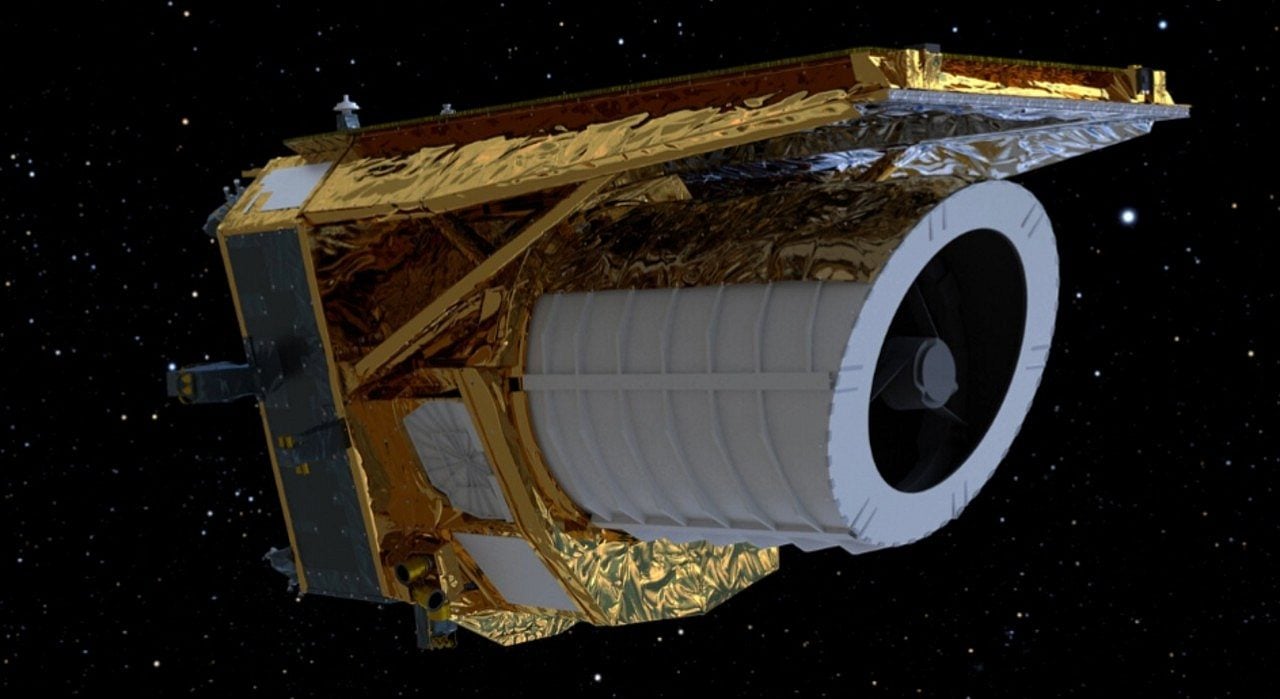
Originally designed to investigate the invisible dark matter and energy elements that prevail in the universe, the Euclid Telescope generally directs its observation toward remote galaxies.
However, at a specific request from scientists, the equipment turned its attention to the vicinity of our system. A significant differentiator of Euclid is its ability to distinguish isolated stars, even in extremely populated areas, without being compromised by light intensity.
This detail is of great value to the scientific community. The image in question has the potential to assist in the discovery and analysis of planets that revolve around other stars, so-called exoplanets, using a methodology known as gravitational microlensing.
This process occurs when a star, in its movement, positions itself in front of a more distant star, acting as a kind of magnifying glass that amplifies the luminosity of the more distant stellar object.
If there is a planet orbiting the nearest star, its gravitational force generates a slight additional variation in luminous intensity, and it is this minimal change that reveals its existence.
“In the last two decades, approximately 300 exoplanets have been identified using this same technique, all through ground-based observatories and always in the direction of the central part of our galaxy. The new Euclid photograph, in turn, covers 51 planetary systems already cataloged and will be crucial for the investigation of countless others that are yet to be discovered”, said Jean-Philippe Beaulieu, researcher at the Institute of Astrophysics in Paris and the University of Tasmania, and one of the project coordinators Euclid.
A single record, made in just one day, is not enough to identify new planets, as detection requires monitoring the stars for a period longer than 20 days.
However, photography fulfills the role of an initial record, documenting the precise location of the stars before any alignment. This establishes it as a fundamental time frame for future space endeavors, such as NASA’s Roman telescope mission.
This way, it will be possible to confirm the presence of planets and determine their respective masses. This approach is particularly effective for locating icy worlds far from their host stars.