

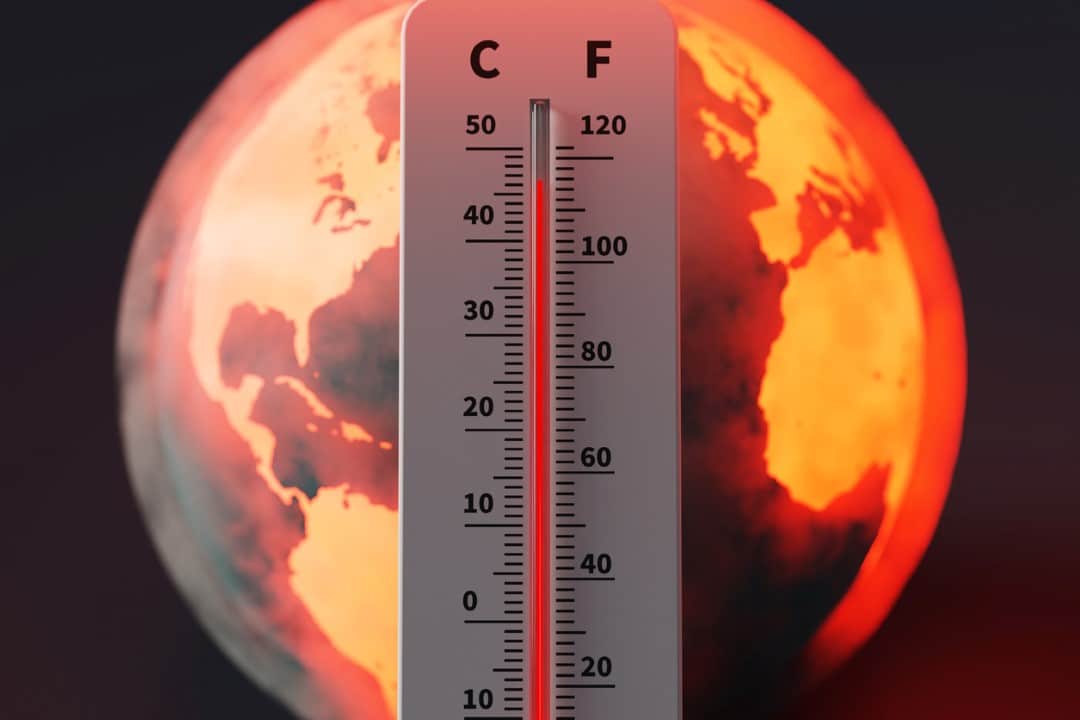
France and other regions of Europe are currently facing an intense heat wave. Experts have noted that the European continent has been warming faster than anywhere else in the world, and this phenomenon is explained by a combination of geographic, physical and atmospheric factors.
Scientists confirm that Europe is experiencing more frequent heat waves and a rate of warming higher than the global average. While the Earth’s average temperature has risen by around 1.4°C since the pre-industrial era, European territory has already recorded an increase of between 2.4°C and 2.5°C, according to the latest report from the European Copernicus service. The study predicts that by 2025, 95% of the European continent will experience greater warming than the rest of the planet.
This sharp rise in temperatures in Europe has several interconnected causes.
The influence of the Arctic on European warming
Geographical proximity to the Arctic contributes significantly to the rapid increase in temperatures on the European continent.
The Arctic region is the one that suffers most from extreme warming on the planet, and this phenomenon directly impacts the northern portion of Europe. This relationship generates a vicious cycle, amplified by albedo, which is the ability of a surface to reflect sunlight. In previous climate conditions, light-colored snow and ice acted as natural mirrors, reflecting the sun’s rays back into space. However, with the accelerated melting of glaciers and the decrease in snow cover in winter, the dark soil and rocks are increasingly exposed.
Data from the Copernicus report indicate that, in March 2025, the period with the highest snow volume, the area covered on the continent was 31% below the historical average (1991-2020). This extension is equivalent to the sum of the territories of France, Italy, Germany, Switzerland and Austria. The deficit represents the third lowest snow cover recorded in Europe since satellite measurements began in 1983.
In this way, solar energy starts to be absorbed instead of reflected, resulting in a considerable increase in temperatures at a local level.

Geographic factors that intensify temperatures on the continent
To explain the increase in temperatures in Europe, Copernicus also highlights that continental masses warm much faster than the oceans.
The oceans absorb almost 90% of the excess heat generated by the greenhouse effect, distribute this energy to the depths through sea currents and release the excess through evaporation. This process considerably mitigates the rise in air temperature over maritime areas.
In contrast, continents like Europe have recorded an average warming of approximately 0.56°C per decade since the 1980s, as detailed by the Copernicus program. This rate is more than double the global average, which is 0.27°C per decade.
This difference can be explained by the density of the Eurasian continental mass, of which Europe is part together with Asia. Copernicus also pointed out internal disparities on the continent: while Western Europe sometimes benefits from the relatively mild climate of the Atlantic Ocean, the Central and Eastern regions are directly exposed to a purely continental climate.
The Copernicus report also emphasizes the increasing frequency of atmospheric blocking events. Due to the warming of the Arctic, high-altitude currents, known as the Jet Stream, lose speed and form large waves. Meteorologists call this phenomenon “omega blockage.” In practice, the current stagnates and attracts extremely hot air from the Sahara, which is trapped over Europe for several weeks.
Improved air quality unexpectedly contributes to heat
Finally, there is another surprising factor that contributes to the scenario: the improvement in air quality.
For decades, industrial pollution in Europe, which included sulfur dioxide and fine particles, acted as a kind of filter. These particles reflected part of the sun’s rays back into space, promoting artificial cooling of the Earth’s surface.
By implementing strict public health regulations aimed at combating acid rain and smog, Europe has managed to significantly clean up its atmosphere. However, an unintended consequence was the general increase in temperatures.
The big question that remains is whether European infrastructures and societies will be able to adapt to these temperature rises, which tend to become permanent and intensify in the coming years.