

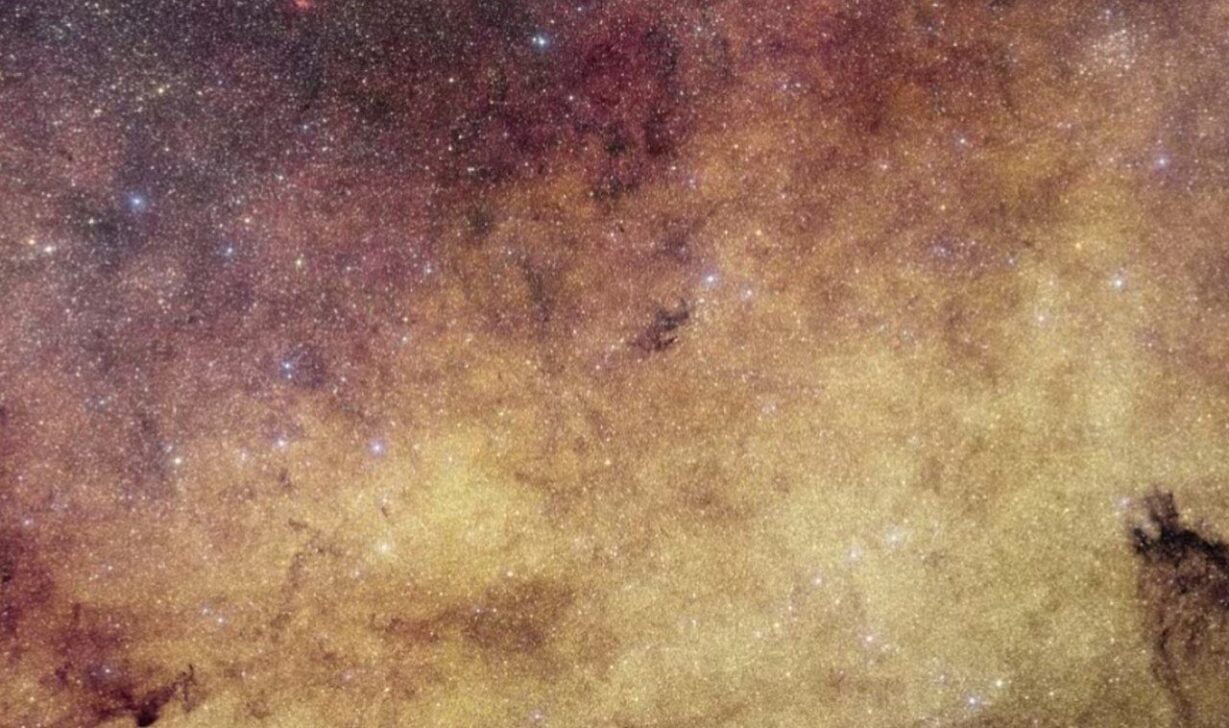
The European Space Agency (ESA) revealed, last Tuesday (24), the most comprehensive and clearest photograph ever produced of the nucleus of the Milky Way in the visible spectrum.
This image, captured by the Euclid space telescope, presents an impressive concentration of more than 60 million stars in the area known as the galactic bulge, the most luminous and central sector of our galaxy, also including nebulae and several stellar groupings.
The photographic composition was created in March 2025, after approximately 26 hours of monitoring, consolidating nine individual images to form the final result.
Each visual segment covers a portion of the firmament that exceeds the apparent size of the full Moon. To illustrate the scale of the achievement, high-capacity terrestrial telescopic equipment would need around 2,000 hours to capture the same perspective.
Although designed to investigate dark matter and dark energy, the preponderant invisible elements in the cosmos, Euclid generally directs its gaze to remote galaxies. However, in response to a request from researchers, the device this time focused on a nearby area. The telescope’s difference lies in its ability to distinguish isolated stars, even in such a densely populated region, without the intense brightness obscuring them.
This attribute is precisely what intrigues scientists. The new image is expected to help in the detection and study of planets orbiting other stars, known as exoplanets, using a methodology called gravitational microlensing.
This procedure occurs when a stellar body is positioned between the Earth and another more distant star, acting as a type of amplifying lens and intensifying the luminosity of the distant object. If there is a planet around the nearest star, its gravitational force generates a discreet additional variation in this brightness, and it is precisely this peculiarity that reveals its existence.
Over the past two decades, around 300 exoplanets have been identified using this approach, predominantly through Earth-based telescopes and always aimed at the center of the Milky Way. According to Jean-Philippe Beaulieu, researcher at the Institute of Astrophysics in Paris and the University of Tasmania, and one of the leaders of the Euclid project, this recent image already encompasses 51 planetary systems already cataloged and will serve as a basis for the investigation of many others that are yet to be discovered.
An observation of just one day is not enough to discover new planets, and stellar monitoring for a period longer than 20 days is necessary to do so. However, the photograph fulfills the role of a “pre-event” record: by outlining the precise location of stars before their alignments, it becomes a crucial temporal reference point for future missions, such as that of NASA’s Roman space telescope.
This way, it will be possible to confirm the presence of planets and determine their masses. This technique is particularly advantageous for locating cold celestial bodies far from their suns.