

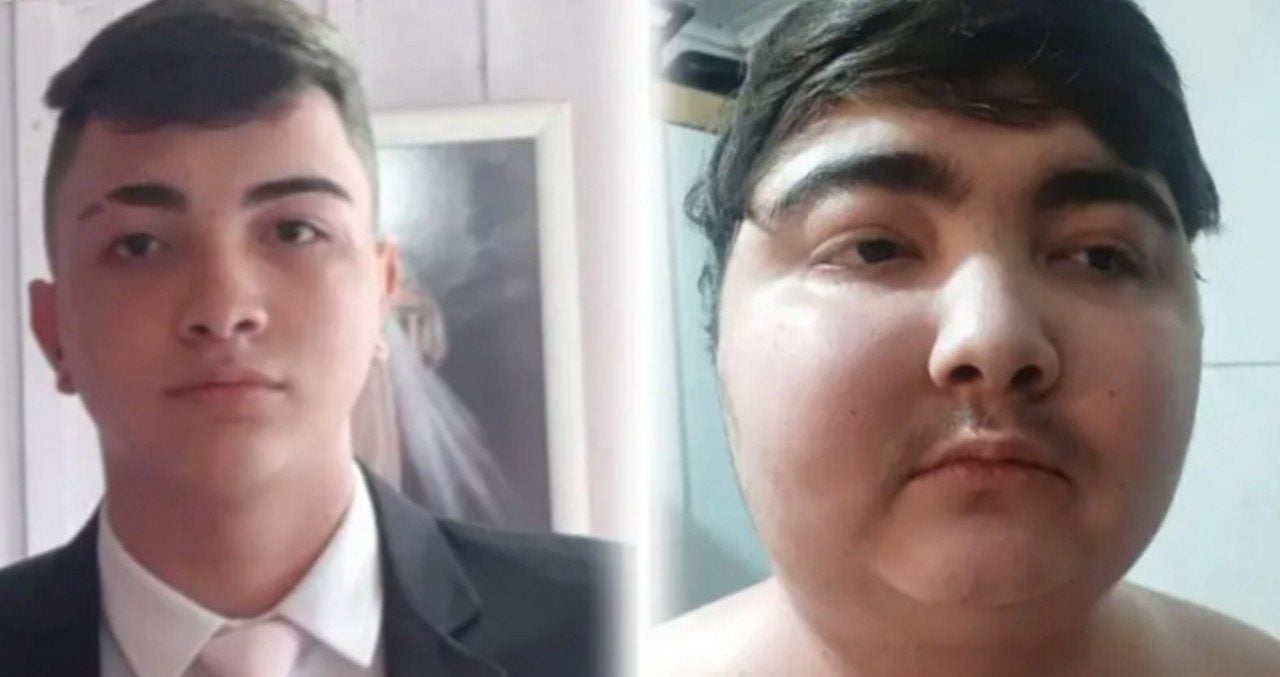
The body of Gustavo de Oliveira, a 16-year-old teenager passionate about muay thai and an Athletico-PR fan, underwent a rapid and radical transformation, even in a phase of intense physical development.
At the beginning of 2025, the young man weighed less than 70 kilos, but at the end of the same year, his scales registered an impressive 113 kg.
Behind this abrupt change, doctors discovered a tiny benign tumor located at the base of the skull, which completely disrupted the production of cortisol, a vital hormone for the body to function properly.
The identification of the tumor mass occurred almost accidentally, changing the course of medical investigation.
Ankle injury led to the unexpected discovery of the disease
Receptionist Silmara de Oliveira, Gustavo’s mother, began to notice that something was wrong with her son’s health in June 2025.
The teenager had headaches for several days, which led his mother to check his blood pressure with a home device in Curitiba.
The result indicated that the pressure was altered, generating concern in the family.
“We believe that the equipment could be defective”, said Silmara, “but, at the same time, he was already gaining weight and a voracious appetite, consuming three dishes per meal.”
Even after consultations with several doctors and nutritionists, and adjustments to his diet, the situation did not improve, despite Gustavo maintaining an intense exercise routine, with three weekly Muay Thai classes.
“The more we dedicated ourselves to the diet, the more he continued to gain weight”, highlighted his mother.
Gustavo’s health progressively deteriorated until an unexpected event took him back to the doctor: in September 2025, he suffered an ankle injury during Muay Thai training.
As the area turned very purple, his mother decided to take him to an emergency room for evaluation.
“He performed an x-ray, but no fracture was identified,” recalled Silmara.
However, the emergency room doctor, observing Gustavo’s general health, requested that mother and son return the following day for a more in-depth investigation.
Confirmation of a rare disease after in-depth examinations
The family was then referred to Hospital Pequeno Príncipe, a reference pediatric institution located in Paraná.
Gustavo recalled how compromised his physical condition was during that period, before the diagnosis.
“I couldn’t walk on the street, nor carry out basic activities, because I felt like I was going to faint, I was short of breath”, he described the severity of the symptoms.
At the hospital, Gustavo underwent a comprehensive series of tests so that doctors could confirm or rule out the possible causes of his condition.
Finally, about a month later, in mid-October, health professionals discovered the origin of the mystery that afflicted the teenager.
Gustavo was diagnosed with Cushing’s disease, a clinical condition considered extremely uncommon.
Global data points to the occurrence of a new case of the disease in just one in every one million children per year, which makes its diagnosis a significant challenge for medicine due to the rarity and complexity of the symptoms.
“When the doctors gave us the diagnosis, everything made sense, it seemed like the whole story fit together”, recalled Silmara.
Understand the mechanisms of Cushing’s disease and its impacts

Basically, Cushing’s disease is triggered by the formation of a benign tumor in the pituitary gland, a gland located at the base of the brain, responsible for producing the hormone ACTH.
ACTH, in turn, has the function of stimulating the adrenal glands, located above the kidneys, to produce another fundamental hormone: cortisol.
In patients with Cushing’s disease, what occurs is an excessively high production of cortisol in the body.
“This excessive volume of cortisol generates multiple changes in the patient. As observed in Gustavo’s case, there is considerable weight gain, swelling, the face takes on a more rounded shape and there is an accumulation of fat on the trunk”, explained neurosurgeon Carlos Mattozo, from Hospital Pequeno Príncipe.
The specialist revealed that, in almost three decades of medical practice, he had only treated four patients with this rare illness.
The most common treatment for these cases is surgical intervention, which aims to remove the pituitary tumor.
Gustavo confessed that the news that he would need to undergo surgery left him apprehensive and discouraged.
“Because, when talking about brain surgery, we imagine that the head will be opened in half to remove the tumor”, expressed the young man, describing his initial fear.
The good news, however, is that surgery to treat Cushing’s disease is minimally invasive, without the need for external incisions; The entire procedure is carried out through the nostrils, with the help of fiber optic cameras and delicate instruments.
“There is a bone located behind the nose, the sphenoid. It is hollow, which allows it to be drilled to directly access the pituitary gland region”, detailed Dr. Mattozo about the method.
Surgery process and the recovery phase of teenager Gustavo
Gustavo’s surgery was carried out in December 2025, lasted approximately two hours and was considered a great success by doctors.
According to the medical team responsible for monitoring, the teenager showed good progress, showing some expected side effects, such as prostration and mild headaches, in addition to a temporary dysregulation in cortisol levels.
“Before the procedure, Gustavo’s adrenal glands were under an abnormal stimulus that caused excessive production of cortisol. When we removed the tumor, this stimulus was interrupted, leading the body to an imbalance and an abrupt drop in the production of the hormone”, explained Dr. Mattozo.
Currently, Gustavo continues to undergo exams and hormone replacement treatments so that his body can reestablish the ideal balance between the pituitary gland and the adrenal glands.
The period of excess weight and high cortisol left consequences on his health, mainly affecting the liver, eyes, heart and blood pressure.
In the first half of 2026, the teenager has already managed to lose around 15 kilos, a positive indication of his recovery.
Regarding Cushing’s disease, he is classified as a patient in remission, which means that the treatment was effective in containing the disease.
In practice, this implies the need for annual medical follow-up to monitor and prevent a possible return of the tumor, avoiding a new surgical intervention.
Challenges and common delay in diagnosing the disease
For Dr. Mattozo, stories like Gustavo’s serve as an important warning for health professionals to maintain vigilance and question diagnoses that, at first glance, may seem obvious.
“As a university professor, I instruct my students to deepen their studies and to always consider different possibilities of diseases behind the symptoms presented”, commented the doctor.
“In the case of Cushing’s disease, it is estimated that patients wait, on average, two years to receive the correct diagnosis. During this time, they are subjected to therapies that will not produce results”, added the neurosurgeon, highlighting the risks of delay.
Silmara reiterated that this situation of delayed diagnosis could easily have happened to her own son, worsening his health condition.
“If he hadn’t had this ankle injury, perhaps we wouldn’t have discovered the disease until today,” the mother speculated, highlighting the importance of the incident.
“And this discovery was possible thanks to the doctor who showed a more comprehensive view. She could have just taken care of his leg and ignored the rest”, added the mother, valuing the professional’s attention.
For some individuals, the long interval between the appearance of symptoms and confirmation of the diagnosis can be fatal, as weight gain, changes in blood pressure and damage to vital organs such as the liver can lead to serious complications, including heart attacks.
For these and other reasons, Gustavo decided to openly share his journey with the disease, in hopes of raising awareness and helping others who may be facing similar conditions.
“I hope that others don’t have to go through what I went through and are able to treat the tumor before the symptoms of weight gain and high blood pressure worsen even further”, concluded the teenager.