

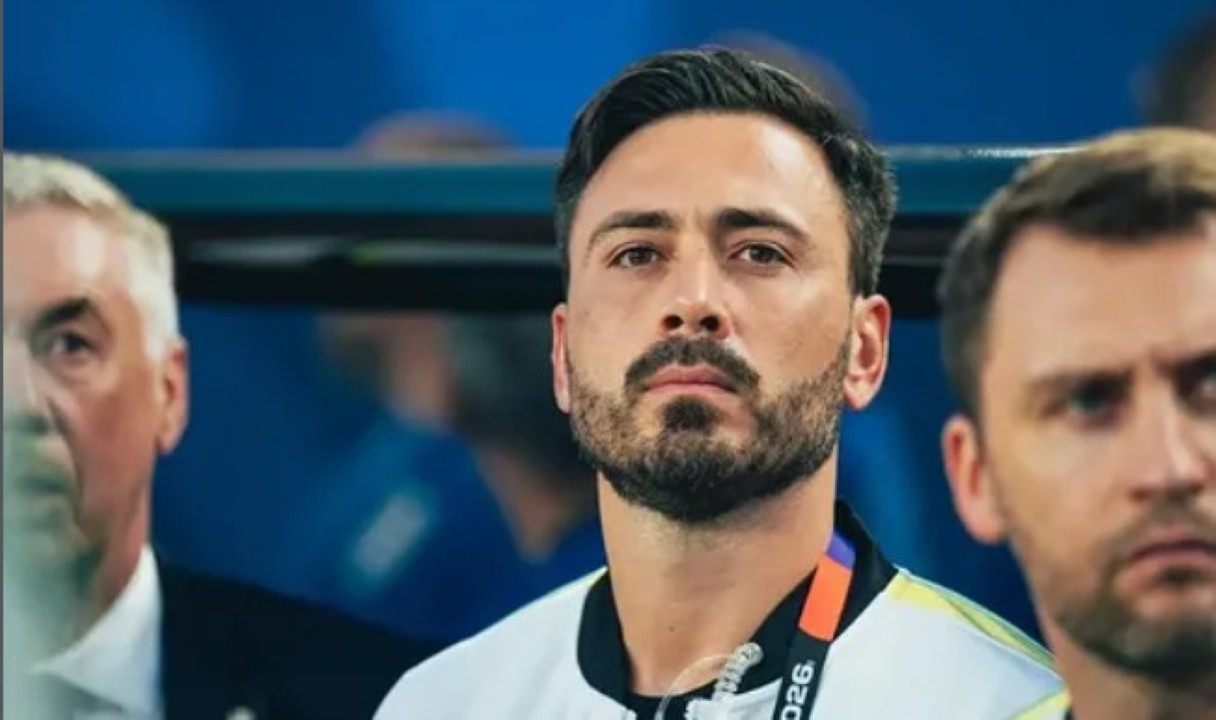
An episode during Brazil’s 3-0 victory against Scotland, last Wednesday, 24, in the World Cup, put Davide Ancelotti, 36, son of coach Carlo Ancelotti, 67, under the spotlight. As assistant coach of the Brazilian team, the Italian had a head movement widely discussed on social media, with many associating it with supposed disapproval of Neymar’s entry into the match.
However, Ana Galocha, Davide’s wife, promptly refuted this interpretation. She explained that the gesture was not aimed at the team’s number 10, but rather was part of a conversation with Paul Clement, who was by her side. In a statement, Ana expressed her frustration: “Do you know that you are interpreting an image in a completely wrong way, with no relation to reality, and that because of this I have been receiving countless insults since this morning? We are the first to want Brazil to win.” This incident highlights the intensity of public scrutiny of football figures, where even simple gestures can be misinterpreted and generate immediate negative repercussions on social media, highlighting the challenge of misinformation in high-pressure environments.
Davide is considered a fundamental and highly trusted member of Ancelotti’s coaching staff. Born in Parma, Italy, he began his career as an assistant in 2015, accumulating spells at renowned clubs such as Napoli, Everton, Bayern Munich and Real Madrid. The Brazilian Football Confederation (CBF) confirms that he has a degree in sports science and the coveted FIFA PRO license. His vast experience in elite commissions with one of the most successful coaches in the world, combined with his professional training and license, demonstrates the high level of qualification and the complexity of the functions performed by an assistant coach in top national teams, which goes far beyond mere gestures on the sidelines of the field.
Prior to his return to the national team, Davide Ancelotti had experience as a head coach, leading Botafogo between July and December 2025. In an assistant role alongside his father, he is often recognized as the main strategist and “tactical arm” of the committee.