

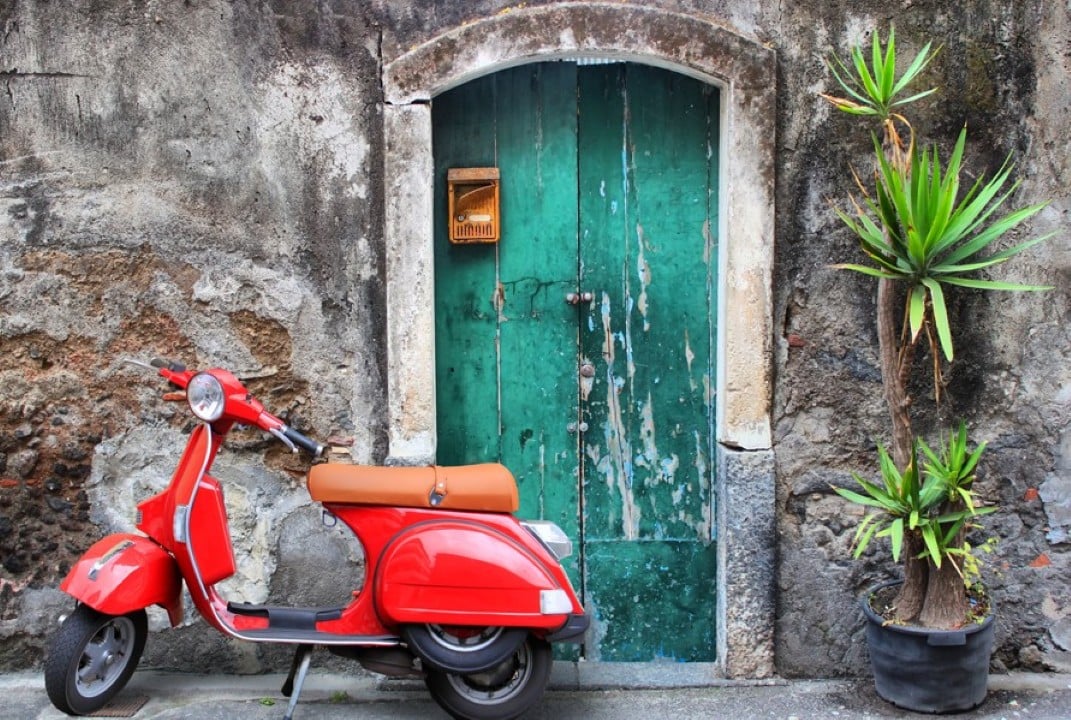
Thousands of scooter enthusiasts gather in the Italian capital to celebrate 80 years of Vespa, a global icon that has transcended its function as a vehicle to become a true cultural symbol. The celebration in Rome marks the longevity of one of the most famous Italian designs, which continues to enchant generations with its unmistakable silhouette and its promise of freedom. Since its inception, Vespa has paved its way from local streets to international recognition, embodying the spirit of a relaxed and elegant lifestyle.
The origin of the legendary scooter in post-war Italy
Vespa’s story begins in a scenario of reconstruction and innovation in Italy, shortly after the Second World War. Piaggio, a company known for manufacturing aircraft, sought a new direction for its business, envisioning an accessible and practical means of transport for the population. Aeronautical engineer Corradino D’Ascanio was responsible for the initial project, with the mission of creating a vehicle that was cheap, easy to drive, and clean enough for men and women to use without getting dirty with grease from the exposed engines.
The first prototype, known as MP5 (“Paperino”), was not pleasing. However, D’Ascanio’s vision for a design that prioritized aerodynamics, rider protection and simplified mechanics led to the MP6. When Enrico Piaggio saw the prototype, he exclaimed “It looks like a wasp!” (“It looks like a wasp!”), referring to her thin waist and voluminous rear end. Thus, the Vespa 98 model was born in April 1946, a revolution that combined functionality and charm in a package that would quickly become synonymous with mobility and optimism.
The undeniable influence of the scooter on world culture
Over its eight decades, the Vespa has solidified its status as more than a simple means of transportation; she has become a global cultural icon. Its striking presence in classic films such as “The Princess and the Commoner” (Roman Holiday, 1953), with Audrey Hepburn and Gregory Peck, catapulted the scooter into the popular imagination, associating it with romance, adventure and the unparalleled charm of Italy. This visibility in cinema and fashion helped immortalize Vespa’s image as a symbol of freedom and good taste.
The scooter also became a centerpiece in subcultural movements, such as the Mods in Britain in the 1960s, who adopted it as an emblem of their identity and style. Its adaptability and timeless design have allowed it to integrate with different aesthetics and eras, always maintaining its original essence. Today, Vespa continues to be a muse for designers and artists, reaffirming its special place at the intersection of engineering and art.
Design innovations and mechanics that captivated generations
The Vespa’s enduring success can be attributed, in large part, to its revolutionary design and intelligent engineering that sets it apart from other motorcycles. Unlike traditional motorcycles of the time, the Vespa had a monocoque chassis, that is, the body structure itself functioned as the vehicle’s support, eliminating the need for a heavy tubular frame. This innovation not only gave the Vespa its characteristic aesthetics, but also contributed to its lightness and agility.
Other distinguishing features include the front wheel mounted on a single swing arm, similar to an airplane landing gear, which made changing tires easy. The engine, compact and protected by a fairing, avoided direct contact with the pilot, ensuring a cleaner and more comfortable ride. Over the years, Piaggio has introduced numerous improvements and new models, but the core philosophy of a stylish, functional and easy-to-use vehicle has remained unchanged, ensuring that Vespa remains relevant and desired.
Special events and projections for the brand’s future
Vespa’s 80th anniversary celebrations in Rome are a testament to the enduring passion the brand inspires across the world. Thousands of fans of different nationalities participate in meetings, parades and exhibitions that pay homage to the scooter’s rich history. These events are not only a look into the past, but also a bridge to the future, where Vespa seeks to reinvent itself without losing its classic soul.
Piaggio has invested in new technologies and models that align the brand’s tradition with contemporary demands, such as sustainability and connectivity. The introduction of electric Vespas, for example, demonstrates the company’s commitment to evolving, offering mobility solutions that respect the environment, while preserving the charm and functionality that have made Vespa a global phenomenon. Vespa’s legacy, therefore, seems ready for many more decades on two wheels.
Important milestones in Vespa’s trajectory
- 1946:Launch of the first Vespa, the 98cc model, in Pontedera, Italy.
- 1953:Film debut in “The Princess and the Commoner”, solidifying her iconic status.
- 1966:Introduction of the Vespa 180 Super Sport (SS), a high-performance model.
- 1988:Production of the Vespa T5 Pole Position, with a more sporty design.
- 2018:Launch of Vespa Elettrica, marking the brand’s entry into the era of electric mobility.
- 2026:Global celebration of 80 years, reaffirming its global relevance and passion.