

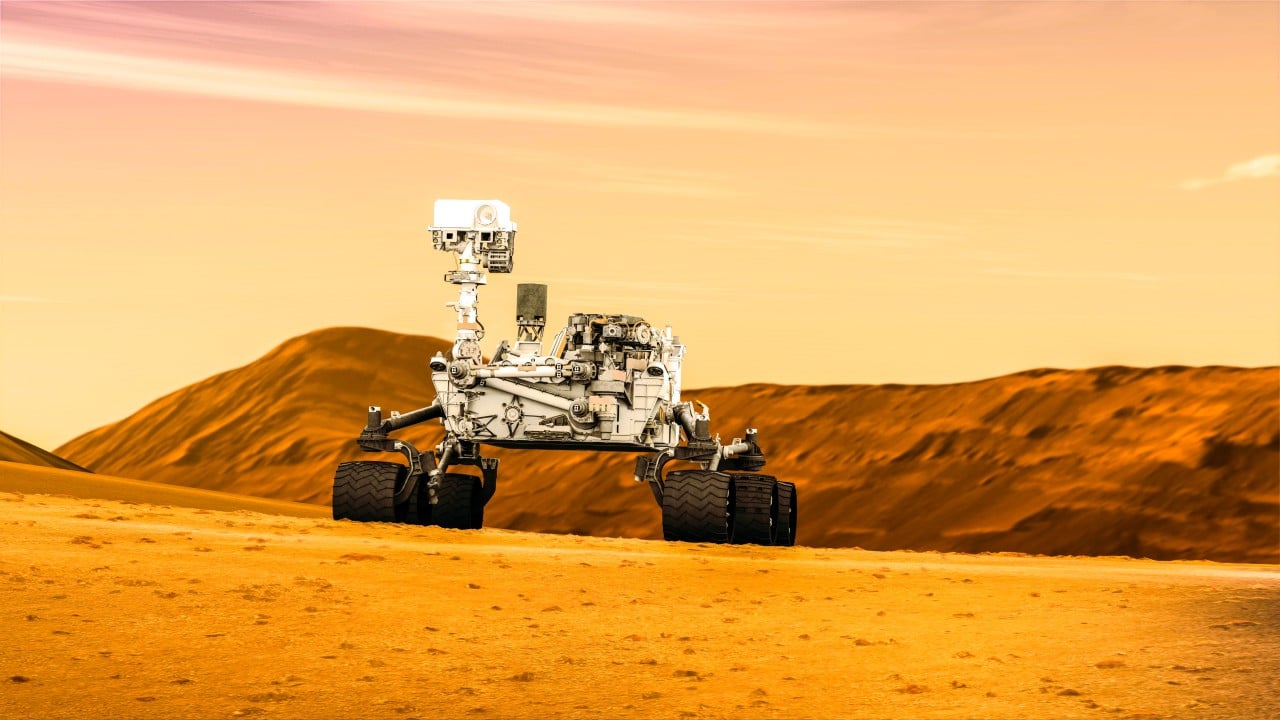
Scientists at NASA’s Jet Propulsion Laboratory (JPL) employ the ERNEST (Exploration Rover for Navigating Extreme Sloped Terrain) prototype in desert trials to improve mobility systems and autonomy artificial intelligence for future space expeditions.
The North American space agency, through JPL, revealed significant progress in testing with ERNEST, a new model of autonomous vehicle. The most recent assessments were conducted in the Colorado desert, in the United States, with a focus on overcoming challenging terrain.
The experimental vehicle covered approximately 26 kilometers in 37 hours of operation, spread over a week of evaluations. The purpose is to forge equipment with greater autonomy and speed, capable of effectively exploring difficult-to-access areas on other celestial bodies, including regions with challenging lighting such as those at the lunar south pole.
In parallel, NASA is developing the Dragonfly mission, scheduled for 2034, which will send an aerial vehicle to Titan, Saturn’s largest moon. The expedition aims to study the chemical composition and organic formations of its surface in a remote spatial context.
Significant progress in robotic space exploration
ERNEST, which stands for Exploration Rover for Navigating Extreme Sloped Terrain, serves as a platform for testing future journeys to the Moon. Its structure has undergone rigorous examinations in terrestrial scenarios that replicate the harsh conditions of other planets and satellites.
In tests carried out in the Colorado desert, the prototype displayed remarkable dexterity when moving over irregular surfaces, reaching speeds greater than those of the Curiosity and Perseverance rovers, currently on Mars. This result is seen as a fundamental advance in expanding the horizons of robotic missions.
Issa Nesnas, principal technologist at JPL and leader of the experiments, emphasized that the goal is to optimize the mobility and autonomy of the systems. He stated, according to information from the team: “These tests help us refine the locomotion hardware and autonomy software to travel extreme distances, over a wide range of terrain and under diverse lighting conditions expected on the Moon.”

In March 2026, during the field phase in the Colorado Desert, in southern California, the JPL team conducted ERNEST at different times of the day. This included operations at dawn, dusk and night, periods when elongated shadows replicate the lunar environment.
Improvements in these systems are already visible in rovers operating on Mars. Perseverance, for example, performs most of its routes autonomously, carrying out continuous checks to ensure the safety of its movement. This competence makes it possible to cover large distances with greater operational efficiency.
Meanwhile, NASA intends to further expand the application of robotic technologies to other celestial bodies. The Dragonfly mission will explore Titan, the Saturnian moon famous for its methane rivers and lakes, and will need high autonomy in its decisions due to the extensive periods without contact with Earth.
According to Zibi Turtle, researcher at the Johns Hopkins Applied Physics Laboratory and main person responsible for the mission, the venture is not primarily focused on the direct detection of life. Instead, its goal is to investigate the chemical processes that preceded biological development on our planet.
On Titan, the flying vehicle will spend up to 16 Earth days at each research site before moving to a new point. The mission has the potential to provide valuable data for the study of other areas of the Solar System, such as Enceladus, another moon that arouses interest because it presents conditions conducive to the existence of life.